Color Identification Addition & Subtraction Worksheets for Ages 4-9 - Page 2
27 filtered results
-
From - To
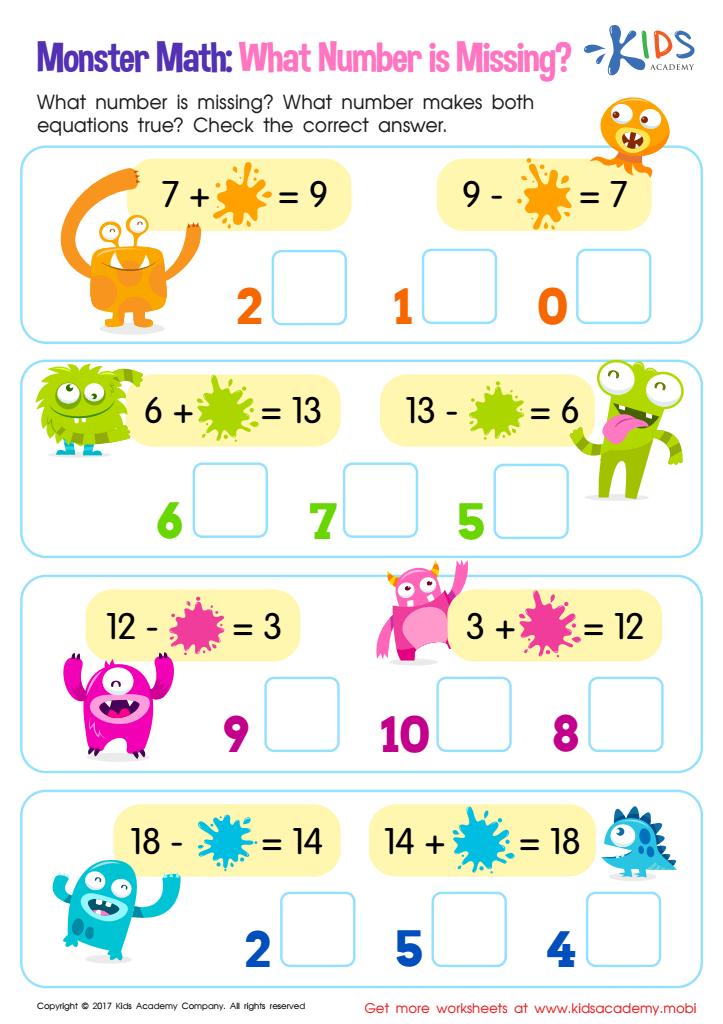
Missing Number: Monster Math Worksheet
 Assign to My Students








Color Identification, Addition, and Subtraction are fundamental skills that form the cornerstone of a young child's cognitive and mathematical development. Parents and teachers should care about these skills for several reasons:
First, color identification is crucial for early learning as it enhances visual perception, which is important for reading and writing. Recognizing and naming colors also supports language development and the ability to follow instructions.
Addition and subtraction are the basic building blocks of math. Mastering these concepts at a young age sets the foundation for more complex mathematical thinking and problem-solving skills later on. Learning these operations fosters logical reasoning and improves mental math abilities, which are useful in everyday life.
Engaging children aged 4-9 in these activities can support their cognitive development by improving memory, concentration, and attention to detail. Moreover, combining color identification with addition and subtraction makes learning more enjoyable and interactive, thus maintaining children's interest and motivation.
In conclusion, focusing on Color Identification and Basic Math during early childhood not only enhances essential academic skills but also supports broader cognitive, motor, and language development, preparing children for future academic success. For these reasons, it's important for both parents and teachers to prioritize and invest time in fostering these competencies.








