
Counting money Math Worksheets for Ages 4-9
3 filtered results
Difficulty Level
Grade
Age
-
From - To
Subject
Activity
Standards
Our counting money math worksheets for ages 4-9 are designed to make learning fun and engaging for young learners. Tailored to varying skill levels, these worksheets help children recognize coins, understand their values, and develop essential math skills through interactive activities. Whether counting pennies, nickels, dimes, or exploring simple equations, kids will build confidence in handling money while having a great time. Perfect for parents and teachers, these resources support classroom lessons and additional practice at home. Unlock your child's potential in numeracy with our expertly crafted worksheets and watch them master the world of money!
Favorites
With answer key
Interactive
Recognizing Money Money Worksheet
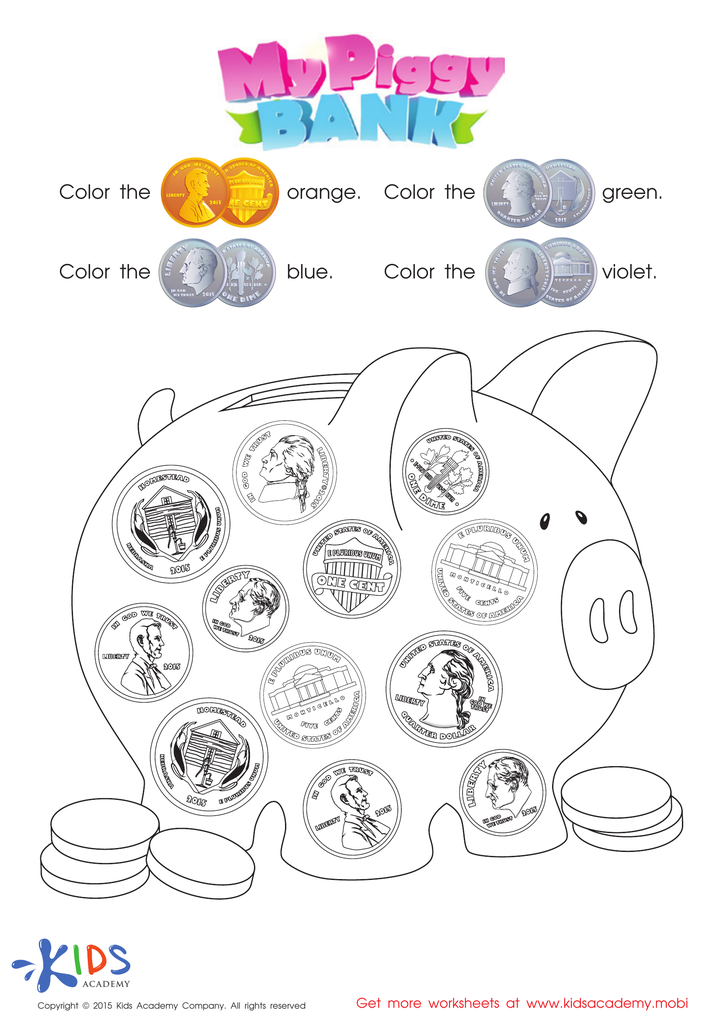
Help the piggy bank by coloring its coins with Kids Academy's free money worksheets! Learn the different coins and their values with your kids. Printable worksheets are available to continue the lesson. Let's learn and have fun!
Recognizing Money Money Worksheet
Worksheet
Ten Cents or the Dime Money Worksheet
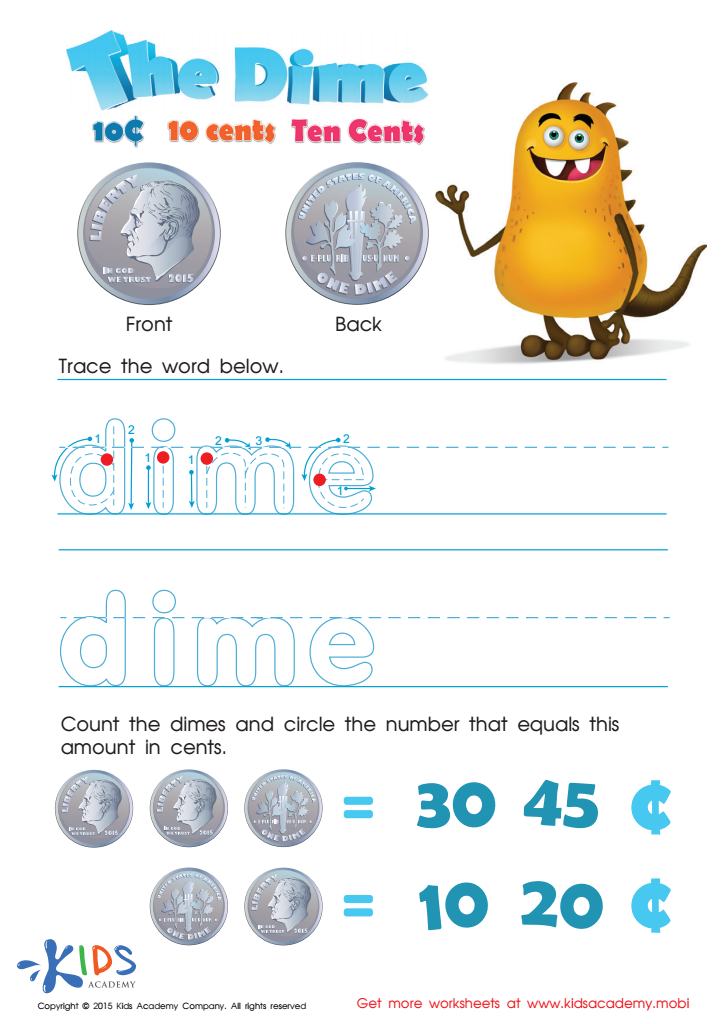
Introduce your kids to coin games! Start with a dime: trace the word on both sides and count the dimes. Kids Academy has printable worksheets to help your kids learn how to count money.
 Assign to My Students
Ten Cents or the Dime Money Worksheet
Worksheet
Join Kids Academy for Free
Who is primarily going to use this learning content?








Counting money is an essential skill for children aged 4-9, forming a crucial part of their early math education that extends far beyond mere arithmetic. Firstly, learning to count money helps young children grasp fundamental mathematical concepts like addition, subtraction, and even multiplication and division. These skills are foundational for more advanced math topics they will encounter later in their education.
Moreover, understanding money is critical for developing financial literacy from an early age. By handling coins and bills, children become familiar with the value of different denominations, fostering an appreciation for the value of money. This practical knowledge is essential as it lays the groundwork for responsible financial behavior in adulthood.
Additionally, counting money enhances cognitive development, including problem-solving skills and logical thinking. Engaging with money-related activities helps children improve their ability to make quick, informed decisions, a skill valuable in everyday life.
Finally, learning to count money can boost a child's confidence and independence. Whether buying a small item, making change, or saving for something special, the ability to manage money gives children a sense of autonomy and accomplishment.
In summary, ensuring that children engage with and understand money by the ages of 4-9 sets the stage for foundational math skills, financial literacy, cognitive development, and personal independence.








