Eye-hand coordination Math Worksheets for Ages 4-9
3 filtered results
-
From - To
Discover engaging Eye-Hand Coordination Math Worksheets designed for children aged 4-9! These interactive worksheets combine essential math skills with fun, hands-on activities to enhance your child’s motor skills. As they trace numbers, match shapes, and complete patterns, kids will develop their fine motor abilities while reinforcing mathematical concepts. Ideal for early learners, our worksheets promote confidence and creativity in a playful learning environment. Whether at home or in the classroom, these resources are perfect for making math enjoyable and promoting essential coordination skills. Download now and watch your child's love for learning grow!
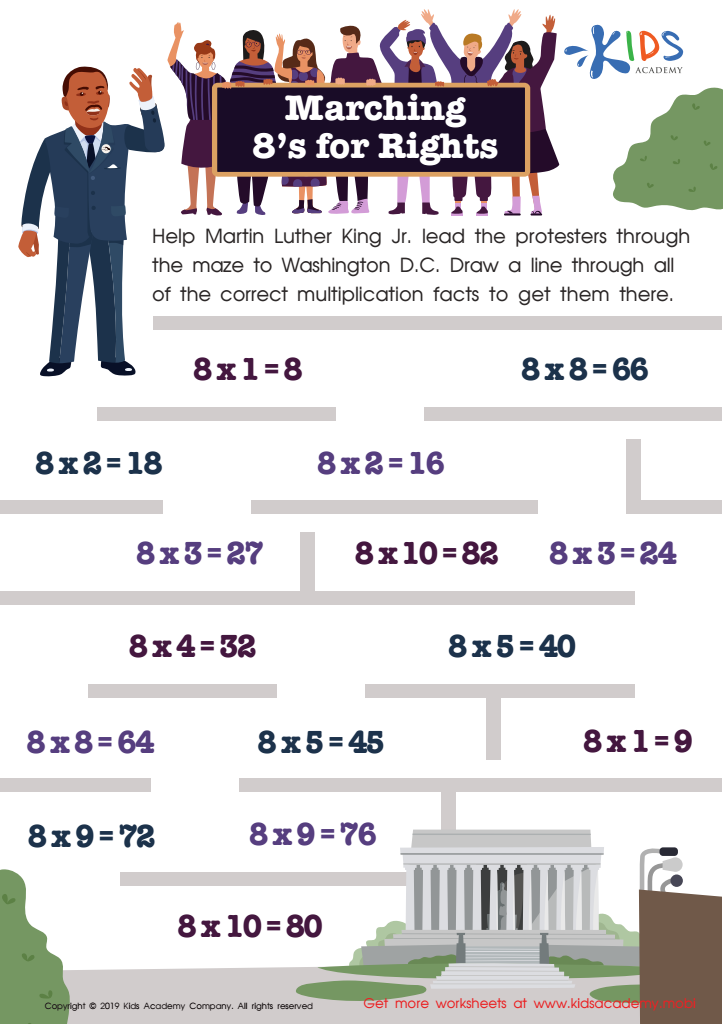
Marching 8’s for Rights Worksheet
 Assign to My Students







Eye-hand coordination is a crucial skill for children aged 4-9, especially in the context of math learning. This ability allows children to effectively use their visual perception to guide their hand movements, which is vital for tasks like counting, writing numbers, and manipulating objects during math-based activities. When parents and teachers focus on developing eye-hand coordination, they are laying the foundation for children's mathematical understanding and promoting fine motor skills simultaneously.
Engaging in math-related activities encourages young learners to feel confident as they grasp concepts such as counting, sorting, and measuring. For instance, using manipulatives like blocks or beads can effectively combine physical activity with problem-solving, making math engaging and fun. Improved eye-hand coordination enhances a child’s dexterity and precision—skills that are not only valuable in math but also in everyday tasks.
Moreover, by facilitating tasks that bolster this coordination, parents and teachers contribute to cognitive development. Better eye-hand coordination supports tasks involving spatial awareness, pattern recognition, and understanding numerical concepts, which are essential for success in later education. Thus, fostering these skills is a vital component of holistic childhood development and early literacy in mathematics.








