
Improving observational skills Math Worksheets for Ages 4-9
3 filtered results
Difficulty Level
Grade
Age
-
From - To
Subject
Activity
Standards
Unlock your child's potential with our "Improving Observational Skills Math Worksheets for Ages 4-9." Our engaging worksheets are designed to enhance critical thinking and attention to detail in young learners. Each activity combines fun math exercises with vibrant illustrations, helping kids sharpen their observational skills while mastering fundamental math concepts. Perfect for both classroom use and home practice, these worksheets cater to various learning styles, ensuring every child finds joy in learning. Empower your child with the tools to excel in math and beyond, all while nurturing their natural curiosity and love for discovery with Kids Academy trusted resources.
Favorites
With answer key
Interactive
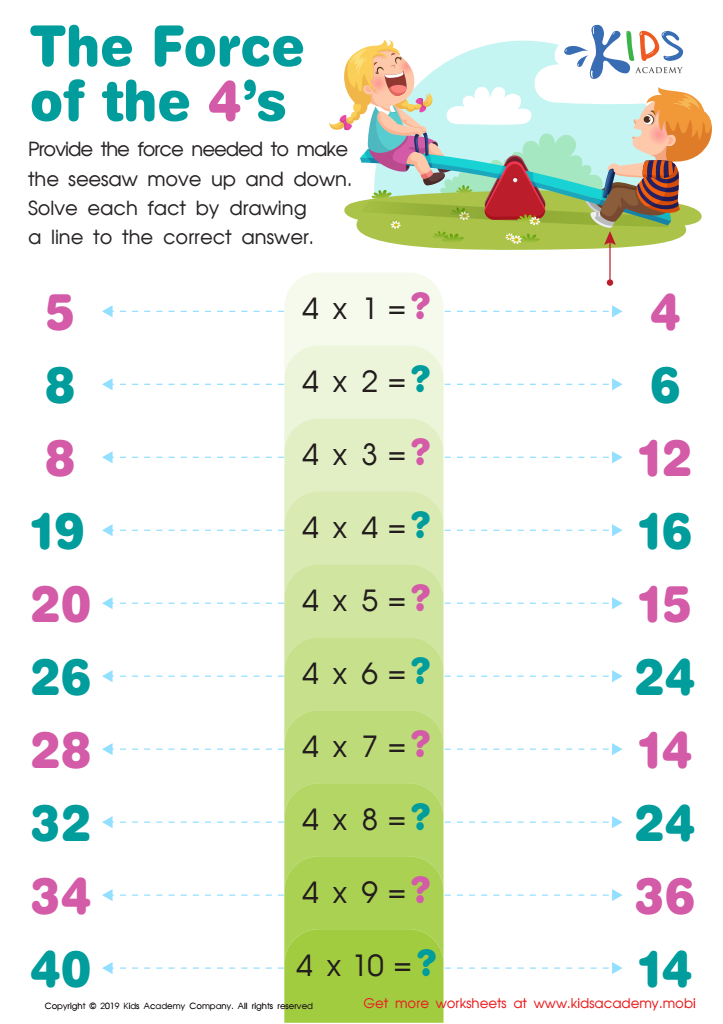
The Force of the 4's Worksheet
Ride a seesaw with your child and explore the physics behind it! Explain how it needs two people and how force makes it go up and down. Use the memories of the pleasurable experience to teach your kid a lesson in force. Show them how to solve the worksheet by drawing a line to the correct answer. This way, they'll learn the force needed for the seesaw to move.
 Assign to My Students
The Force of the 4's Worksheet
Worksheet
Join Kids Academy for Free
Who is primarily going to use this learning content?





.jpg)


Improving observational skills in math for children ages 4-9 is pivotal in laying a strong foundation for their future learning and cognitive development. At this formative stage, young minds are especially receptive to new information and ways of thinking. By honing their observational skills, parents and teachers can help children become more aware of patterns, shapes, quantities, and spatial relationships—all of which are crucial components of early math comprehension.
Observational skills enhance a child's ability to notice and interpret their environment, thereby improving problem-solving abilities and critical thinking. For instance, recognizing patterns and sequences goes beyond math; these skills are essential for understanding the world and can lead to better performance in subjects like reading and science. Furthermore, when children are encouraged to observe and understand mathematical concepts in their daily environment, they become more engaged and interested in learning. Activities like counting objects during playtime, identifying shapes in household items, or exploring the concepts of more and less with everyday objects make math relatable and fun.
Investing time in developing these skills ensures that children build a robust mathematical foundation. This foundation not only supports academic success but also fosters a lifelong curiosity and enthusiasm for learning, problem-solving, and critical thinking. Therefore, guiding young learners in sharpening their observational skills is invaluable for their comprehensive development.








