
Understanding pollination Math Worksheets for Ages 4-9
3 filtered results
Difficulty Level
Grade
Age
-
From - To
Subject
Activity
Standards
Discover the magic of nature and math combined with our "Understanding Pollination Math Worksheets for Ages 4-9". Tailored for young learners, these worksheets beautifully blend basic math skills—from counting to simple addition and subtraction—with essential concepts of pollination. Each engaging activity not only bolsters mathematical abilities but also fosters an appreciation for how flowers and bees work together. Ideal for curious minds, these worksheets make learning both fun and educational, sparking a love for nature and numeracy simultaneously. Perfect for both classroom settings and homeschool programs. Download today and watch your child's enthusiasm for math and biology bloom!
Favorites
With answer key
Interactive
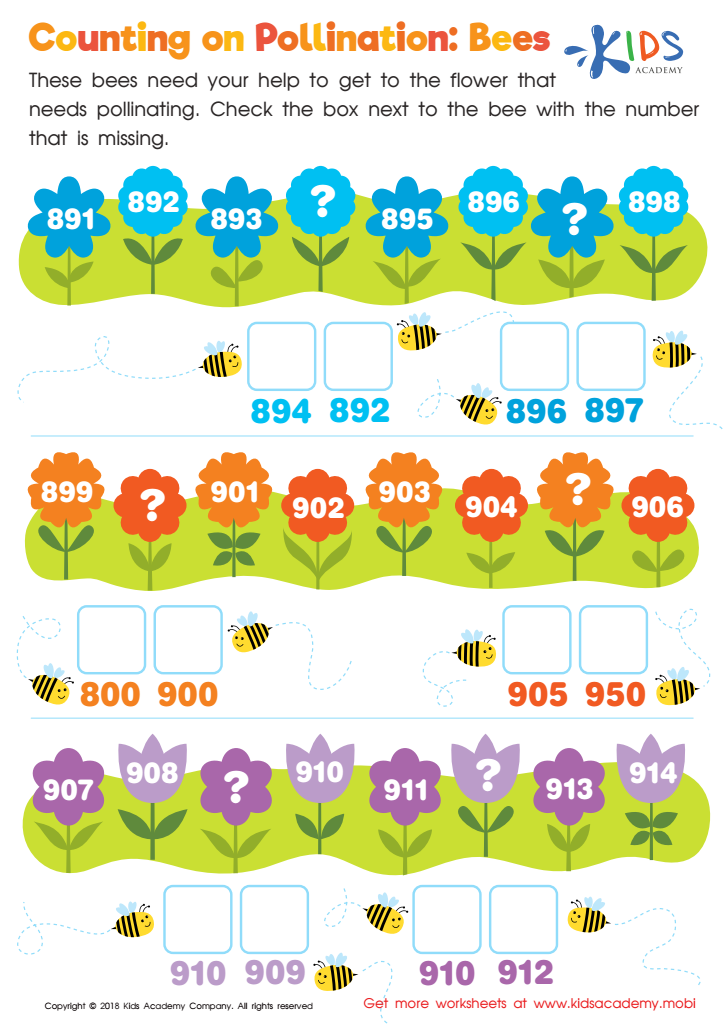
Counting on Pollination: Bees Worksheet
This downloadable worksheet helps kids improve their math skills while having fun - they'll help the bees pollinate the flowers by finding the missing number. It's an entertaining way to practice number patterns, sequences and number line skills, aiding in fast and efficient math computations.
 Assign to My Students
Counting on Pollination: Bees Worksheet
Worksheet
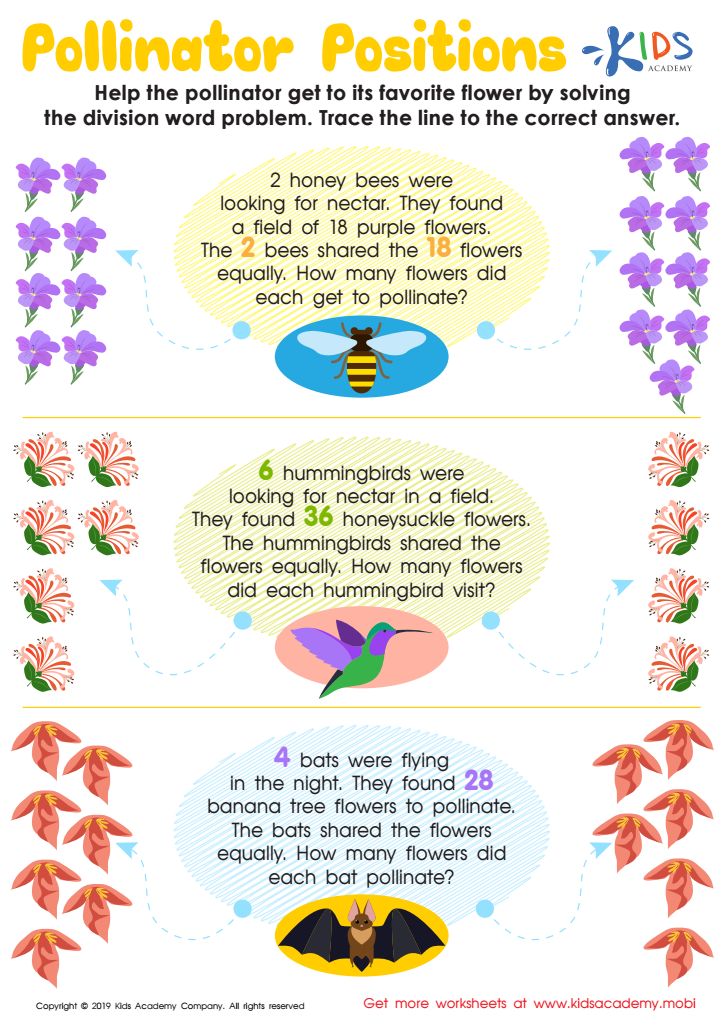
Pollinator Positions Worksheet
Kids will love learning about pollinators and how vital they are. Help their favorite friends get to the right flowers with this fun PDF. Children can solve the problems without even knowing they're doing division; just read the word problems and use the highlighted numbers. Finish by tracing the lines to the correct quotient!
Pollinator Positions Worksheet
Worksheet
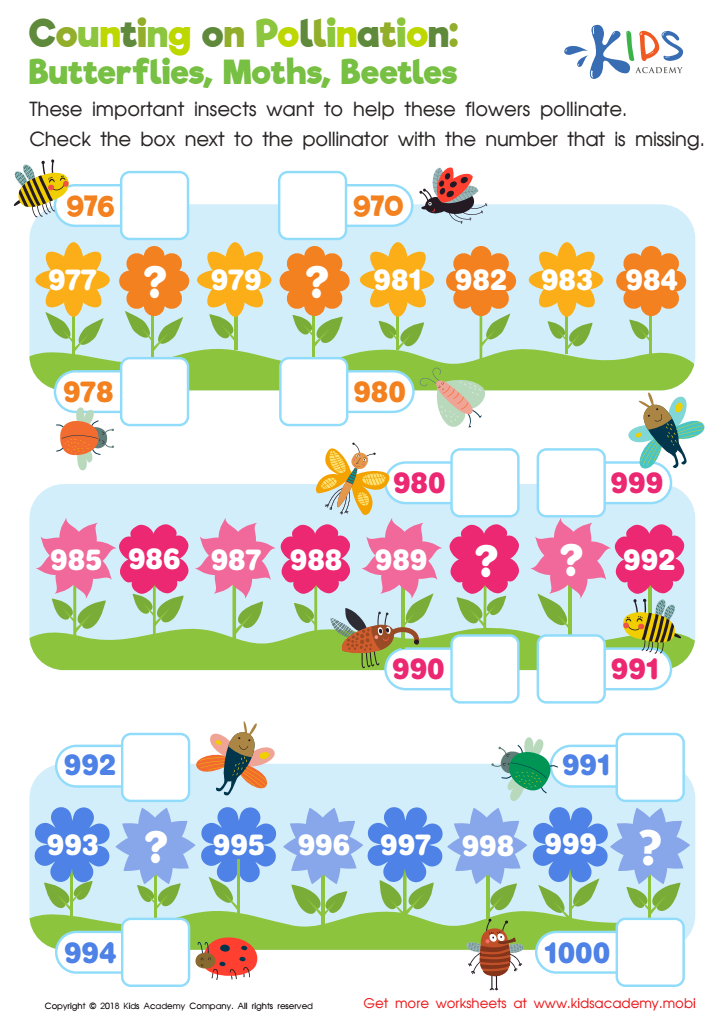
Counting on Pollination: Butterflies, Moths, Beetles Worksheet
A number line can help boost computation accuracy and efficiency. It can also be used with more advanced numbers. Help your child practice by having them identify missing numbers in sequences. This fun worksheet lets them help the pollinators in the process, as they strengthen their number sense.
Counting on Pollination: Butterflies, Moths, Beetles Worksheet
Worksheet
Join Kids Academy for Free
Who is primarily going to use this learning content?







Understanding pollination and its math for young children is crucial for fostering early scientific curiosity and promoting ecological literacy. At ages 4-9, children are naturally curious and absorb information quickly. Teaching them about pollination—how flowers reproduce through the transfer of pollen, often by bees or other animals—helps kindle an early interest in biology, ecology, and environmental stewardship. This foundational knowledge enables children to grasp the interconnectedness of living organisms and their environments, instilling a sense of responsibility towards nature.
Incorporating math into lessons about pollination provides a hands-on way to develop core mathematical skills such as counting, measuring, sorting, and pattern recognition. For example, counting the number of bees visiting a flower or measuring the growth of plants over time introduces basic arithmetic and data collection methods. This approach melds practical math skills with real-world scenarios, making learning dynamic and enjoyable.
Moreover, this dual focus can enhance critical thinking and problem-solving abilities. By integrating science and math, educators create cross-disciplinary experiences, fostering holistic educational development. Ultimately, understanding pollination and its math equips young learners with essential skills and knowledge, empowering them to be informed and conscious citizens who appreciate and protect their natural world.








