
Enhance fine motor skills Worksheets for 4-Year-Olds
3 filtered results
Difficulty Level
Grade
Age
-
From - To
Subject
Activity
Standards
Welcome to our collection of "Enhance Fine Motor Skills Worksheets for 4-Year-Olds"! Designed specifically for young learners, these engaging worksheets promote essential skills like hand-eye coordination, dexterity, and grip strength. Our activities include tracing, cutting, and coloring, which stimulate children’s creativity while developing their fine motor abilities. Perfect for classroom use or at-home learning, these worksheets make skill-building fun and interactive. Whether preparing your little one for school or looking to enrich their playtime, our expertly crafted resources will keep kids entertained and learning. Explore our range today to support your child's growth and readiness for future challenges!
Favorites
With answer key
Interactive
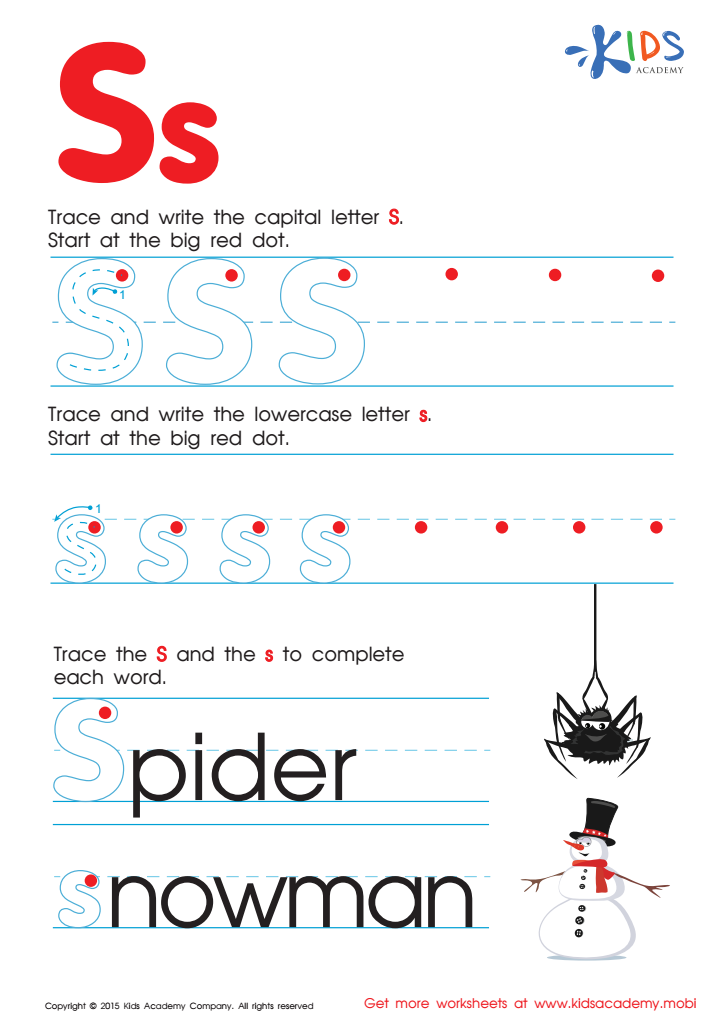
Letter S Tracing Page
Trace and write the capital and lowercase "S" on this ABC worksheet for kindergarten. Start with the big red dot and be careful. When you finish, help the spider and snowman in the pictures restore their words with the capital and lowercase letters. Continue learning the alphabet with Kids Academy.
 Assign to My Students
Letter S Tracing Page
Worksheet
Join Kids Academy for Free
Who is primarily going to use this learning content?








Enhancing fine motor skills in 4-year-olds is essential for their overall development and future success in various life areas. First and foremost, fine motor skills involve the coordination of small muscles in the hands and fingers, which is critical for tasks like writing, buttoning shirts, and even using utensils. By fostering these skills early, parents and teachers can help children develop the dexterity and control needed for these everyday tasks, building independence and confidence.
Moreover, fine motor skills are directly linked to cognitive development. Engaging in activities such as drawing, painting, cutting, and playing with manipulative toys promotes hand-eye coordination and spatial awareness, which are foundational for more complex learning, including mathematics and language arts.
Furthermore, developing fine motor skills can also enhance social-emotional growth. When children grasp new tasks and overcome challenges, they gain self-esteem and a sense of achievement. Parents and teachers who prioritize fine motor skill activities can facilitate healthier, well-rounded development in young children, ensuring they are better prepared for the demands of school and life. Investing in these skills now lays the groundwork for a successful academic journey and helps children thrive in their social environments.








