Spelling Skills Vowels Worksheets for Ages 5-6
3 filtered results
-
From - To
Enhance your child's early reading and writing abilities with our Spelling Skills Vowels Worksheets for ages 5-6. These engaging activities are designed to strengthen young learners' understanding of vowel sounds, improve their phonics and spelling skills, and foster a love for learning. Featuring colorful illustrations, fun exercises, and age-appropriate challenges, our worksheets cater to early grade students, making spelling practice enjoyable and effective. Perfect for both classroom use and homeschooling, our comprehensive worksheets will set your child on the path to academic success. Download today to support your child's literacy journey!
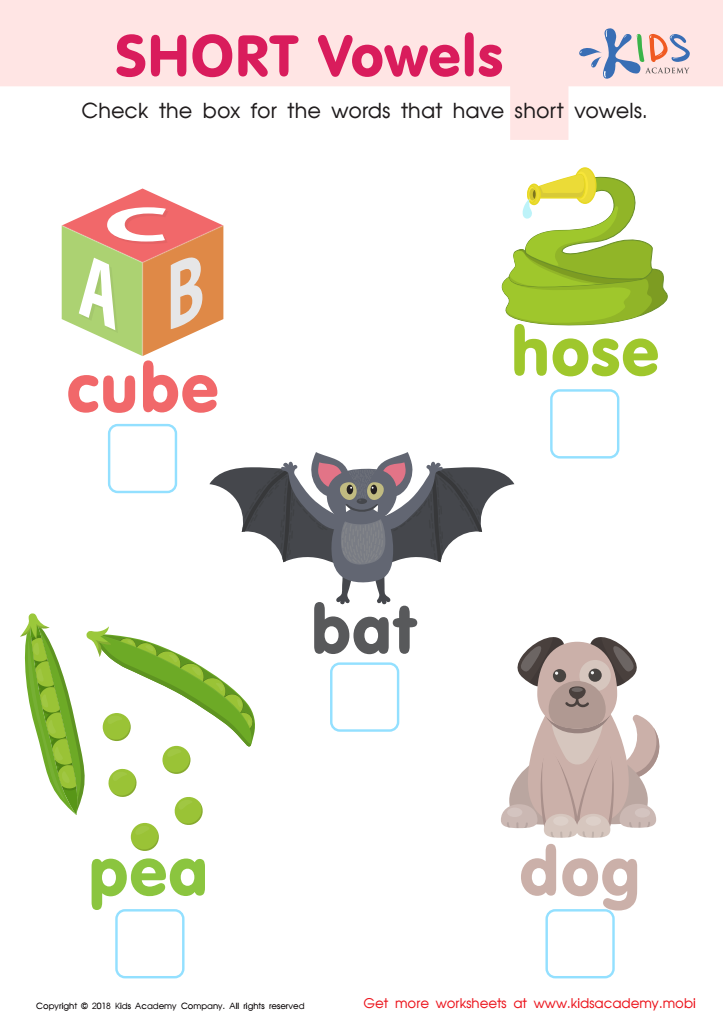
short vowels Worksheet
 Assign to My Students
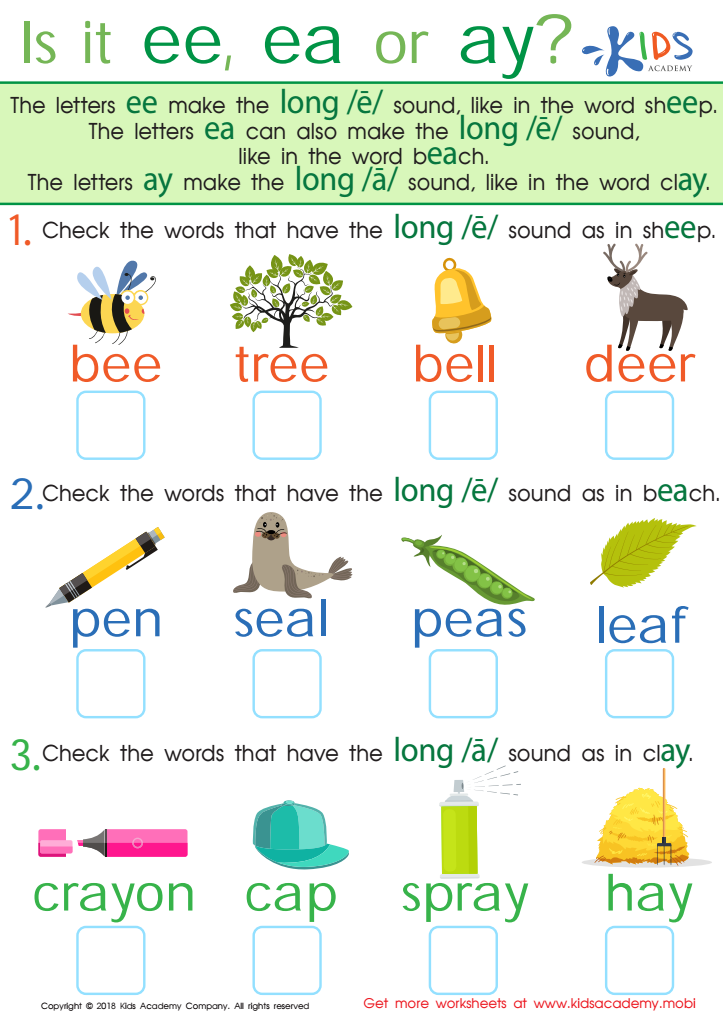
Is It EE, EA, or AY? Worksheet
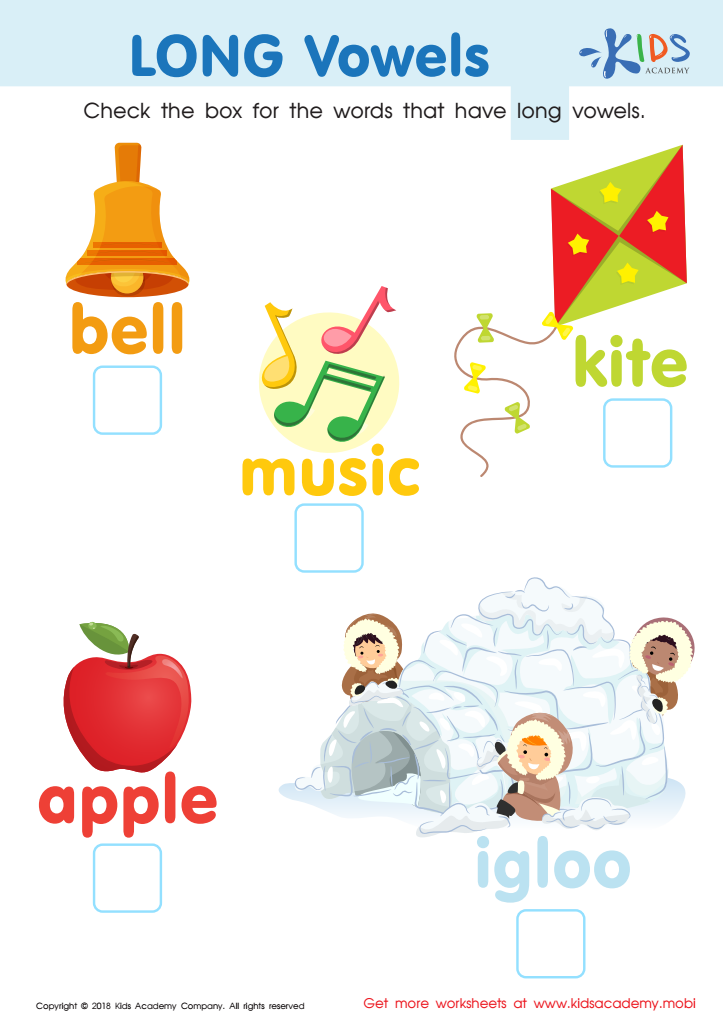
long vowels Worksheet





Spelling skills, particularly with a focus on vowels, are crucial for children ages 5-6 because they form the foundation for reading and writing. During these early years, children's brains are highly receptive to language acquisition. Understanding vowels—the sounds that the letters A, E, I, O, and U represent—enables children to decode words, improving their reading fluency.
Parents and teachers should care about developing these skills because proper spelling helps children better understand the mechanics of language. It aids in word recognition, a vital component of literacy. Spelling also enhances phonemic awareness, which is understanding that words are made of individual sounds. This awareness is a key predictor of long-term reading success.
At this stage, children learn best through multisensory approaches that involve seeing, hearing, and touching. Engaging them in activities like phonics games, word matching, and writing exercises enhances their ability to grasp vowel sounds and their usage in words. Early mastery of vowels also boosts children's confidence in their academic abilities, laying a solid foundation for more complex literacy skills in the future. Therefore, attentive focus on this aspect of spelling will set children up for continued success in their educational journey.







