Logical thinking development Chess Worksheets for Ages 5-6
3 filtered results
Difficulty Level
Grade
Age
-
From - To
Subject
Activity
Standards
Enhance your child's logical thinking skills with our engaging Chess Worksheets designed for ages 5-6! These fun and educational activities introduce young minds to the fundamentals of chess, helping to develop critical thinking and problem-solving abilities. Each worksheet is thoughtfully created to capture the interest of young learners, blending colorful illustrations with easy-to-understand instructions. Whether your child is a beginner or developing their chess knowledge, these worksheets provide the perfect blend of challenge and entertainment. Start the journey to cognitive excellence today with our beautifully designed, age-appropriate chess worksheets!
Favorites
With answer key
Interactive
Chess Pieces Math Worksheet
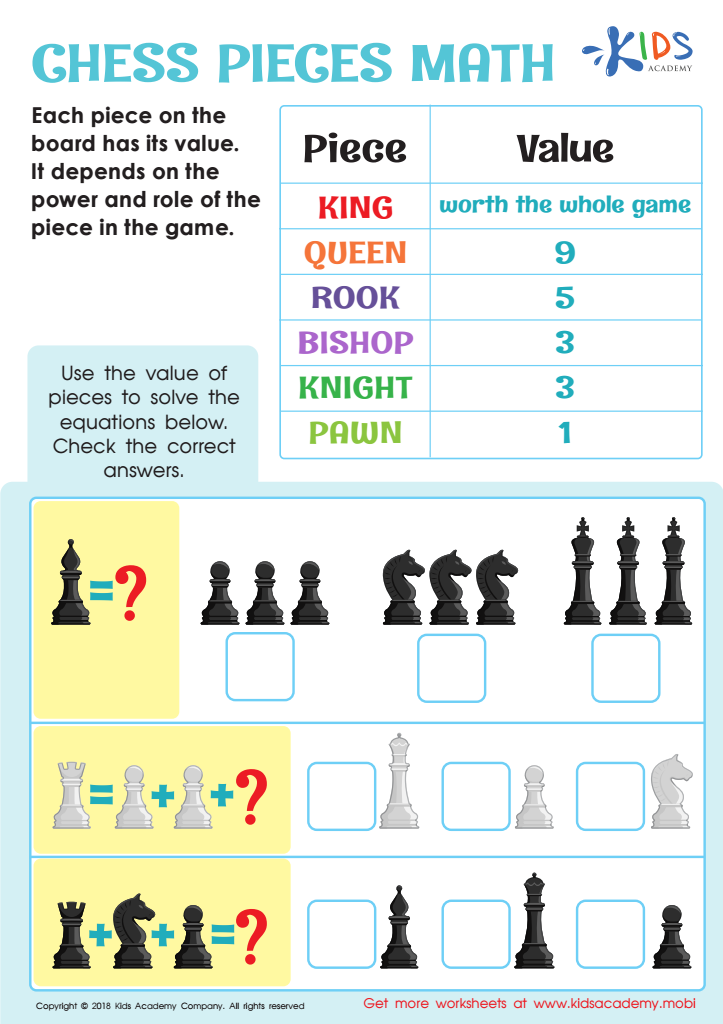
Chess involves math! Each piece has its own value, from the king (worth the entire game) to the queen (9 points), varying according to their power and role. In the worksheet, your child must use these values to solve the equations at the bottom.
 Assign to My Students
Chess Pieces Math Worksheet
Worksheet
What Is a Stalemate? Worksheet
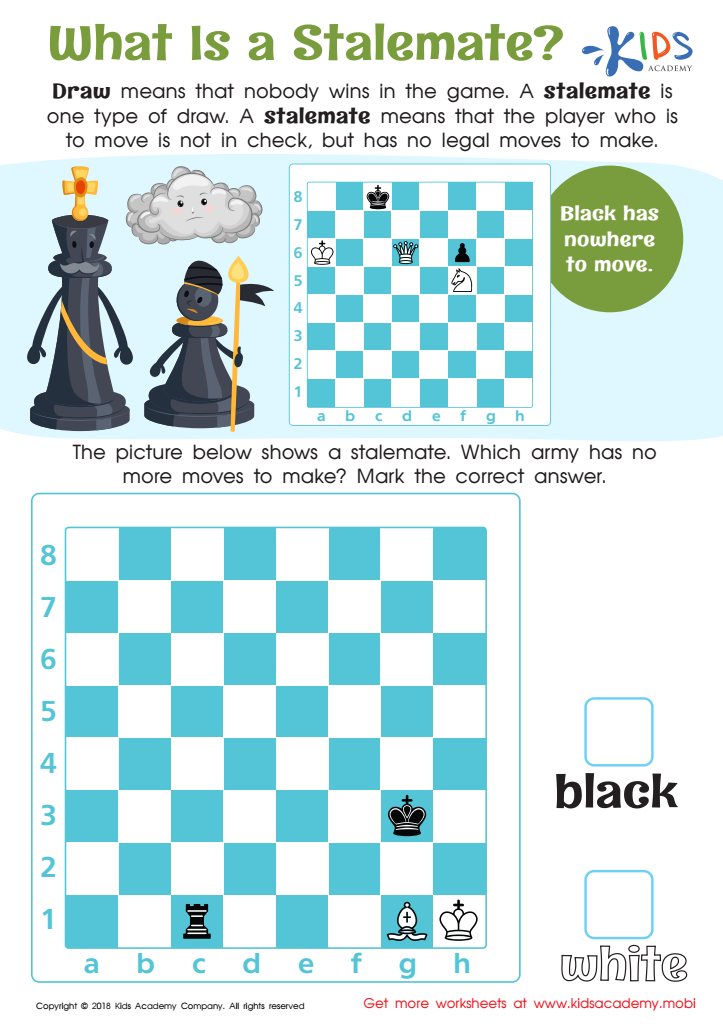
Chess is an ideal way to develop logic, strategizing, problem-solving and more! Even kids can learn it. With this worksheet, children can learn about draws and stalemates. Sample boards will help them decide which team, black or white, is at a stalemate.
What Is a Stalemate? Worksheet
Worksheet
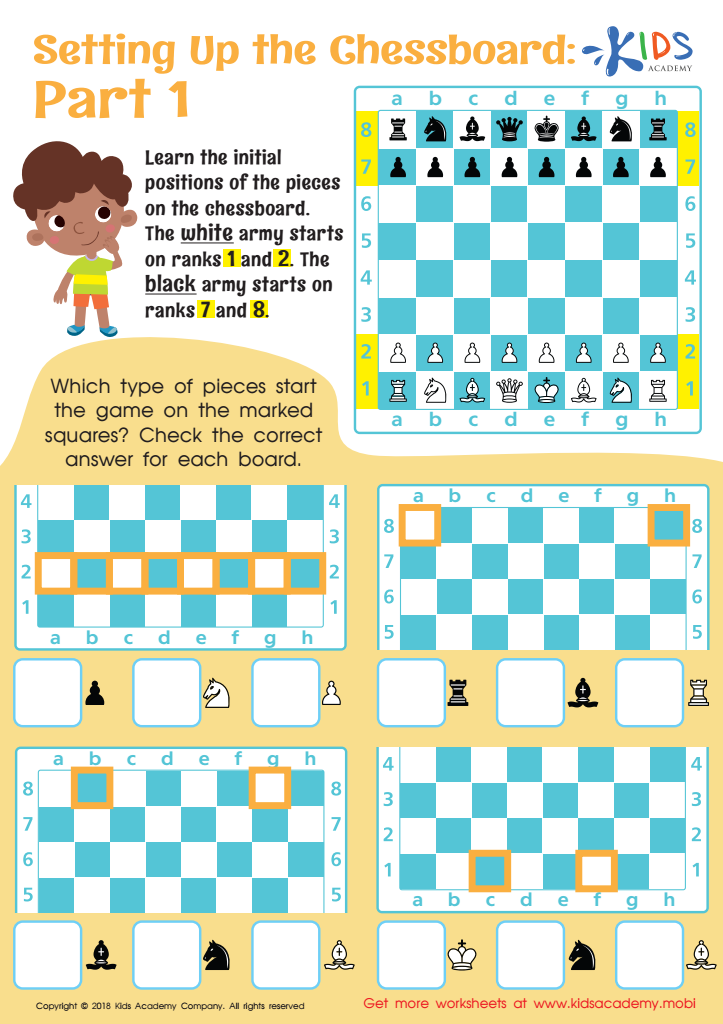
Setting up the Chessboard: Part 1 Worksheet
Teach your child the starting positions of the black and white armies on the chessboard. Black pieces are placed on ranks 7 and 8, and white pieces on ranks 1 and 2. Have them check the highlighted boxes on the chessboard to make sure they know the correct pieces to start with.
Setting up the Chessboard: Part 1 Worksheet
Worksheet
Join Kids Academy for Free
Who is primarily going to use this learning content?







Parents and teachers should place significant importance on developing logical thinking in children aged 5-6, and chess is an excellent tool for achieving this. At this pivotal age, children's cognitive abilities are rapidly expanding, and introducing them to the game of chess can significantly enhance their logical and critical thinking skills. Chess requires players to think ahead, foresee possible outcomes, and make decisions based on logical analysis rather than impulse. This encourages young minds to appreciate strategic planning and understand cause-and-effect relationships, which are fundamental aspects of logical reasoning.
Furthermore, chess helps improve problem-solving skills. When faced with a challenging position, children learn to evaluate different possibilities and choose the most viable solution. This practice translates to real-life situations where logical thinking and problem-solving are essential. Additionally, playing chess can enhance memory and improve concentration in young children, as they need to remember specific rules, sequences, and the positions of individual pieces.
Parents and teachers should recognize that these cognitive benefits extend beyond the game. Logical thinking fostered through chess can lead to better academic performance, particularly in math and science, subjects that heavily rely on logic and reasoning. Moreover, the sense of accomplishment and boosted self-esteem from mastering the game are invaluable for a child's overall emotional and social development.
In summary, integrating chess into early childhood education promotes essential cognitive skills, laying a robust foundation for future academic and personal success.