
Number formation Worksheets for Ages 5-6
3 filtered results
Difficulty Level
Grade
Age
-
From - To
Subject
Activity
Standards
Introduce young learners to number formation with our engaging worksheets tailored for ages 5-6. Our expertly designed activities help children develop fine motor skills and numerical understanding through fun tracing, counting, and colored exercises. These worksheets are perfect for homeschooling or classroom settings, ensuring kids grasp essential number-writing techniques. With bright, attractive designs and a variety of tasks, children stay motivated and enjoy learning the basics of number formation. Equip your child with the skills they need to succeed in early math concepts. Visit Kids Academy today to explore our comprehensive collection and start your educational journey!
Favorites
With answer key
Interactive
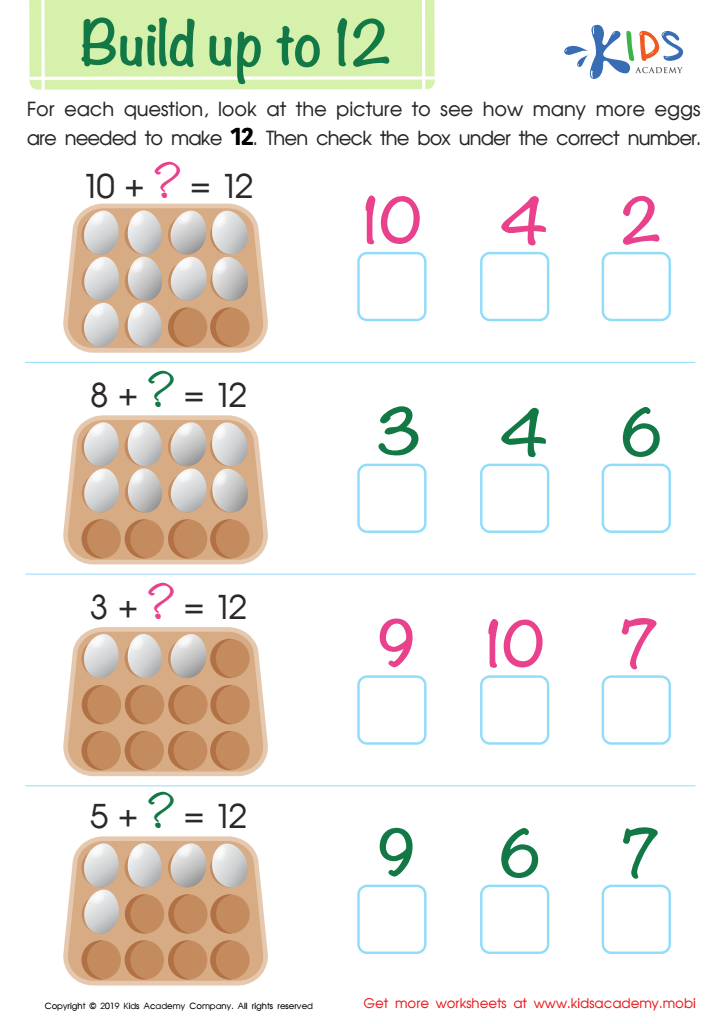
Build up to 12 Worksheet
Love eggs? Kids can identify them in the picture in this worksheet. We need to add numbers to make 12. Look at the picture and see how many eggs are needed. Check the correct number box. Breakfast or baking, eggs are essential!
 Assign to My Students
Build up to 12 Worksheet
Worksheet
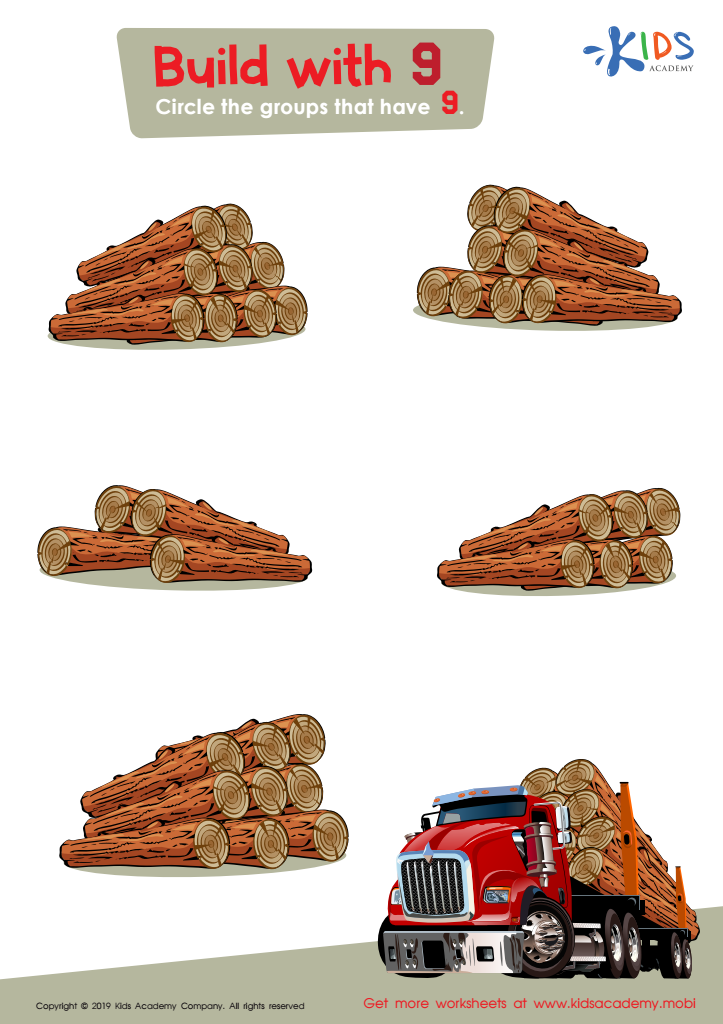
Build with 9 Worksheet
Your students' learning journey can be challenging, but ultimately rewarding. This worksheet helps them practice counting: count the logs in all the groups and circle those with 9 logs.
Build with 9 Worksheet
Worksheet
Join Kids Academy for Free
Who is primarily going to use this learning content?








Number formation is a critical aspect of early education, particularly for children aged 5-6. At this age, children are developing foundational skills that will impact their academic journey. Proper number formation enhances a child's ability to write numbers clearly and legibly, which is essential for accurate communication and understanding in math. This foundation is vital for tasks ranging from writing page numbers to solving arithmetic problems.
Parents and teachers should care about number formation because it directly influences a child's confidence and competence in mathematics. When children struggle with writing numbers correctly, it can lead to confusion and frustration, impeding their ability to grasp more complex mathematical concepts in the future. Early intervention ensures that children do not develop bad habits that could detract from their academic performance.
Moreover, learning proper number formation also supports the development of fine motor skills, hand-eye coordination, and cognitive abilities. These skills are not only beneficial for mathematical work but are also applicable to other subjects and everyday activities. By fostering good number-writing habits early on, parents and teachers lay the groundwork for a more successful and enjoyable educational experience. Cultural numeracy is also growing more important in a data-driven world. Strong numeracy skills build critical thinking and problem-solving strategies valuable for better handling real-life mathematical tasks.








