
Comparing heights Math Worksheets for Ages 5-6
3 filtered results
Difficulty Level
Grade
Age
-
From - To
Subject
Activity
Standards
Discover engaging "Comparing Heights" math worksheets tailored for ages 5-6! These worksheets are designed to help young learners grasp the concept of height comparison through interactive and fun activities. Children will use visual aids and simple exercises to identify taller and shorter objects, fostering critical thinking and observational skills. Each worksheet offers a mix of colorful illustrations and appealing formats, making learning enjoyable and effective. Perfect for classroom settings or at-home learning, these resources provide an excellent way to enhance foundational math skills while encouraging kids to explore their environment. Start your child’s math journey today with our dynamic worksheets!
Favorites
With answer key
Interactive
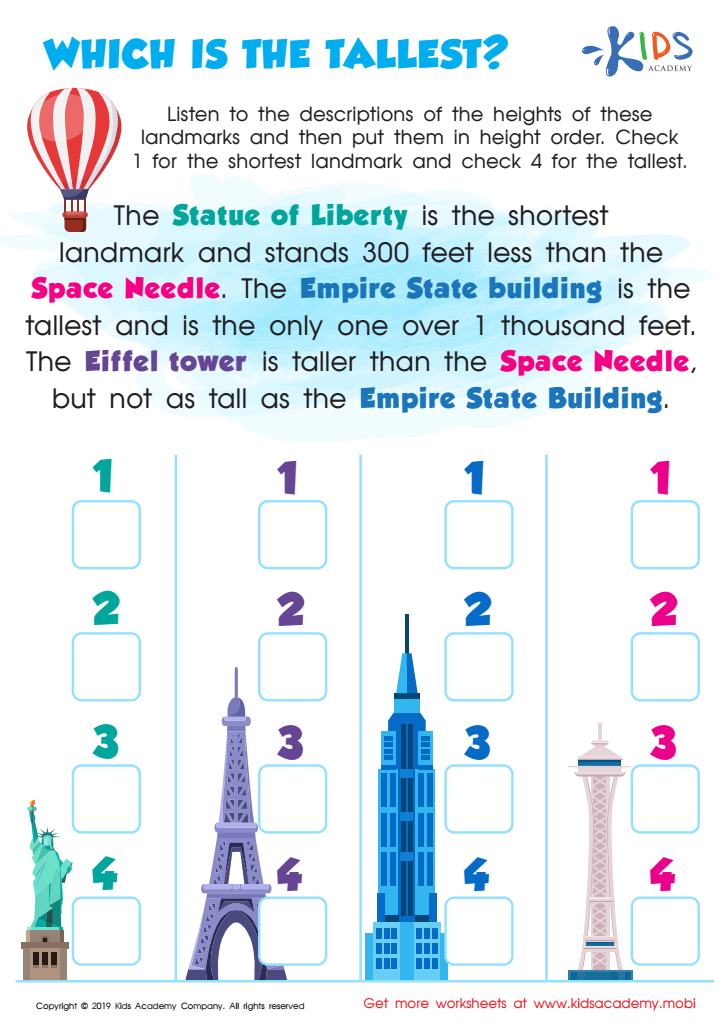
Which is the Tallest? Worksheet
Help your kids arrange the buildings in order of height: highest (4) to lowest (1). Ask them if they can think of other ways things can be measured. Read the texts describing the buildings and check 4 for the tallest and 1 for the shortest.
 Assign to My Students
Which is the Tallest? Worksheet
Worksheet
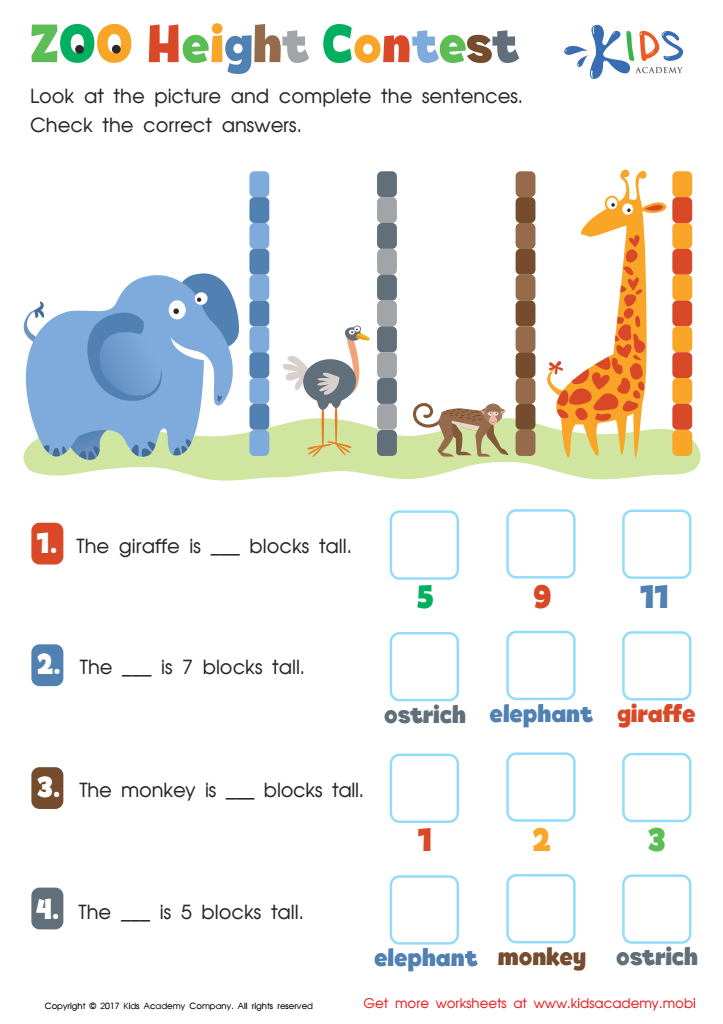
Zoo Height Contest Worksheet
Let's head to the zoo and use colorful blocks to measure your child's favorite animals! With this Kids Academy worksheet, help them practice and prepare for learning measurement. Guide them in looking at the zoo animals and counting blocks to find the height. Then, read the questions and check the box next to the correct answer.
Zoo Height Contest Worksheet
Worksheet
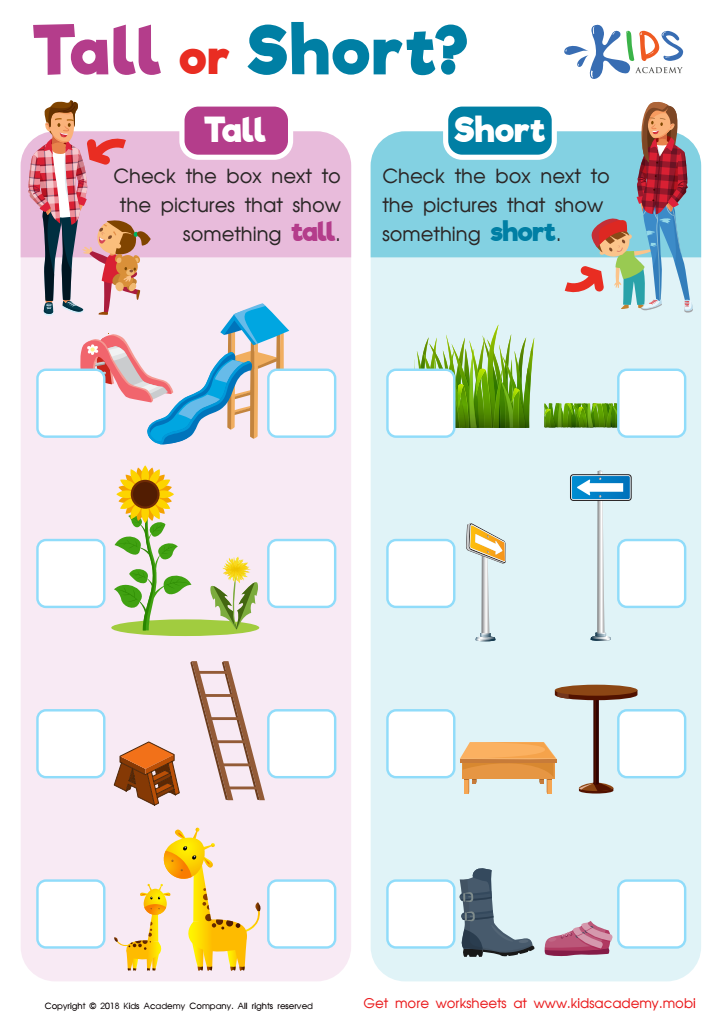
Tall or Short? Worksheet
Comparing tall and short objects is an early math skill. Our free worksheet uses fun colors and pictures to help kids practice. This will give them a head start for higher-level measurement skills, and they'll remember tangible objects for comparison.
Tall or Short? Worksheet
Worksheet
Join Kids Academy for Free
Who is primarily going to use this learning content?








Comparing heights in mathematics for children aged 5-6 is a vital educational activity with numerous benefits. At this developmental stage, children are naturally curious about their surroundings, and engaging them in hands-on learning promotes their cognitive skills. Understanding and comparing heights allows young learners to grasp fundamental measurement concepts, which are foundational to more complex mathematical ideas they will encounter later.
Moreover, this activity fosters critical thinking and problem-solving abilities. As children explore who is taller or shorter among their peers, they analyze visual data, formulate questions, and draw conclusions. This helps improve their logical reasoning skills. Additionally, comparing heights encourages social interaction and teamwork, as children collaborate in measuring and discussing their findings.
From a broader perspective, such activities can help bridge the gap between math and real-world applications, reinforcing the relevance of math in everyday life. Parents and teachers care about this foundational context because it cultivates not only basic mathematical skills but also instills a love for learning. When children engage in measurement activities, they build confidence, develop communication skills, and foster curiosity—all crucial components for future academic success. Thus, incorporating height comparison into early math activities is imperative for well-rounded development.








