
Understanding Math Concepts Math Worksheets for Ages 5-6
3 filtered results
Difficulty Level
Grade
Age
-
From - To
Subject
Activity
Standards
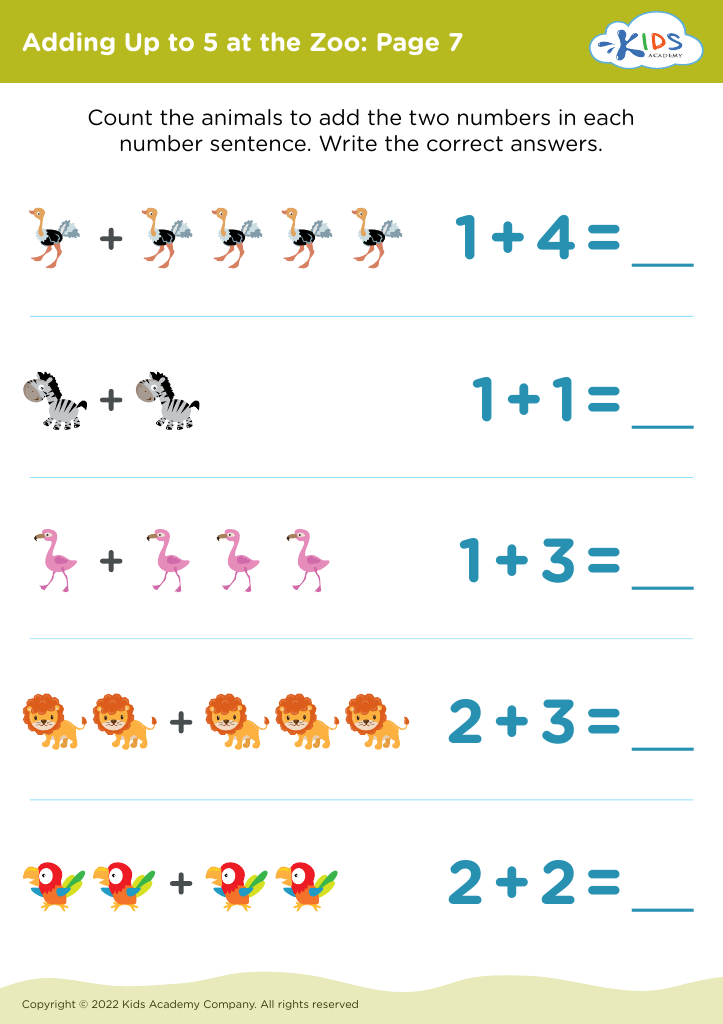
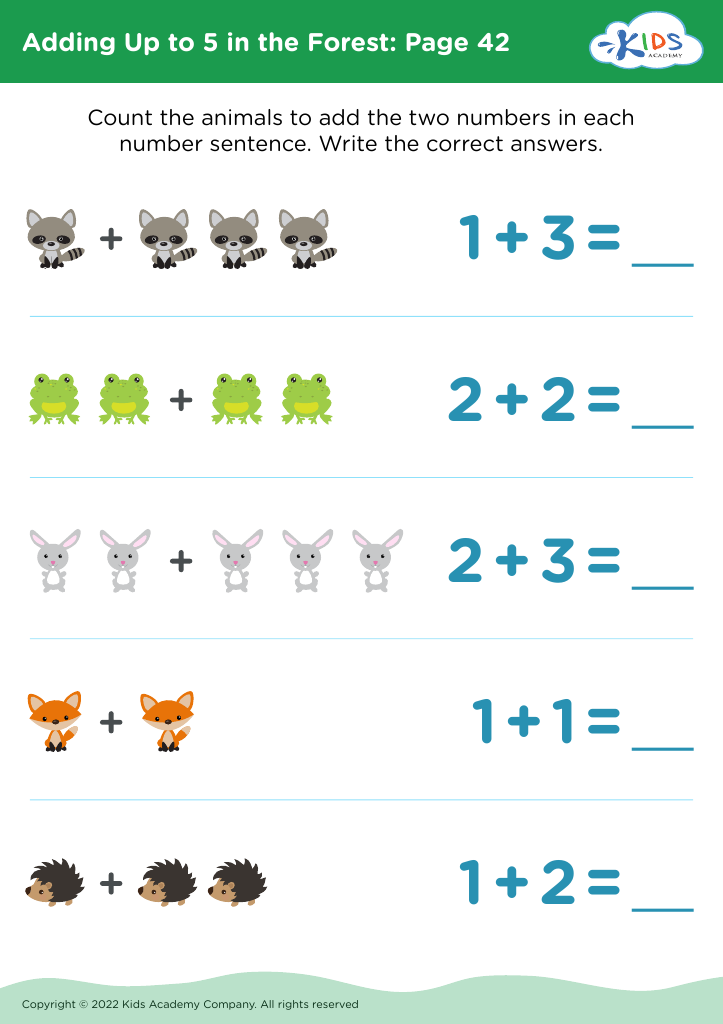
Explore our "Understanding Math Concepts Worksheets" designed specifically for children aged 5-6. These engaging worksheets help young learners grasp foundational math principles, fostering a solid base for future educational success. Activities focus on essential skills such as number recognition, basic addition and subtraction, shape identification, and introductory problem-solving. Each worksheet is crafted to stimulate curiosity and encourage interactive learning, making math fun and accessible for young minds. Perfect for home or classroom use, our resources support your child’s confidence and competence in mathematics. Download and print our engaging worksheets today to inspire a love for math in your little learner!
Favorites
With answer key
Interactive
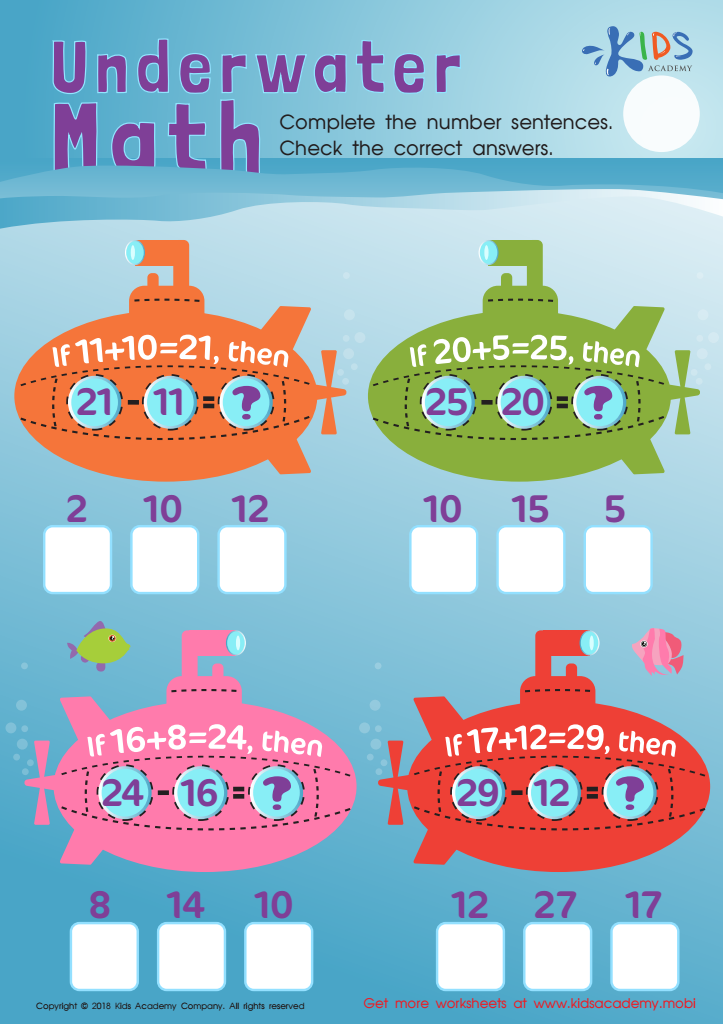
Addition and Subtraction: Underwater Math Worksheet
Take your little mathematicians on an undersea adventure as they work to solve number sentences. With fun worksheets, they'll analyze numbers, orders of operation and use if/then statements. They'll learn addition and subtraction are opposites, helping them solve more problems!
 Assign to My Students
Addition and Subtraction: Underwater Math Worksheet
Worksheet
Join Kids Academy for Free
Who is primarily going to use this learning content?







Understanding math concepts at ages 5-6 is crucial for children's cognitive development and future academic success. During these formative years, children develop foundational skills that serve as building blocks for more complex mathematical understanding later on. Mastering basic concepts like number recognition, counting, and simple addition lays the groundwork for problem-solving abilities and critical thinking.
Parents and teachers play an essential role in fostering a positive attitude towards math. Engaging young learners in playful, hands-on activities can make math enjoyable and accessible, helping to reduce anxiety often associated with the subject. Understanding math conceptually, rather than just memorizing facts, encourages children to recognize patterns, discern relationships, and apply mathematical thinking to real-world situations.
Furthermore, early math skills are predictors of later academic achievement. By investing time and effort into teaching math concepts at this stage, parents and teachers provide children with tools necessary for success in school and beyond. This investment not only nurtures mathematical proficiency but also instills confidence in children, empowering them to explore and persist through challenges in all aspects of their education. Ultimately, building a solid mathematical foundation sparks a lifelong appreciation for mathematics and its relevance in everyday life.








