Comparing heights Measurement Worksheets for Ages 5-6
3 filtered results
-
From - To
Discover our "Comparing Heights Measurement Worksheets for Ages 5-6," uniquely designed to make learning fun and engaging for young minds. These beautifully illustrated, age-appropriate worksheets help children practice measuring and comparing heights of different objects. Using colorful visuals and simple exercises, they develop essential skillsets, including observation, critical thinking, and mathematical reasoning. Perfect for classroom use or at-home learning, these worksheets provide an intuitive and enjoyable way for children to grasp the concept of measurement. Help your child build a strong foundation in math with our expertly crafted worksheets!
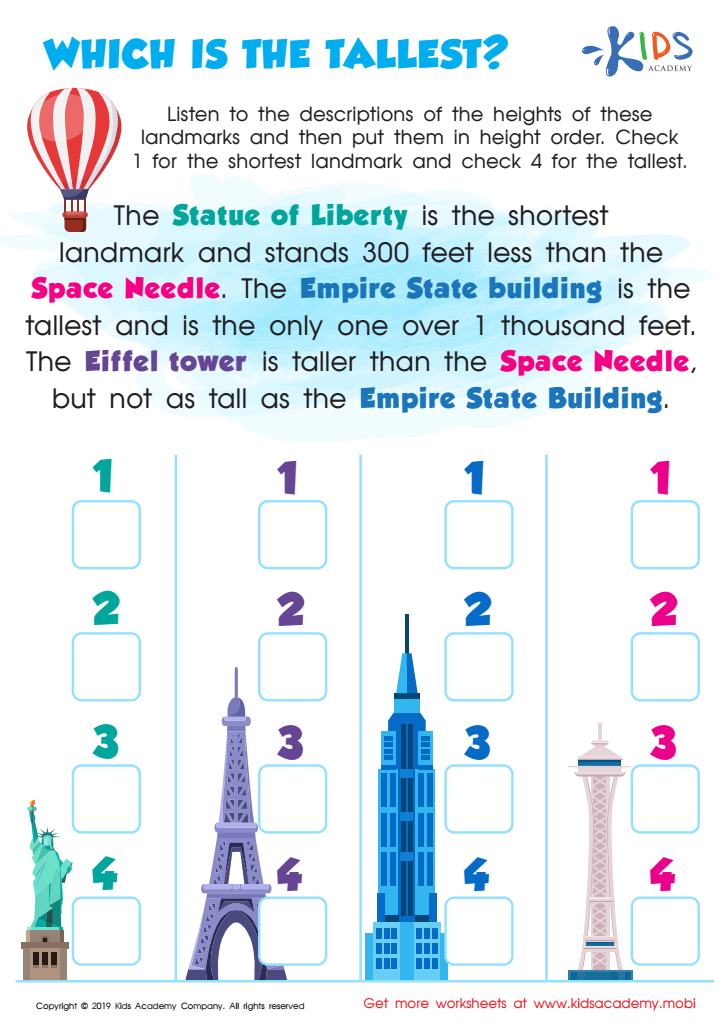
Which is the Tallest? Worksheet
 Assign to My Students
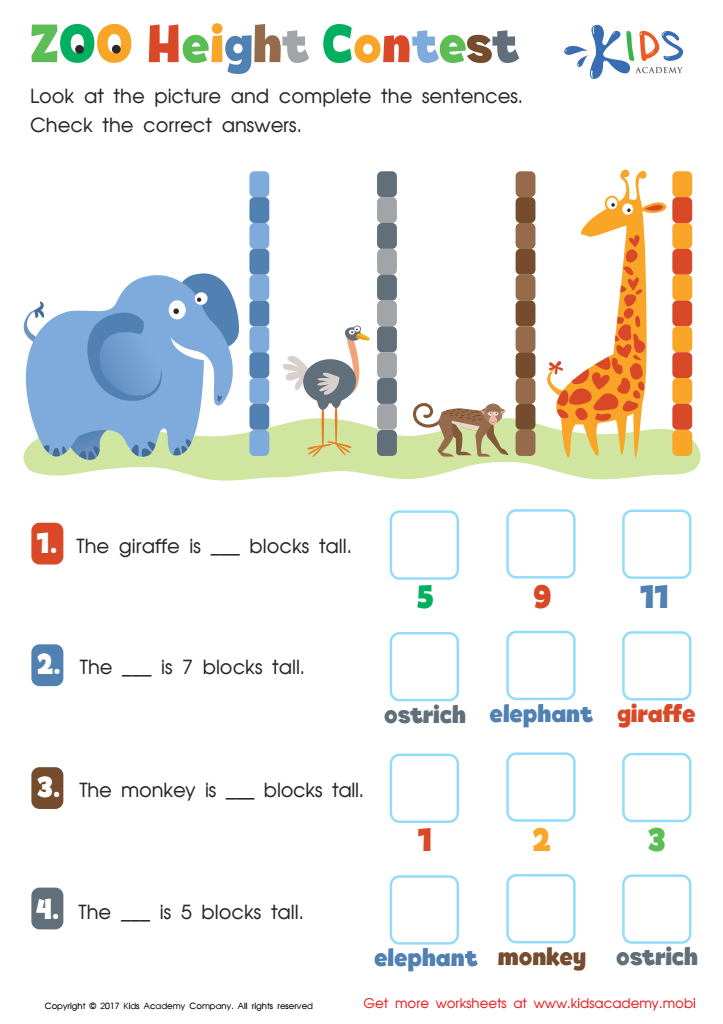
Zoo Height Contest Worksheet
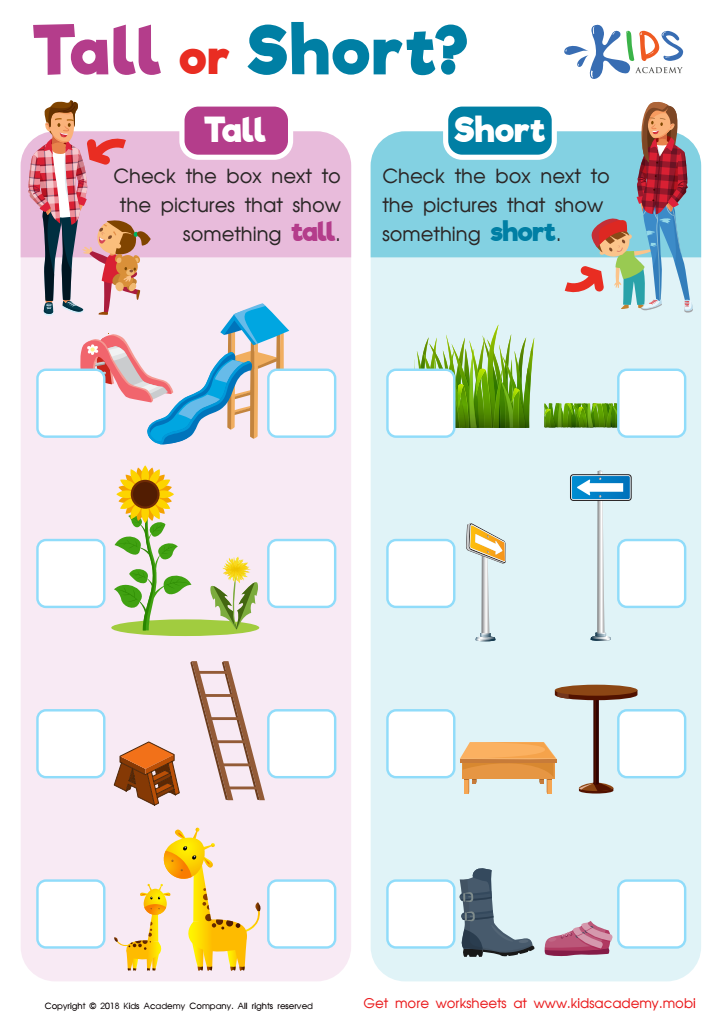
Tall or Short? Worksheet








Understanding and learning to compare heights at ages 5-6 is fundamental for a child's cognitive and mathematical development. At this age, children are just starting to grasp basic concepts of measurement, which are crucial building blocks for more advanced math skills they will encounter in school. Comparing heights helps them understand relationships in the physical world and distinguish between different sizes.
Firstly, engaging in height comparison fosters observational and analytical skills. Children begin to use terms like "taller," "shorter," and "the same height," which enhances their vocabulary and descriptive abilities. This supports language development and effective communication.
Secondly, these activities bridge concrete and abstract thinking. As children compare visible, tangible objects and people, they create mental models that they can use for abstract problem-solving later on. It is also an introductory step to understanding units of measurement they will learn in subsequent grades.
In addition, parents and teachers who emphasize these comparisons often foster an environment of curiosity and exploration. Such engagement helps maintain children's interest in learning and establishes positive attitudes toward mathematics from an early age.
Lastly, understanding and comparing measurements, including height, connects children to everyday life. This not only makes math relevant but also boosts their self-confidence as they navigate real-world situations. For instance, distinguishing the heights of playground equipment can be vital for their safety.
Thus, parents and teachers play a crucial role in guiding these early comparisons, ultimately supporting holistic developmental milestones.








