Understanding skip-counting Skip Counting Worksheets for Ages 5-6
3 filtered results
-
From - To
Explore engaging learning with our Understanding Skip Counting Worksheets designed for ages 5-6! Skip counting boosts math proficiency by helping young learners recognize patterns and develop number sense. Our printable worksheets make mastering this vital skill fun and easy. Featuring colorful activities, these worksheets guide children through counting by 2s, 5s, and 10s. Perfect for parents and teachers, these tools support early math education and enhance problem-solving abilities. Foster a love for numbers today with our skip counting resources! Access them at Kids Academy and watch your child’s confidence grow. Happy learning!
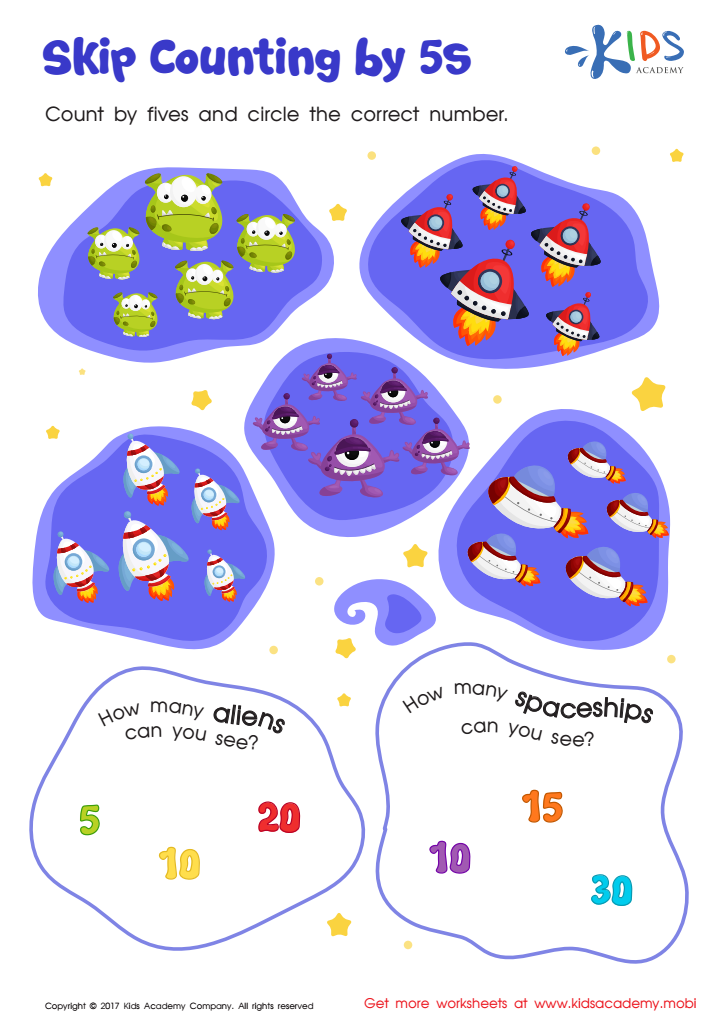
Skip Counting by 5s: Aliens and Spaceships Printable
 Assign to My Students
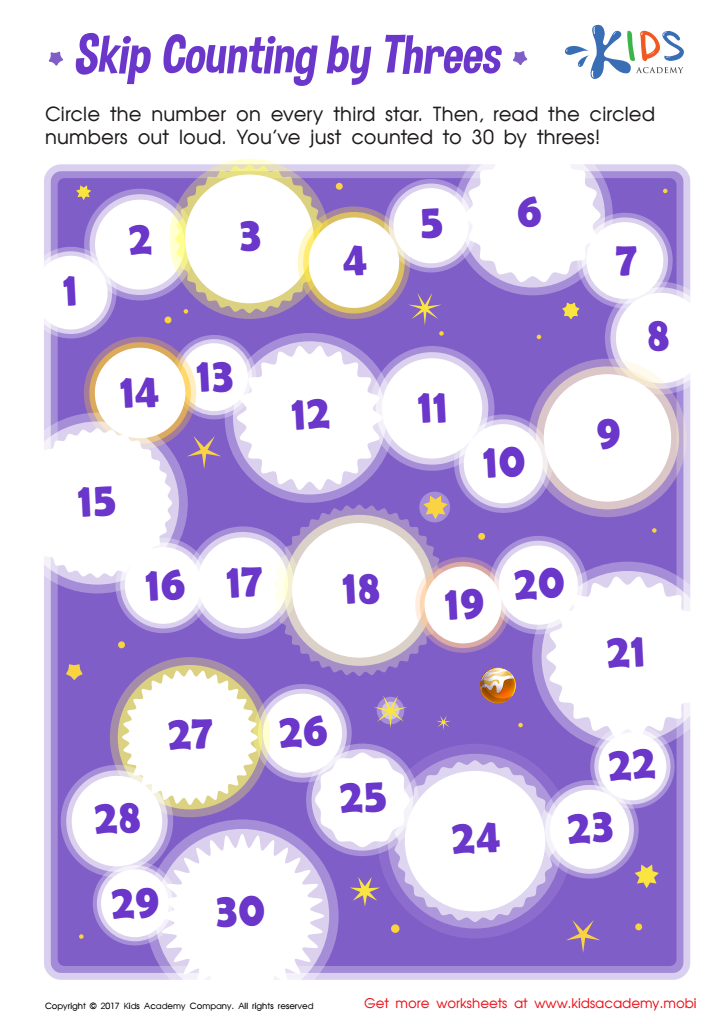
Skip Counting By Three Printable
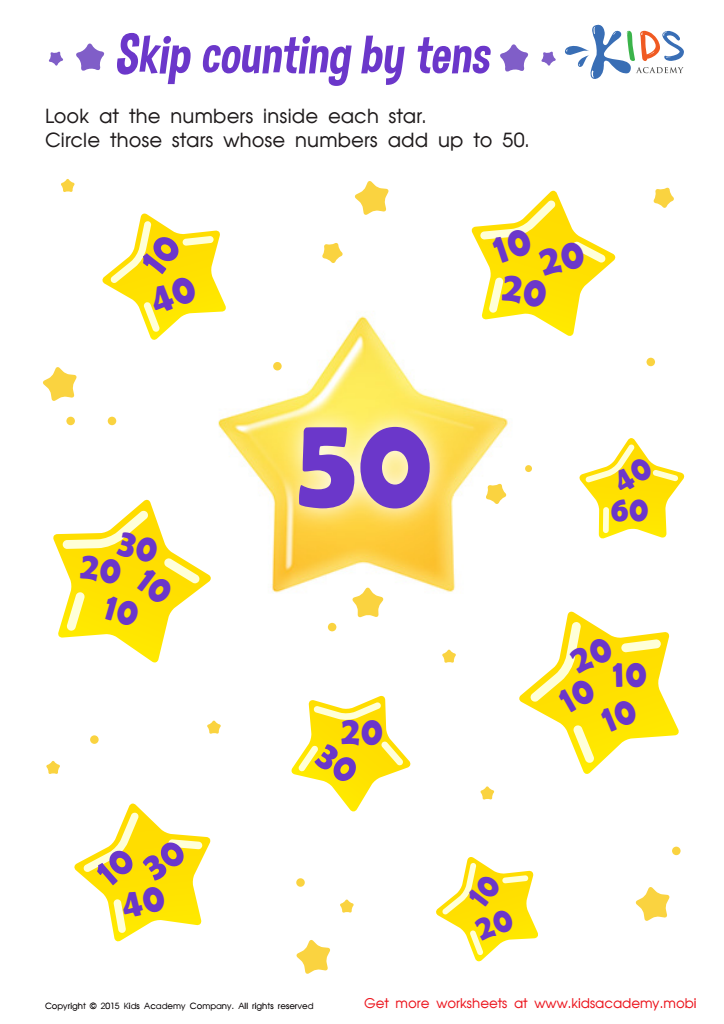
Learn Dozens: Skip Counting by Tens Printable








Skip counting is an essential mathematical skill for young children, particularly those aged 5-6, and parents and teachers should prioritize it for several reasons. First, skip counting lays the foundation for more advanced arithmetic concepts, such as multiplication and division. By learning to count by 2s, 5s, or 10s, children begin to recognize patterns in numbers, which helps them grasp the concepts of groupings and repeated addition.
Secondly, skip counting aids in developing number sense, an intuitive understanding of numbers and their relationships. This understanding is crucial for reasoning and problem-solving in mathematics. For example, when children skip count, they learn to navigate and understand the number line more fluidly, which prepares them for tackling mental math challenges and more complex calculations in the future.
Additionally, skip counting enhances memory and cognitive development through repetition and pattern recognition. It encourages children to pay attention to sequences and fosters logical thinking. Engaging in skip counting activities also reinforces other key skills such as listening, chanting, and rhythm, fostering a multi-sensory learning experience.
Therefore, understanding skip counting is not just about learning numbers; it's about building the foundational blocks for comprehensive mathematical understanding and developing critical cognitive skills. Parents and teachers who emphasize this area contribute significantly to their children's long-term academic success.








