
Basic science knowledge Worksheets for Ages 5-9
3 filtered results
Difficulty Level
Grade
Age
-
From - To
Subject
Activity
Standards
Discover our engaging Basic Science Knowledge Worksheets, designed for children aged 5-9. These worksheets provide an exciting way for young learners to explore fundamental scientific concepts through hands-on activities and captivating illustrations. Each printable task encourages exploration of the natural world, covering topics such as plants, animals, weather, and the environment. Our user-friendly materials are perfect for teachers and parents alike, fostering curiosity and a love for science in children. Enhance your child's learning experience with these fun, interactive worksheets that support critical thinking and foundational science skills. Start your educational journey today with our comprehensive collection!
Favorites
With answer key
Interactive
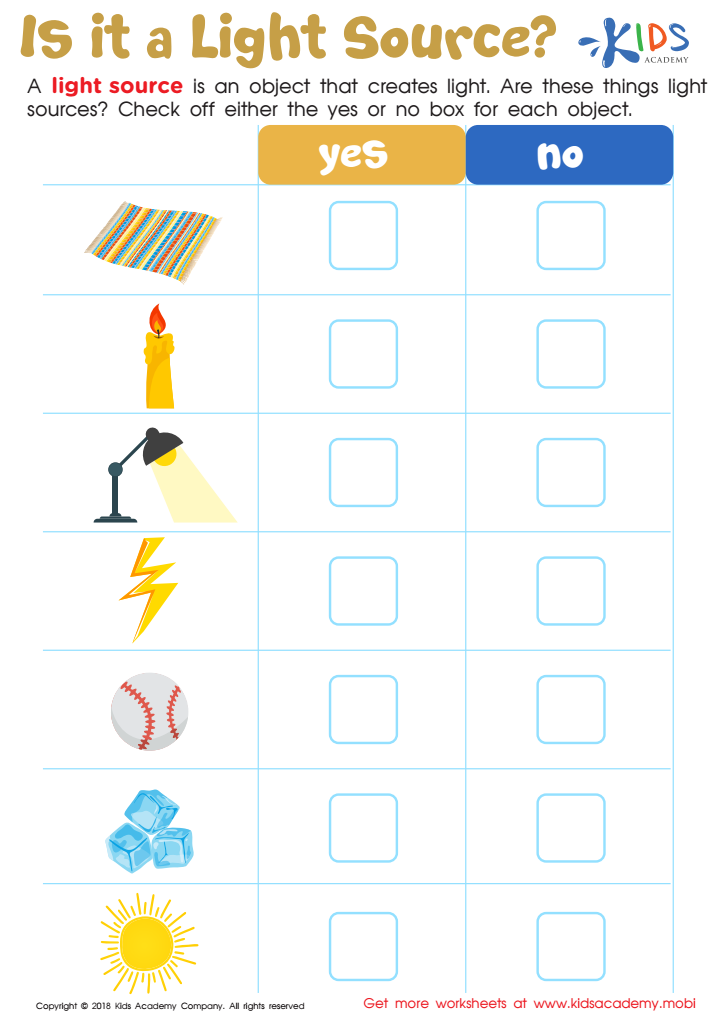
Is It a Light Source? Worksheet
This worksheet is a fun way to teach kids about light sources. Children must identify natural sources like the sun and lightning, and man-made sources such as candles and lamps. Ask them to look at each object and check the box to indicate if it's a light source or not.
 Assign to My Students
Is It a Light Source? Worksheet
Worksheet
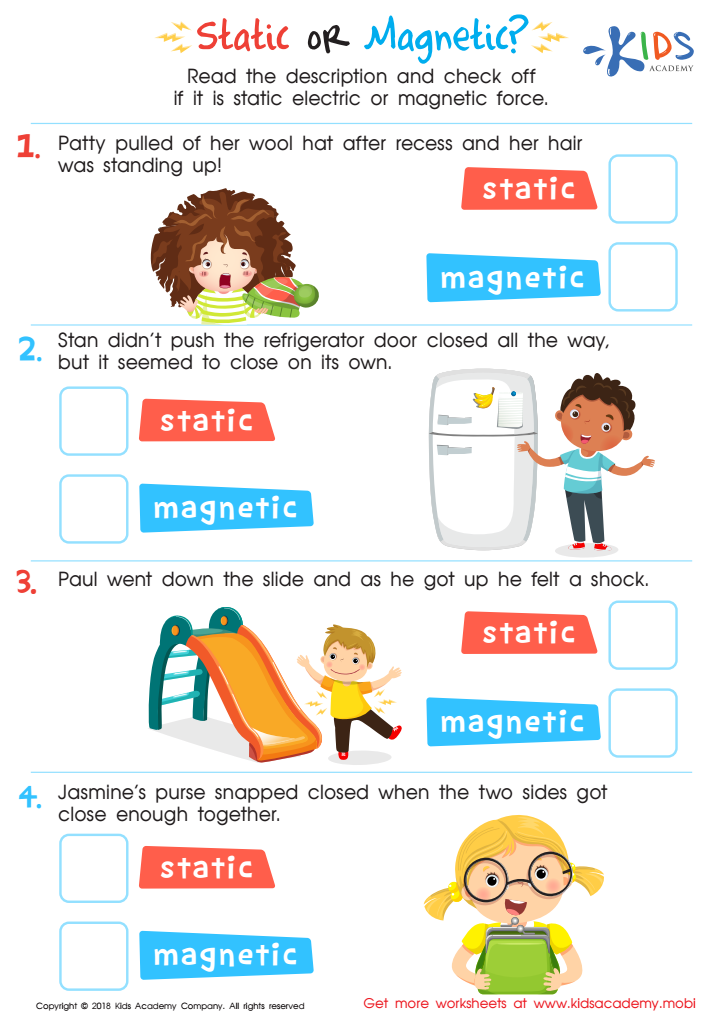
Static or Magnetic Printable Worksheet
Ever wondered if a situation involved static or magnetic force? This printable worksheet has the answer! Read the scenarios and check out the illustrations to decide which force is in play for each. Learn about these two amazing forces with this fun activity!
Static or Magnetic Printable Worksheet
Worksheet
Join Kids Academy for Free
Who is primarily going to use this learning content?







Basic science knowledge for children ages 5-9 is crucial as it lays the foundation for critical thinking, curiosity, and a deeper understanding of the world around them. At this age, children are naturally inquisitive, and exposing them to fundamental science concepts fuels their curiosity and fosters a love for learning. Engaging with science enhances problem-solving skills and encourages children to ask questions, explore their environment, and seek answers, all of which are vital for their cognitive development.
Furthermore, basic science education introduces essential concepts like the scientific method, observation, and experimentation, which promote logical reasoning and analytical skills. These foundational skills are transferable across subjects and will significantly impact their academic growth later on.
Parents and teachers also play a pivotal role in helping children develop a scientific mindset, understanding the importance of observation, and nurturing their sense of wonder. By integrating simple, hands-on experiments and nature explorations, educators and caregivers can help children build confidence in their abilities to think and learn independently.
In summary, ensuring children acquire basic science knowledge at this crucial age not only enriches their education but also prepares them for future academic pursuits and informed citizenship.








