
Developing arithmetic skills Worksheets for Ages 5-9
3 filtered results
Difficulty Level
Grade
Age
-
From - To
Subject
Activity
Standards
Welcome to our comprehensive collection of Developing Arithmetic Skills Worksheets, specially crafted for children ages 5 to 9. These engaging and interactive worksheets are designed to enhance foundational math skills through fun activities that promote number recognition, addition, and subtraction. Tailored to meet the learning needs of early learners, our resources incorporate colorful visuals and playful themes to maintain high levels of interest and motivation. By practicing with these worksheets, children can build confidence in their arithmetic abilities and develop a solid understanding of essential math concepts. Explore our website to find the perfect worksheets that will make learning math an enjoyable adventure!
Favorites
With answer key
Interactive
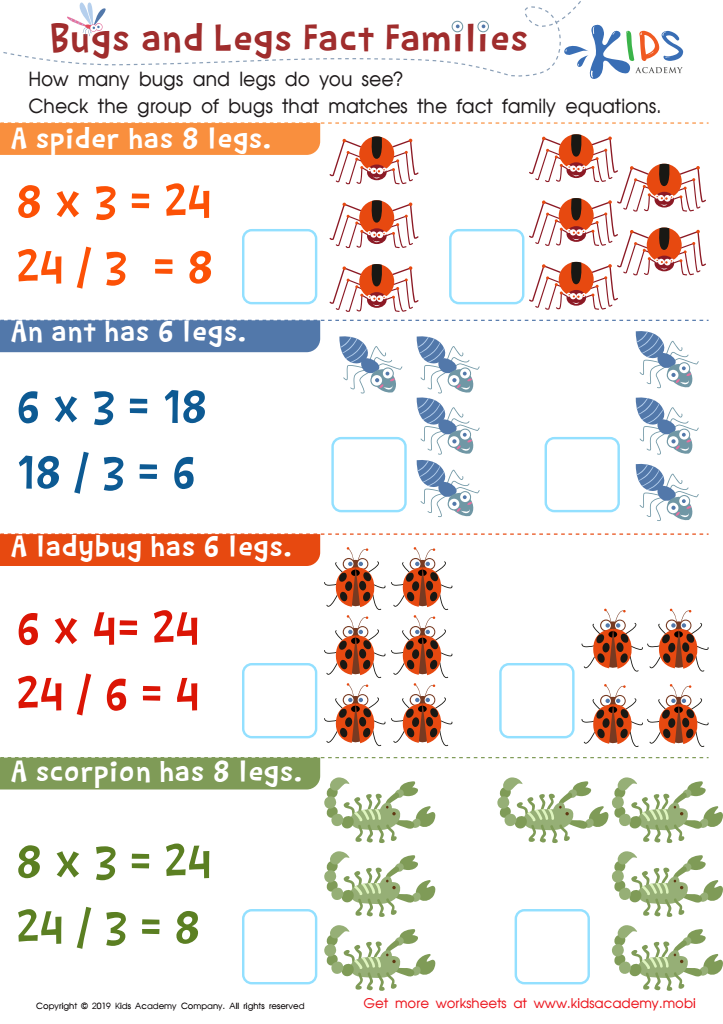
Bugs and Legs Fact Families Worksheet
This free worksheet uses bugs and insects to help young math students learn about fact families and recognize patterns in multiplication and division. It's a fun and colorful way to gain automaticity and efficiency in computation skills, without even realizing it's math!
 Assign to My Students
Bugs and Legs Fact Families Worksheet
Worksheet
Join Kids Academy for Free
Who is primarily going to use this learning content?







.jpg)
Developing arithmetic skills in children aged 5-9 is crucial for several reasons. First, this age range marks a critical period in cognitive development where foundational math skills begin to take shape. Mastery of basic arithmetic—addition, subtraction, and an introduction to multiplication and division—forms the building blocks for more complex mathematical concepts they'll encounter in later grades.
In addition, strong arithmetic skills foster a child's confidence and enjoyment in learning. When students grasp these fundamental concepts, they are more likely to engage positively with math, reducing the likelihood of math anxiety. Engaging parents and teachers in this process can create a supportive environment that encourages exploration and curiosity about numbers.
Moreover, the ability to perform basic arithmetic is essential for everyday life, enabling children to solve practical problems, manage money, and understand time. Encouraging arithmetic proficiency also reinforces critical thinking skills, teaching children to analyze situations and find solutions, thereby enhancing their overall problem-solving abilities.
Ultimately, prioritizing arithmetic skill development in early education not only prepares children for academic success but also equips them with valuable life skills that will benefit them well beyond the classroom. Collaboration between parents and teachers can create effective strategies to nurture these essential skills.








