
Learning subtraction Worksheets for Ages 5-9
4 filtered results
Difficulty Level
Grade
Age
-
From - To
Subject
Activity
Standards
Explore our engaging subtraction worksheets designed for children ages 5-9! Our collection offers a variety of fun and interactive activities that promote strong foundational math skills. Tailored to meet the developmental needs of young learners, these worksheets feature bright illustrations and relatable contexts, making subtraction enjoyable and accessible. From basic concepts to more advanced problems, our printable resources help students practice and reinforce their understanding of subtraction in creative ways. Perfect for home or classroom use, our materials foster self-confidence and a love for learning math. Start your child’s subtraction journey today with our comprehensive worksheets!
Favorites
With answer key
Interactive
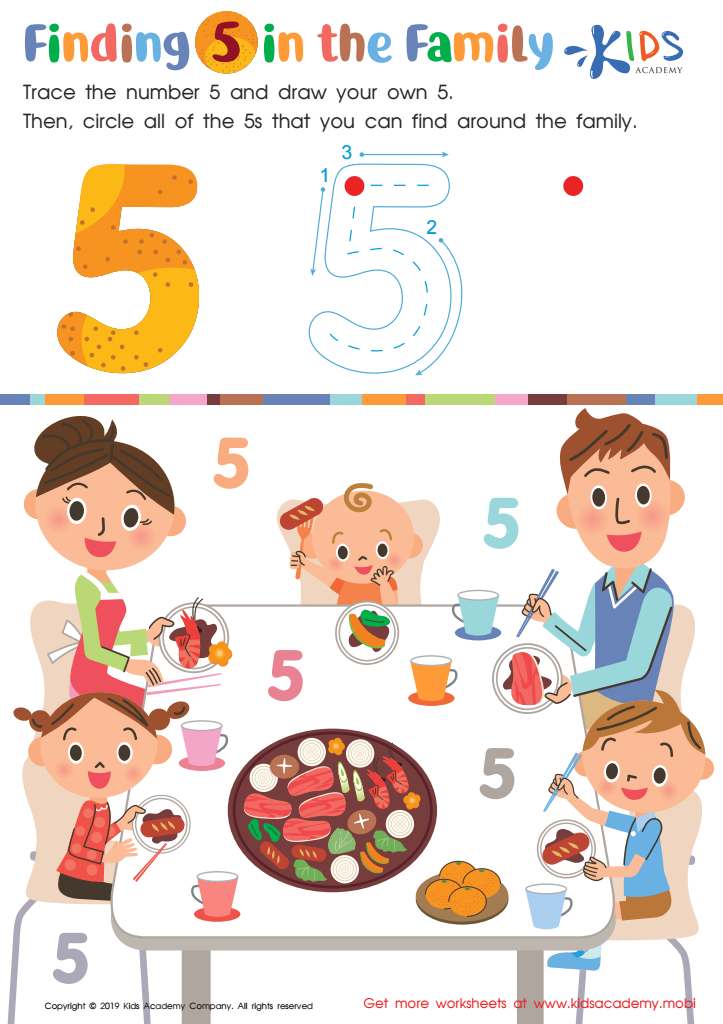
Finding 5 in the Family Worksheet
This worksheet helps kids identify and write the number 5. Ask what the family is doing and who the family members are. Help them trace and draw the 5, then have them circle all 5s in the picture.
 Assign to My Students
Finding 5 in the Family Worksheet
Worksheet
Join Kids Academy for Free
Who is primarily going to use this learning content?



.jpg)



Learning subtraction is essential for children aged 5-9 as it lays the foundation for their overall mathematical understanding and problem-solving skills. At this age, children are not only acquiring basic arithmetic skills but also developing critical thinking and cognitive abilities. Subtraction introduces concepts of number relationships and enhances their ability to think logically.
Understanding subtraction helps children grasp the idea of "taking away," which is fundamental in everyday situations, such as sharing candy or determining how many items are left after some are removed. This foundational knowledge fosters confidence in their ability to tackle more complex mathematical concepts as they progress.
Moreover, mastering subtraction promotes persistence and resilience. As they encounter challenges in learning, students practice patience and problem-solving strategies. These skills extend beyond mathematics into their overall academic journey and personal development.
For teachers and parents, fostering a strong foundation in subtraction can promote a positive attitude toward math, ensuring children do not develop anxiety or dislike for the subject. By actively engaging in subtraction activities, adults can reinforce importance, making learning more enjoyable and effective. Thus, supporting subtraction education is a vital step in nurturing a child’s academic success and lifelong mathematical understanding.








