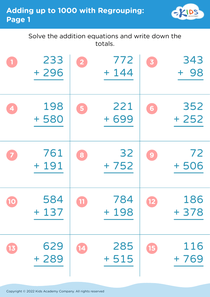
Simplifying Fractions Adding up to 1000 Without Regrouping Worksheets for Ages 5-9
3 filtered results
-
From - To
Introducing our "Simplifying Fractions Adding up to 1000 Without Regrouping Worksheets" for ages 5-9! Designed to make learning math fun and engaging, these worksheets help young learners master the essential skill of simplifying fractions while adding numbers up to 1000, all without the need to regroup.
Packed with colorful illustrations and age-appropriate challenges, these worksheets provide a hands-on way for children to practice and understand fundamental math concepts. Perfect for classroom use or at-home learning, they will build a strong foundation in fractions and addition. Encourage your child's math journey with our expertly crafted resource!
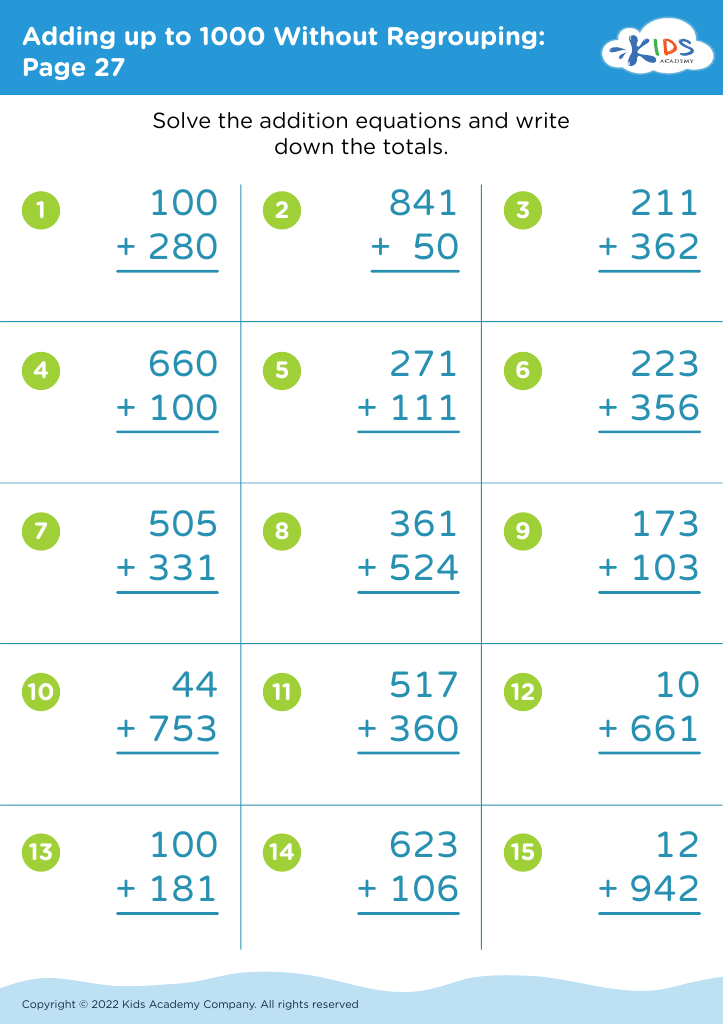
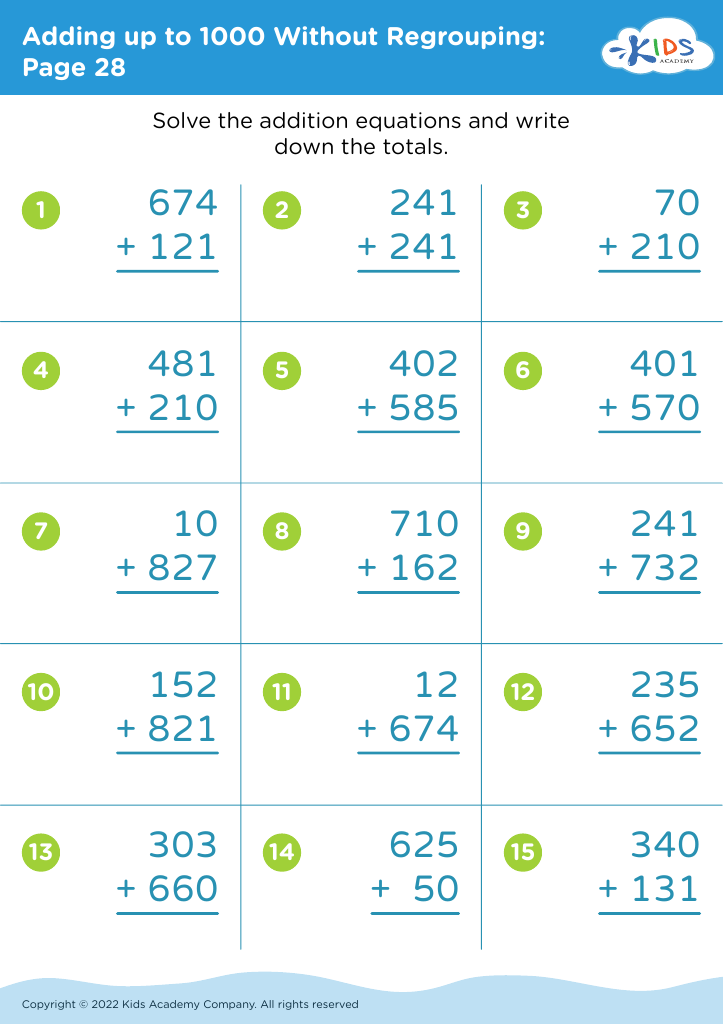
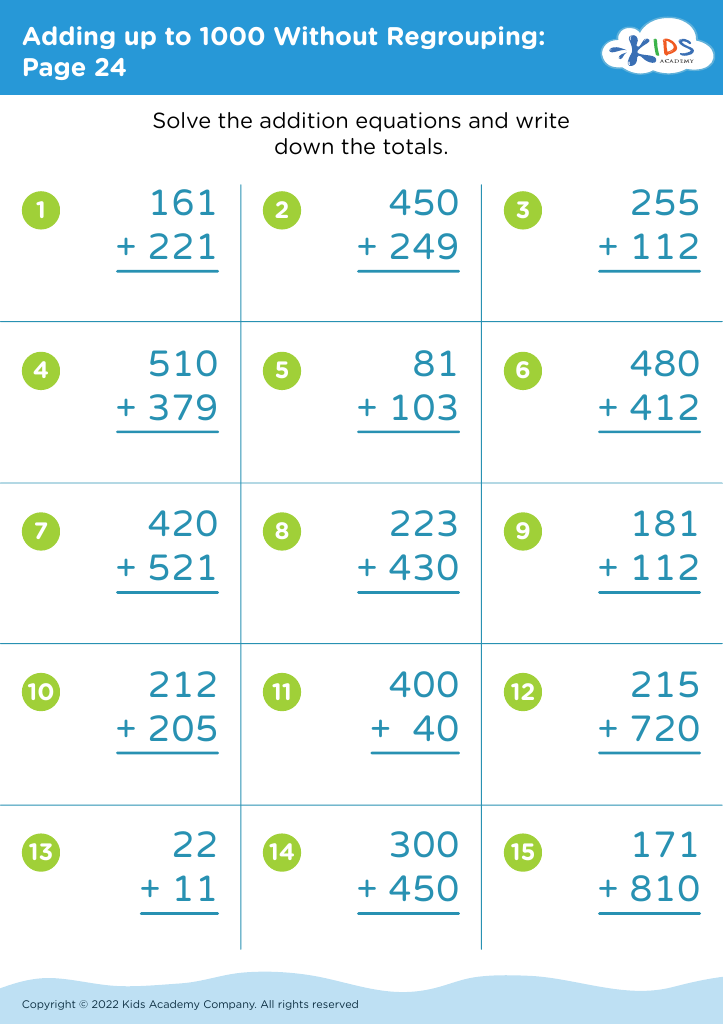


Introducing concepts like simplifying fractions and achieving sums without regrouping to young children is foundational for developing strong mathematical skills and logical thinking. For ages 5-9, engaging with such numerical exercises helps to enhance their counting abilities, pattern recognition, and problem-solving skills. At this age, children's brains are highly receptive and adaptable, thus learning to simplify fractions solidifies an understanding of number equivalency—a core mathematical concept. Adding numbers up to 1000 without regrouping pushes the boundaries of their basic arithmetic skills, fostering confidence and a sense of accomplishment in handling larger numbers.
Moreover, these skills are not only pivotal for mathematics but also for everyday activities. Whether it's dividing a pizza equally among friends or understanding the parts of a whole in practical situations, children who master these concepts are better equipped to navigate real-life scenarios. Additionally, early exposure to fractions and large numbers without regrouping builds a strong foundation essential for more complex mathematical operations in the future, such as multiplication, division, and algebra.
Parents and teachers who prioritize these skills ensure that children develop a robust mathematical persona, making future learning smoother and possibly igniting a lasting interest in STEM subjects. Therefore, integrating these concepts into early education is crucial for cultivating proficient, confident, and curious mathematicians.