Subtraction skills Addition & Subtraction Worksheets for Ages 5-9 - Page 2
27 filtered results
-
From - To
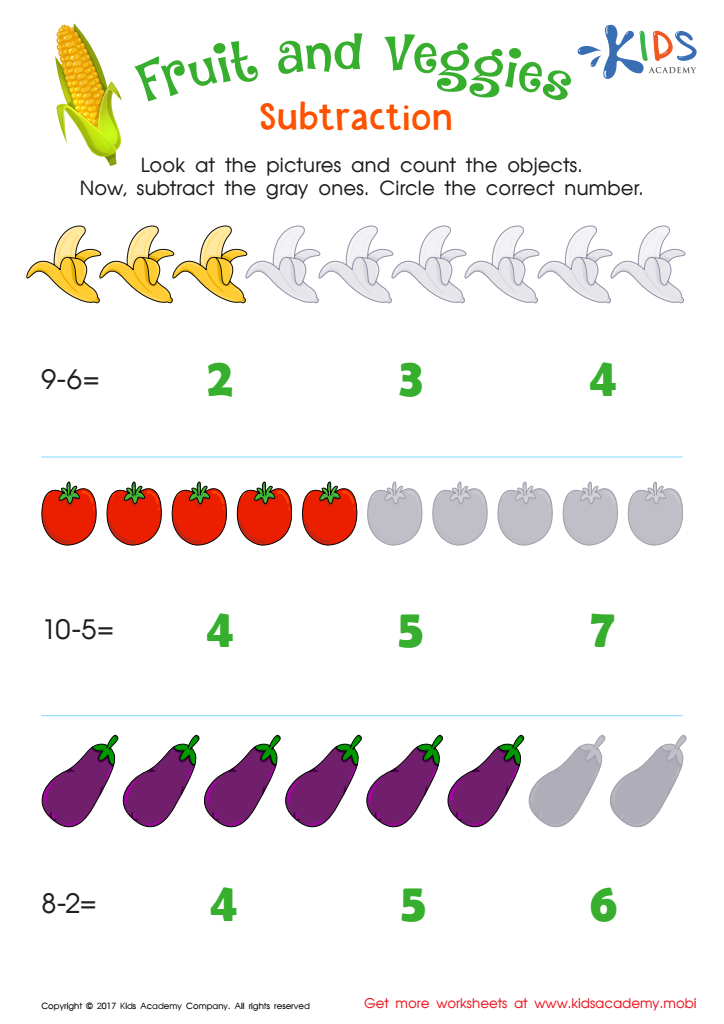
Fruit and Veggies Subtraction Worksheet
 Assign to My Students
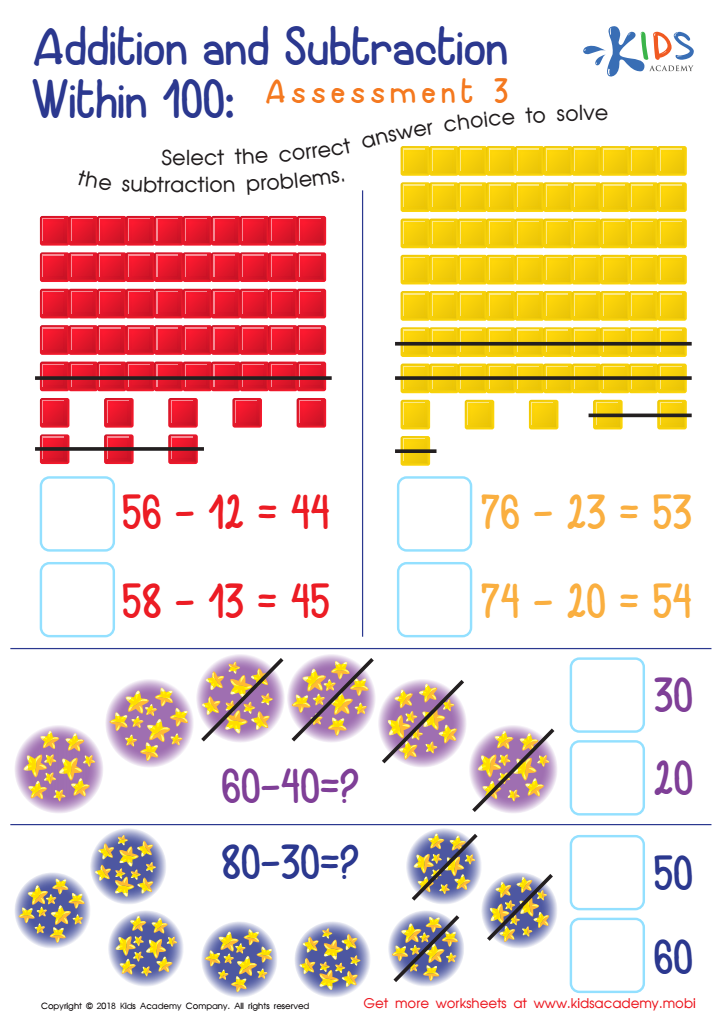
Addition and Subtraction Within 1: Assessment 3 Worksheet








Parents and teachers should care about developing subtraction skills, as well as addition skills, in children ages 5-9 because these fundamental abilities form the building blocks for future mathematical learning and everyday problem-solving. Subtraction is more than just taking away; it teaches children to think critically, recognize patterns, and solve problems efficiently. Early confidence and proficiency in both addition and subtraction allow children to approach more complex math concepts with greater ease, such as multiplication, division, fractions, and beyond.
Introducing addition and subtraction at a young age helps to build a solid foundation in arithmetic, necessary not only in academics but in day-to-day activities like determining change, measuring ingredients for cooking, managing time, and understanding sports scores. Strong skills in these areas lead to better performance in school and a greater likelihood of enjoying math-related activities, which can influence career choices in STEM (Science, Technology, Engineering, Mathematics).
Moreover, acquiring these math skills bolsters cognitive development by strengthening parts of the brain related to logical reasoning, attention, and memory. Thus, by prioritizing the mastery of subtraction and addition, parents and teachers empower children with critical life skills, foster a positive attitude towards learning, and contribute significantly to their overall intellectual growth.








