
Spatial awareness Addition Worksheets for Ages 5-9
5 filtered results
Difficulty Level
Grade
Age
-
From - To
Subject
Activity
Standards
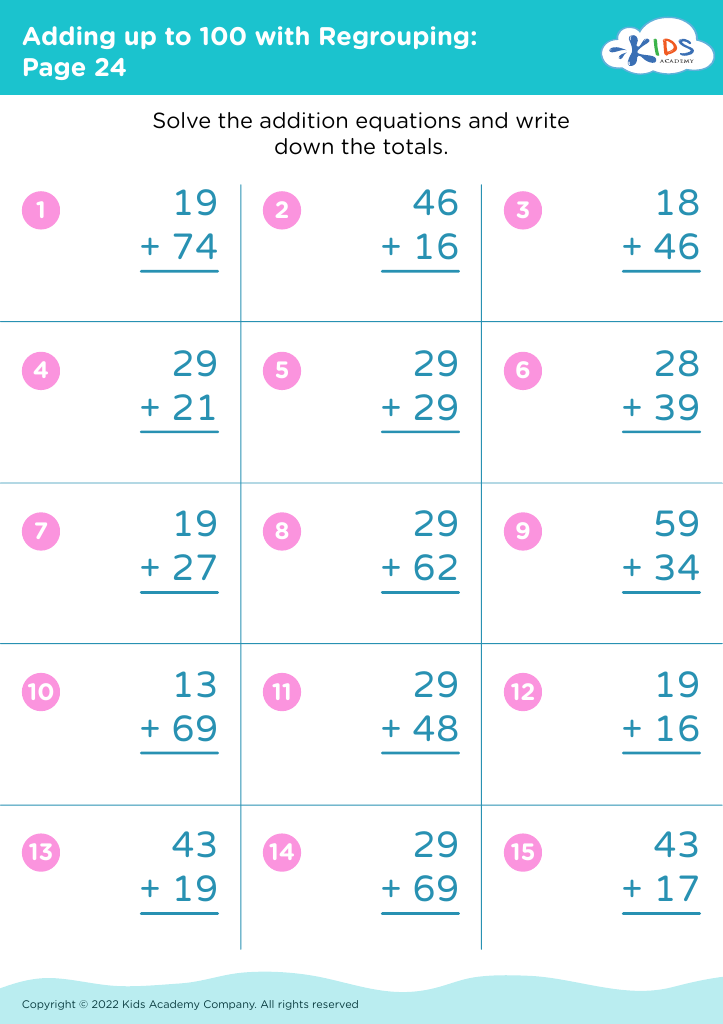
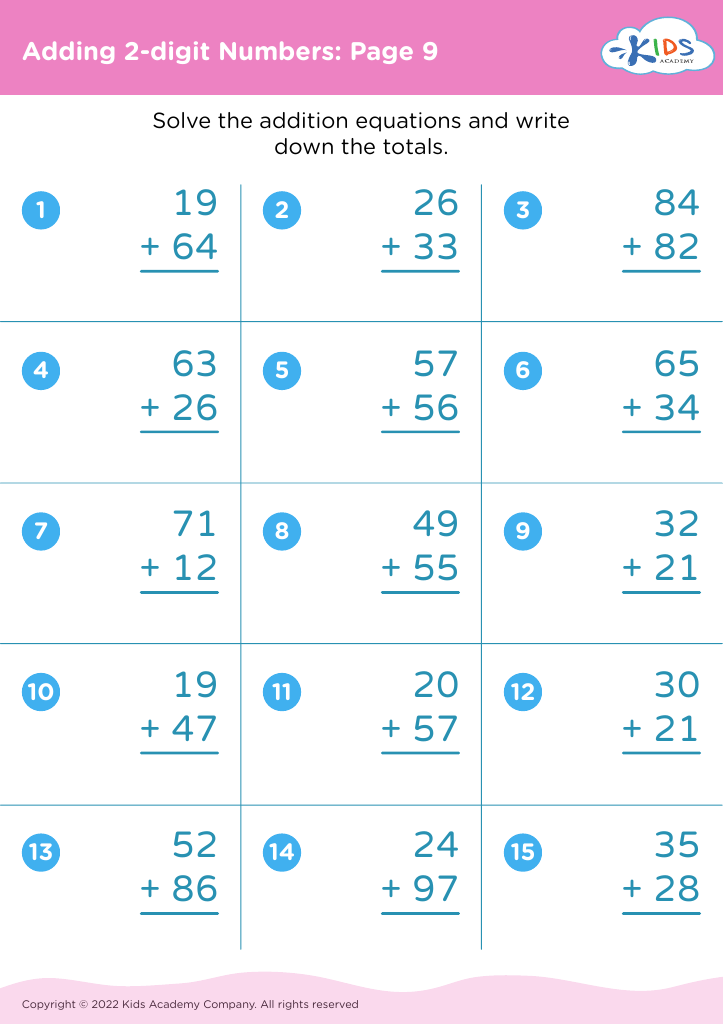
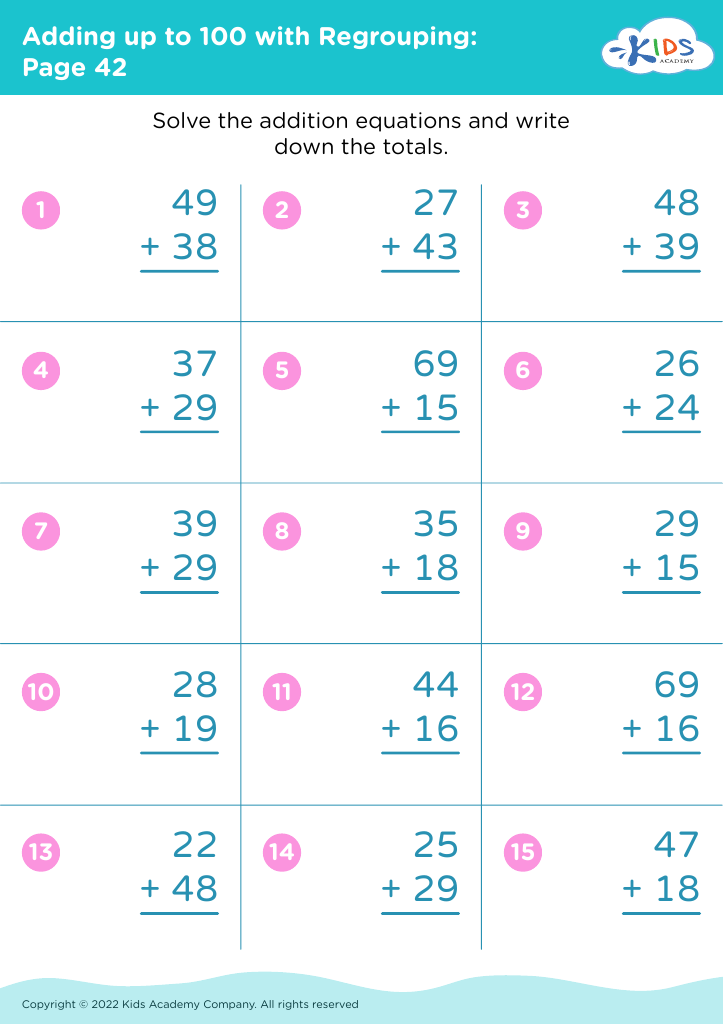
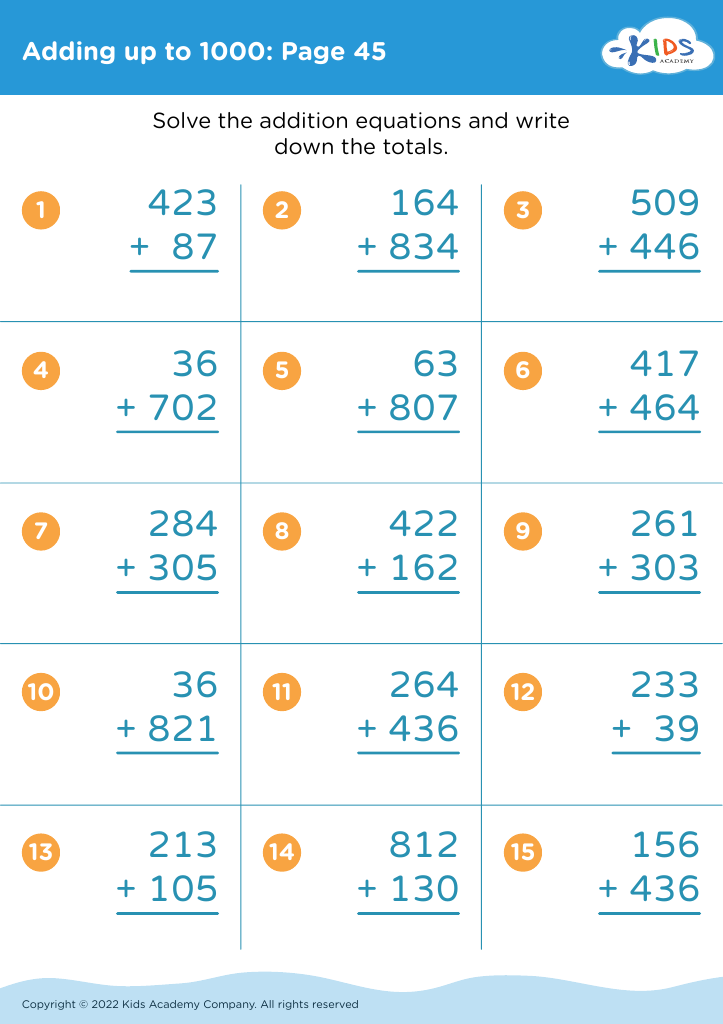
Boost your child's math skills with our engaging Spatial Awareness Addition Worksheets designed for ages 5-9. These carefully crafted worksheets combine the fundamentals of addition with spatial awareness exercises, helping kids understand the concepts of space, alignment, and positioning while practicing math. Ideal for early learners, the printable worksheets enhance problem-solving abilities and cognitive development, fostering a strong foundation in math through fun and interactive tasks. Suitable for both home and classroom use, these resources promise to keep young minds entertained and challenged, preparing them for more advanced mathematical concepts. Start building spatial and mathematical skills today!
Favorites
With answer key
Interactive
Join Kids Academy for Free
Who is primarily going to use this learning content?








Spatial awareness addition refers to the understanding of how objects relate to each other in space, including concepts of location, direction, distance, and orientation. This skill is essential for young children, especially ages 5-9, as it forms the cornerstone of many critical developmental and cognitive abilities.
Firstly, spatial awareness is crucial for day-to-day tasks such as navigating environments, playing sports, or even assembling puzzles. These activities enhance fine and gross motor skills which are fundamental for a child's physical development.
Academically, spatial awareness is directly linked to mathematics learning. Concepts such as geometry, measurement, and even number lines rely on a robust sense of space and relationship between objects. When children understand spatial relations, they can better grasp mathematical principles which are pivotal in problem-solving and logical thinking.
Furthermore, spatial abilities are vital for early literacy. Children with good spatial awareness can better understand the physical orientation of letters and words, which aids in reading and writing. For instance, differentiating between letters such as 'b' and 'd' involves spatial perception.
Moreover, spatial skills contribute to creativity and STEM (Science, Technology, Engineering, and Math) learning. Building blocks, drawing, and interactive games nurture these abilities, fostering an early interest in engineering and technology.
Hence, parents and teachers should prioritize activities that enhance spatial awareness, making learning engaging and setting the stage for future academic success.








