Eye-hand coordination Math Worksheets for Ages 5-9
3 filtered results
-
From - To
Enhance your child's learning experience with our Eye-Hand Coordination Math Worksheets, designed for ages 5-9! These engaging and interactive worksheets not only promote essential math skills but also strengthen physical coordination and fine motor skills. Tailored to foster a deeper understanding of math concepts, these exercises include fun activities such as tracing numbers, connecting dots, and solving simple equations. As children work through our thoughtfully crafted worksheets, they will improve their focus, concentration, and confidence in math. Perfect for classroom use or at-home learning, our resources are ideal for making math enjoyable and effective! Explore and download today's exciting worksheets!
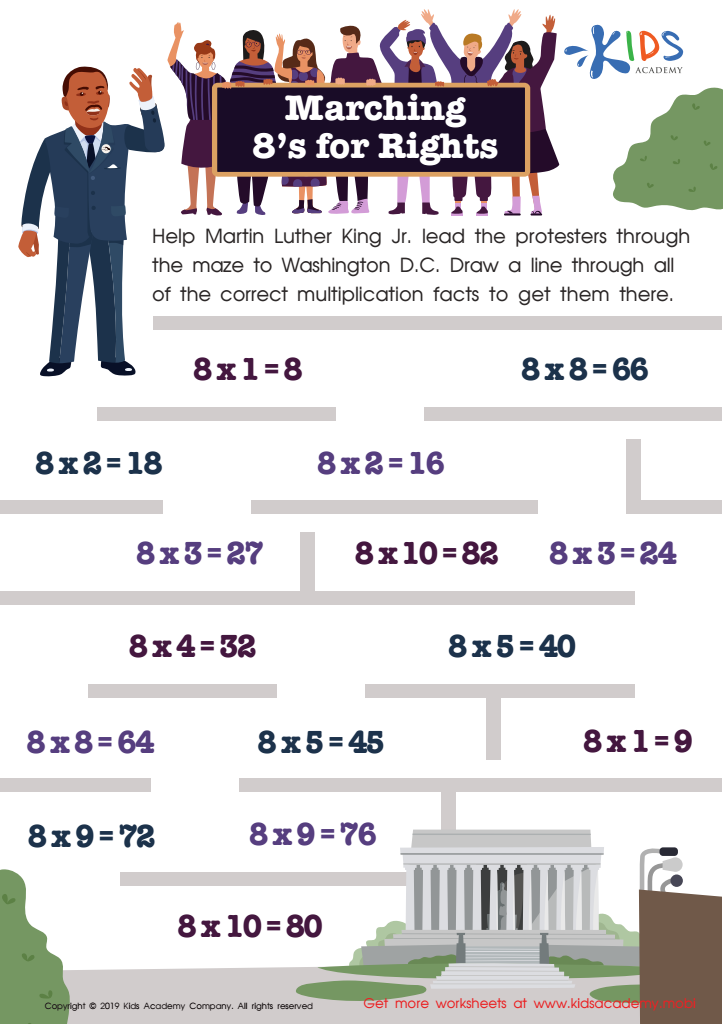
Marching 8’s for Rights Worksheet
 Assign to My Students








Eye-hand coordination is a crucial skill for children aged 5-9, as it significantly impacts their mathematical learning and overall development. This skill enhances a child's ability to perform tasks that require visual processing and motor function, both of which are essential in mathematics. For instance, when handling tools like rulers or manipulatives, or during activities such as drawing shapes or working with puzzles, strong eye-hand coordination enables children to engage more effectively with mathematical concepts.
Moreover, developing eye-hand coordination fosters patience and focus, which are vital for problem-solving and critical thinking. Children who master these skills early are often more confident in their abilities, leading to a positive attitude toward learning. Beyond academia, these motor skills translate into broader life skills, influencing children’s performance in sports and daily routines.
Parents and teachers should prioritize activities that nurture this coordination, such as crafting, building with blocks, or playing engaging games that require hand-eye precision. By doing so, they not only support a child’s mathematical growth but also contribute to their social, emotional, and physical development, laying a solid foundation for future learning and success. Thus, investing in eye-hand coordination is an investment in children's overall educational journey.








