
Improving observational skills Math Worksheets for Ages 5-9
3 filtered results
Difficulty Level
Grade
Age
-
From - To
Subject
Activity
Standards
Enhance your child's observational skills with our engaging math worksheets designed specifically for ages 5-9. These worksheets encourage young learners to sharpen their attention, detail recognition, and critical thinking through fun and interactive math activities. From identifying patterns and shapes to solving simple problems, each worksheet is crafted to cultivate critical observational skills while making learning enjoyable. Perfect for homeschooling or supplementary practice, our materials aim to boost confidence and facilitate a strong foundation in math. Explore our collection and watch your child enjoy the journey of discovery through observation while mastering essential math concepts!
Favorites
With answer key
Interactive
The Force of the 4's Worksheet
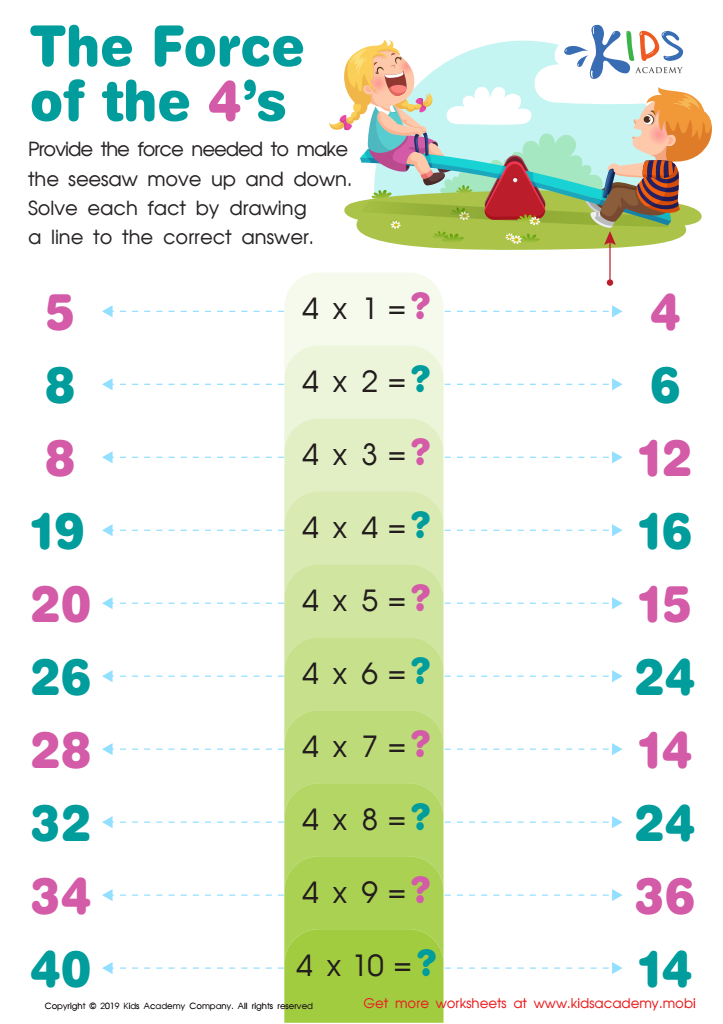
Ride a seesaw with your child and explore the physics behind it! Explain how it needs two people and how force makes it go up and down. Use the memories of the pleasurable experience to teach your kid a lesson in force. Show them how to solve the worksheet by drawing a line to the correct answer. This way, they'll learn the force needed for the seesaw to move.
 Assign to My Students
The Force of the 4's Worksheet
Worksheet
Join Kids Academy for Free
Who is primarily going to use this learning content?








Improving observational skills in mathematics for children aged 5-9 is crucial for several reasons. Firstly, these foundational years are critical for cognitive development, as young learners begin to form the basis for critical thinking and problem-solving skills. By fostering better observational skills, children become more adept at noticing patterns, relationships, and numerical concepts in their everyday environments.
Secondly, observational skills enhance mathematical understanding by enabling children to make connections between real-world experiences and abstract math concepts. For example, noticing shapes and counting objects during recreational play can lead to a deeper understanding of geometry and arithmetic.
Additionally, nurturing these skills promotes a child’s confidence and enthusiasm for learning. When they can observe and analyze their surroundings effectively, they are more likely to engage with challenging math tasks without fear. Furthermore, developing these skills collaboratively with parents or teachers through activities, games, and discussions can strengthen their relationship, making learning a joyous experience.
Ultimately, prioritizing observational skills in math not only prepares children for academic success, but also cultivates lifelong learners who are curious and competent in navigating the world around them. Parents and teachers play a pivotal role in instilling these vital skills during this formative stage of development.








