Understanding seasons Math Worksheets for Ages 5-9
5 filtered results
-
From - To
Our "Understanding Seasons Math Worksheets for Ages 5-9" blend seasonal themes with fundamental math skills, captivating young learners. These worksheets incorporate fun, engaging activities designed to improve numerical abilities, counting, addition, subtraction, and pattern recognition. Featuring vibrant illustrations and season-specific tasks, students can explore the magic of various times of the year while sharpening essential math concepts. Ideal for both classroom settings and home practice, our worksheets foster a love for learning and make math an exciting adventure. Equip your child with the skills to actively engage with the world around them, one season at a time.
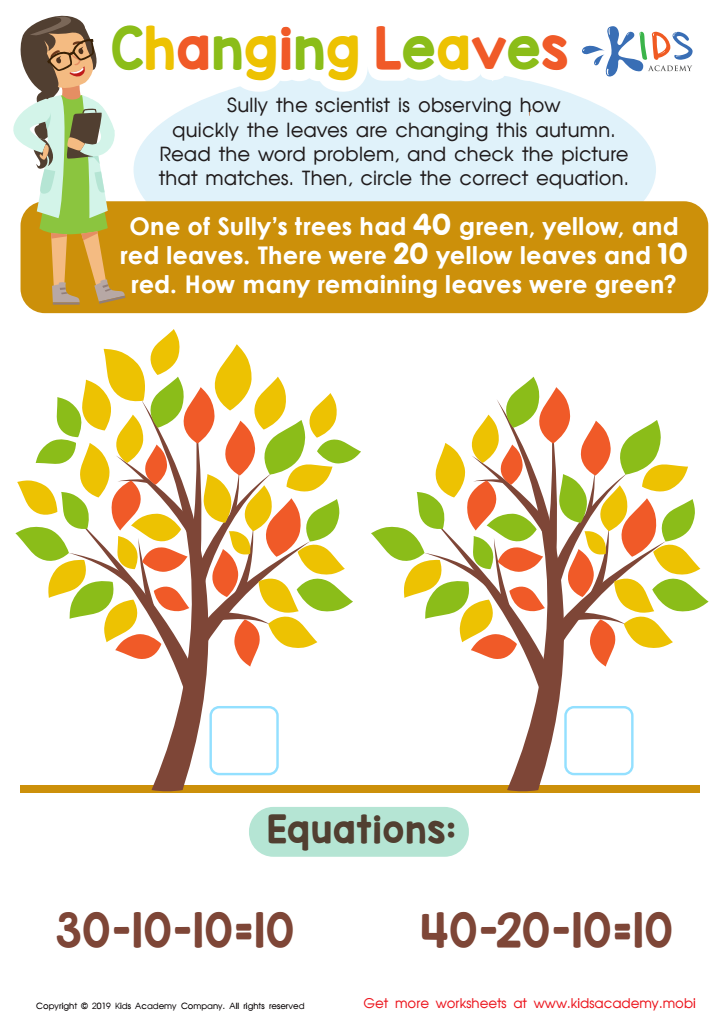
Changing Leaves Worksheet
 Assign to My Students
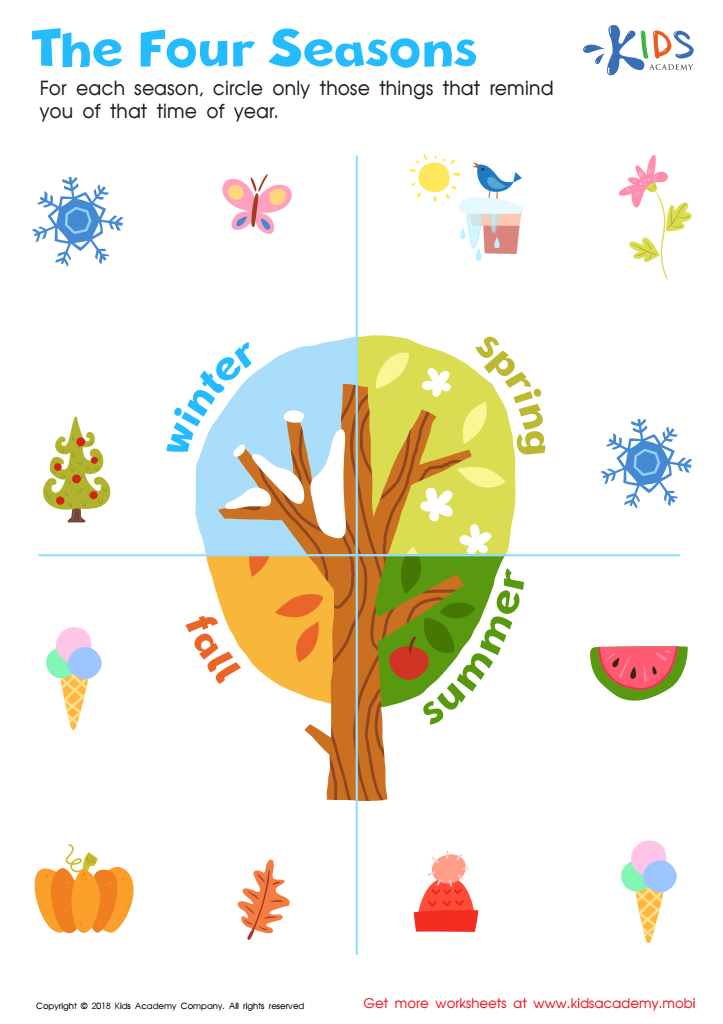
The Four Seasons Worksheet






Understanding seasons is not just a scientific or environmental concept; it also holds significant value in teaching math to young children aged 5-9. Parents and teachers should emphasize this because it enhances several core skills in an engaging and relatable manner.
First, learning about seasons helps develop their understanding of time. Seasons provide a natural framework through which children can grasp cyclical patterns and periods, concepts central to time-related math skills. For instance, knowing that a year comprises four seasons promotes the idea of division and sequencing.
Secondly, seasons offer practical examples for measurement and data collection. Children can track temperature changes, daylight hours, and rainfall, incorporating real data into simple charts or basic math problems. This helps children grasp abstract mathematical concepts by linking them to real-world phenomena.
Additionally, discussing the seasons can help in geographical and spatial awareness. Children learn about Earth's tilt, orbit, and how different regions experience different weather patterns at the same time. Such discussions foster spatial reasoning, an important mathematical skill.
Moreover, integrating seasons in math lessons makes learning interactive and enjoyable. Outdoor activities like measuring shadows or collecting leaves can be both educational and fun, thus promoting a positive attitude toward math from an early age.
By understanding seasons, math becomes more than numbers and equations; it becomes a way to understand and predict the world around them. This practical relevance is crucial in fostering long-term interest and competence in math.








