
Understanding opposites Measurement Worksheets for Ages 5-9
3 filtered results
Difficulty Level
Grade
Age
-
From - To
Subject
Activity
Standards
Discover our engaging "Understanding Opposites Measurement Worksheets" designed for children aged 5-9! These worksheets introduce kids to the concept of opposites in various contexts, helping them develop critical thinking and observational skills. With fun activities that cover comparisons such as big vs. small, hot vs. cold, and more, your child will learn to identify and understand contrasting measurements. Perfect for at-home learning or classroom activities, these worksheets foster creativity while reinforcing important mathematical concepts. Ensure your young learners grasp the basics of measurement through interactive exploration and practical examples that make learning enjoyable and effective! Download today and spark curiosity!
Favorites
With answer key
Interactive
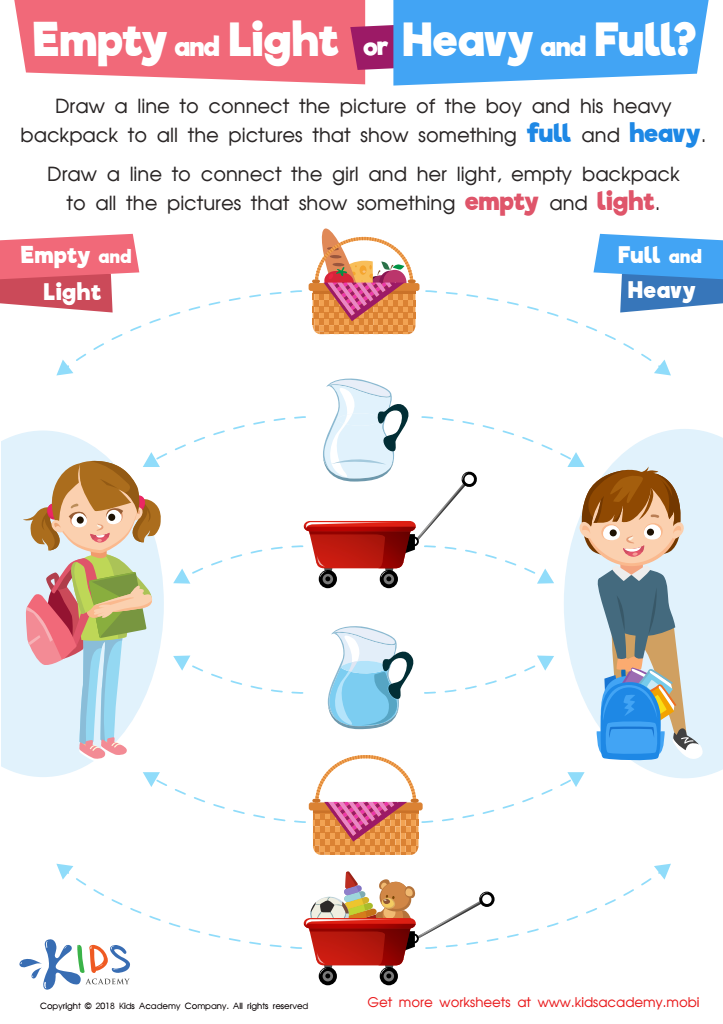
Empty and Light or Heavy and Full? Worksheet
Kids can have trouble understanding measurement, like the differences between heavy and light. This worksheet helps them associate full with heavy and empty with light, using familiar images. Plus, it's a fun way to practice fine motor skills, tracing the lines to connect the pictures.
 Assign to My Students
Empty and Light or Heavy and Full? Worksheet
Worksheet
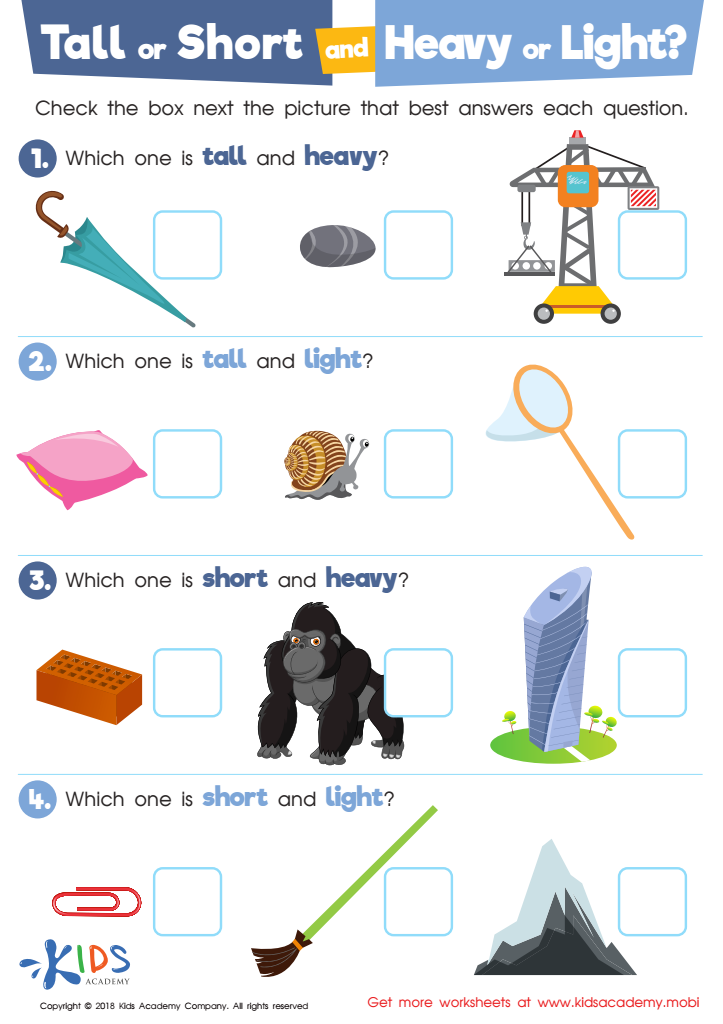
Tall or Short and Heavy or Light? Worksheet
Young children can find basic measurement concepts tricky. This PDF introduces them to the appropriate vocabulary for describing heavy, light, tall and short items, by using familiar pictures. It helps them accurately select which items fit each category.
Tall or Short and Heavy or Light? Worksheet
Worksheet
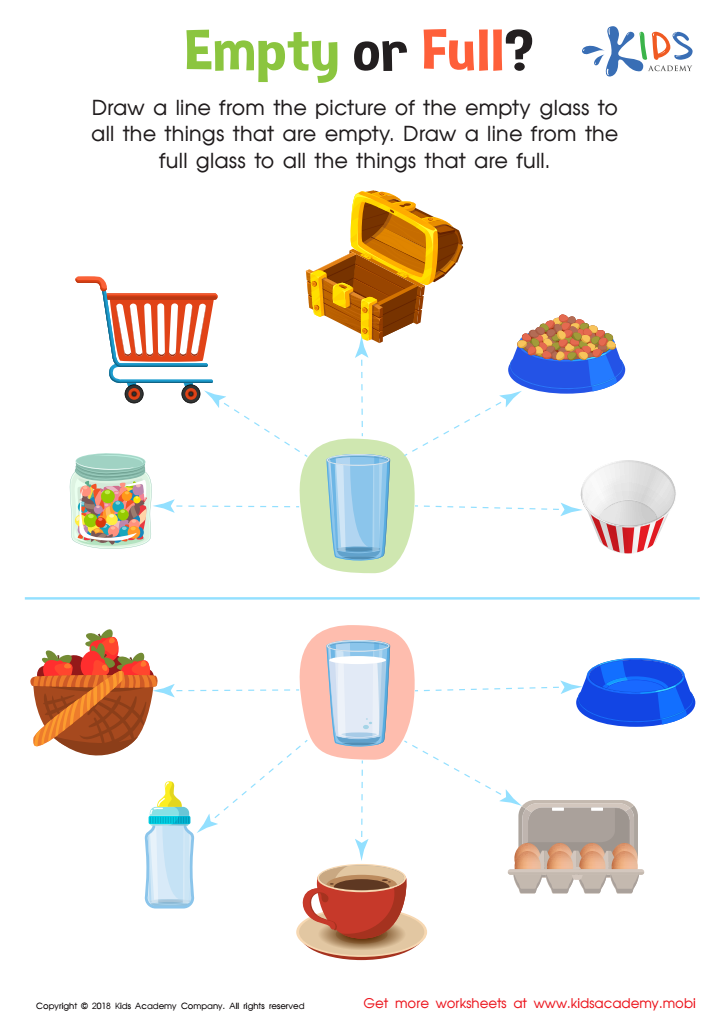
Empty or Full? Worksheet
Let students get to grips with the concepts of empty and full with this PDF worksheet. It uses fun, bright pictures to help them comprehend the difference and also helps develop fine-motor skills with tracing lines. Kids will be proud of themselves as they get answers right!
Empty or Full? Worksheet
Worksheet
Join Kids Academy for Free
Who is primarily going to use this learning content?








Understanding opposites and measurement is crucial for young children, as it lays the foundation for critical cognitive skills and real-world applications. For parents and teachers of children aged 5-9, grasping these concepts is not just about academic knowledge; it's about helping children navigate their surroundings.
Firstly, the concept of opposites—such as hot/cold, big/small, and light/heavy—helps children develop vocabulary and enhances their ability to categorize information, which is vital for problem-solving. Recognizing opposites fosters critical thinking, as children learn to compare and contrast various attributes.
Additionally, measurement introduces children to understanding quantities, comparisons, and spatial awareness. Learning about “long/short,” “time,” and even basic math concepts enhances their numerical literacy essential for future learning. Measurement activities—like comparing heights of friends or durations of playtime—make math concrete and enjoyable, reinforcing knowledge through hands-on experiences.
Ultimately, engaging with opposites and measurement supports children's overall development, encouraging curiosity and collaboration. Parents and teachers play an instrumental role in creating learning environments that promote these concepts, preparing children not only for future academic success but also for navigating life’s everyday challenges. By making these foundational skills engaging, adults can inspire a lifelong love of learning.








