
Noun identification Grammar Worksheets for 5-Year-Olds
4 filtered results
Difficulty Level
Grade
Age
-
From - To
Subject
Activity
Standards
Discover our engaging Noun Identification Grammar Worksheets designed specially for 5-year-olds at Kids Academy. Our expertly crafted activities help young learners identify and understand nouns through fun, colorful, and interactive exercises. Through these worksheets, children will explore various types of nouns while practicing essential grammar skills. Our resources are perfect for both classroom and home use, ensuring that children develop a strong foundation in language arts at an early age. Give your child the boost they need in mastering noun identification with our delightful and effective worksheets. Visit Kids Academy today to access these invaluable learning tools!
Favorites
With answer key
Interactive
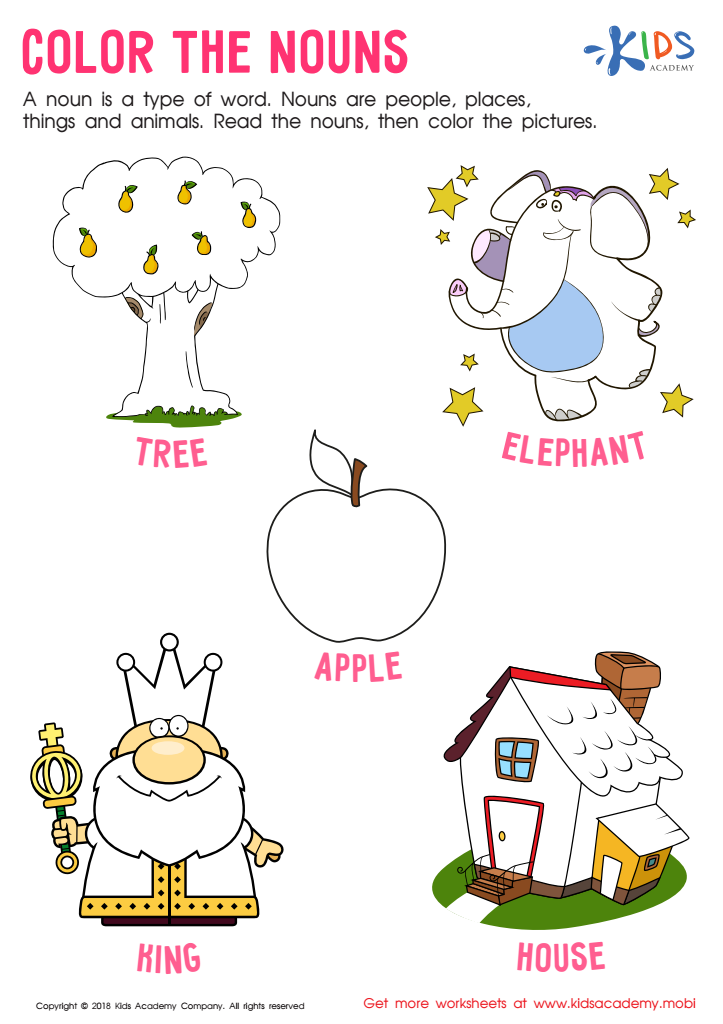
Color the Nouns Worksheet
Test your child's understanding of nouns with this downloadable worksheet. Explain that nouns are words for people, places, animals and things. With the coloring sheet, read each word and color the corresponding picture. By the end of it, your child should be able to recognize common nouns.
Download (PDF)
 Assign to My Students
Assign to My Students
Color the Nouns Worksheet
Worksheet
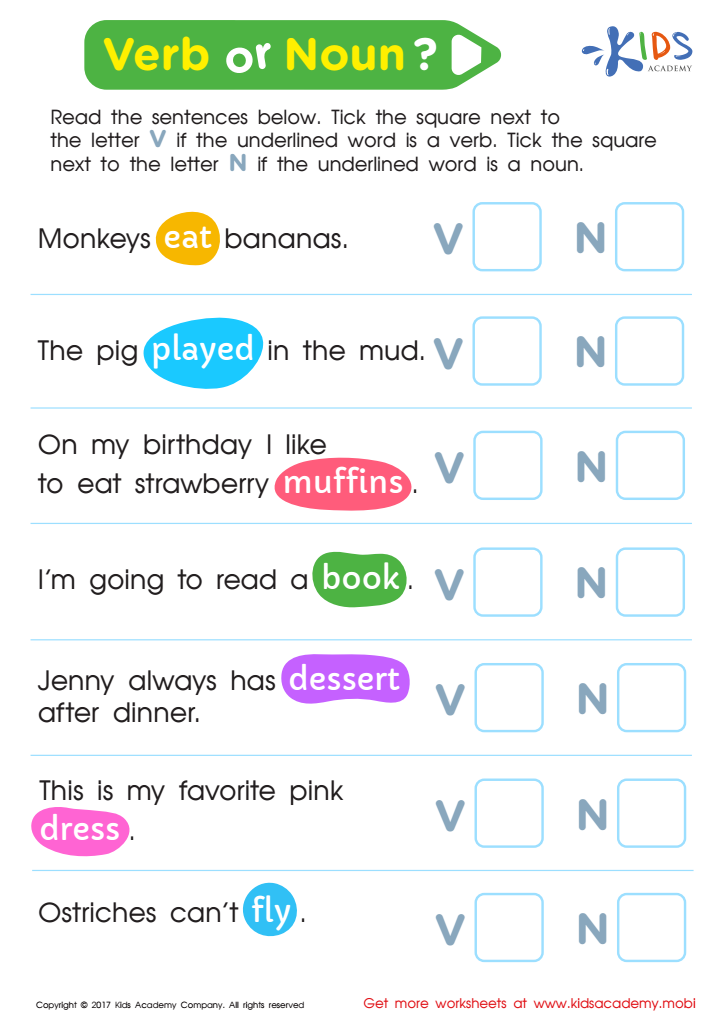
Verb or Noun Worksheet
This worksheet will help your child identify verbs and nouns quickly. With colorful highlights and simple sentences, they'll master parts of speech in no time! Get ahead of the game with this incredible worksheet.
Verb or Noun Worksheet
Worksheet
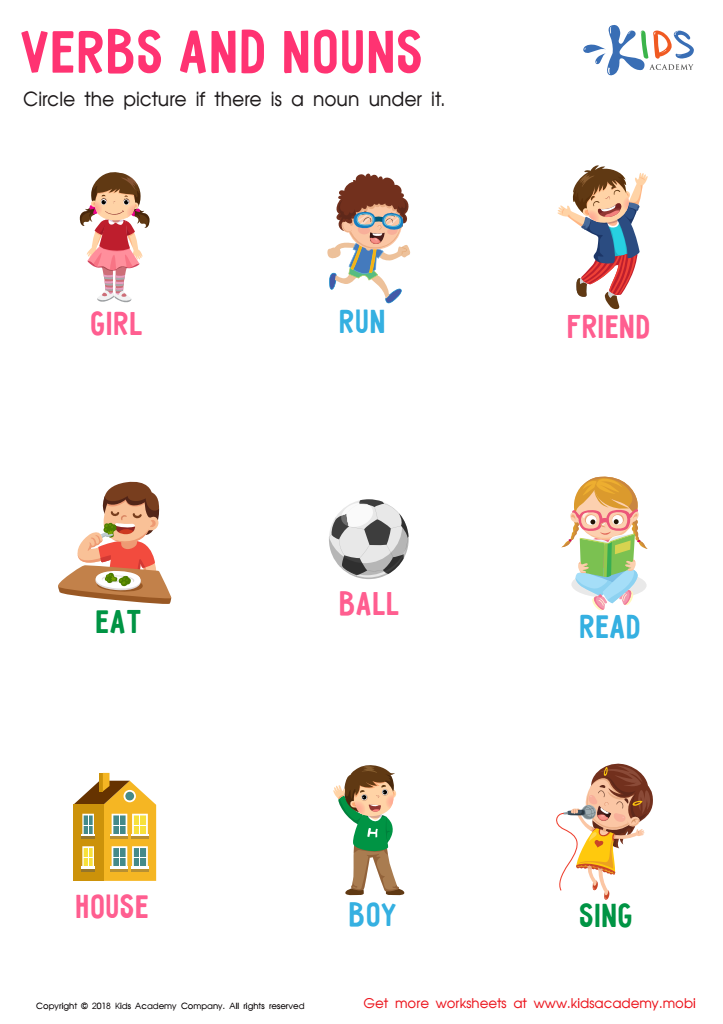
Verbs and Nouns Worksheet
Your child should have basic knowledge of verbs and nouns before starting this worksheet. Go through it with them and ask them to circle the pictures with nouns under them. This way, they'll become more familiar with parts of speech.
Verbs and Nouns Worksheet
Worksheet
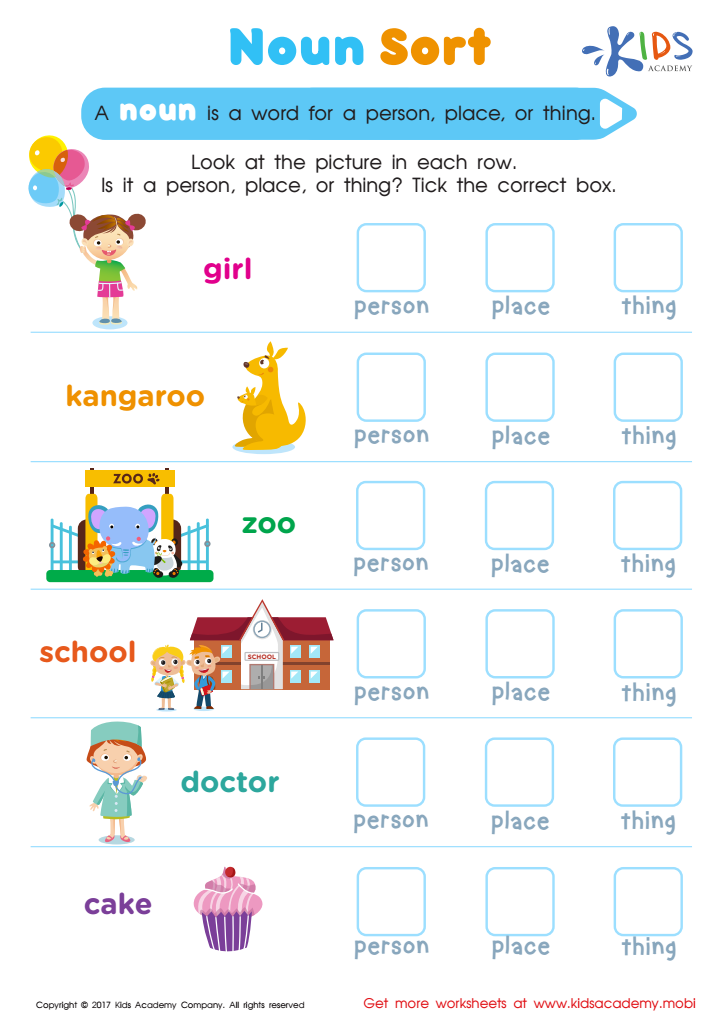
Noun Sort Printable
This printable worksheet helps kids sort nouns into person, place, or thing categories. Perfect for learning the basics of grammar!
This printable worksheet helps kids learn parts of speech by sorting nouns into person, place, or thing categories using familiar images. Perfect for mastering basic grammar!
Noun Sort Printable
Worksheet
Join Kids Academy for Free
Who is primarily going to use this learning content?







Noun identification plays a crucial role in the early stages of language development for 5-year-olds. At this age, children are rapidly expanding their vocabularies and learning the basic building blocks of sentences. Teaching them to identify nouns—the words that name people, places, things, and ideas—lays a strong foundation for their future grammatical understanding and language skills.
When children can identify nouns, they gain a better grasp of sentence structure. For instance, knowing that "dog" is a noun helps them understand that a noun often functions as a subject in a sentence, like in “The dog runs.” This understanding is essential for constructing coherent and meaningful sentences.
Early noun identification also enhances reading comprehension. When children recognize nouns in stories, they can better visualize and understand the text, making reading a more enjoyable and effective learning experience.
Furthermore, familiarity with nouns supports vocabulary development. By learning various nouns, children expand their knowledge of the world around them, stimulating curiosity and conversations that promote cognitive and social growth.
In summary, focusing on noun identification at a young age aids in sentence structure understanding, improves reading comprehension, and enriches vocabulary—important aspects that collectively support a child's overall communication skills and academic success.








