
Fraction Addition Worksheets for Ages 6-7
18 filtered results
Difficulty Level
Grade
Age
-
From - To
Subject
Activity
Standards
Introduce your child to the fascinating world of fractions with our engaging Fraction Addition Worksheets, designed specifically for ages 6-7! These worksheets offer a variety of fun exercises that help young learners understand the concept of adding fractions with both like and unlike denominators. Each activity encourages critical thinking and problem-solving skills while promoting confidence in math. With vibrant visuals and easy-to-follow instructions, your child will enjoy mastering fractions in no time. Perfect for classroom use or at-home practice, these printable worksheets are an invaluable resource for any early grade teacher or parent looking to enhance their child's math skills!
Favorites
With answer key
Interactive
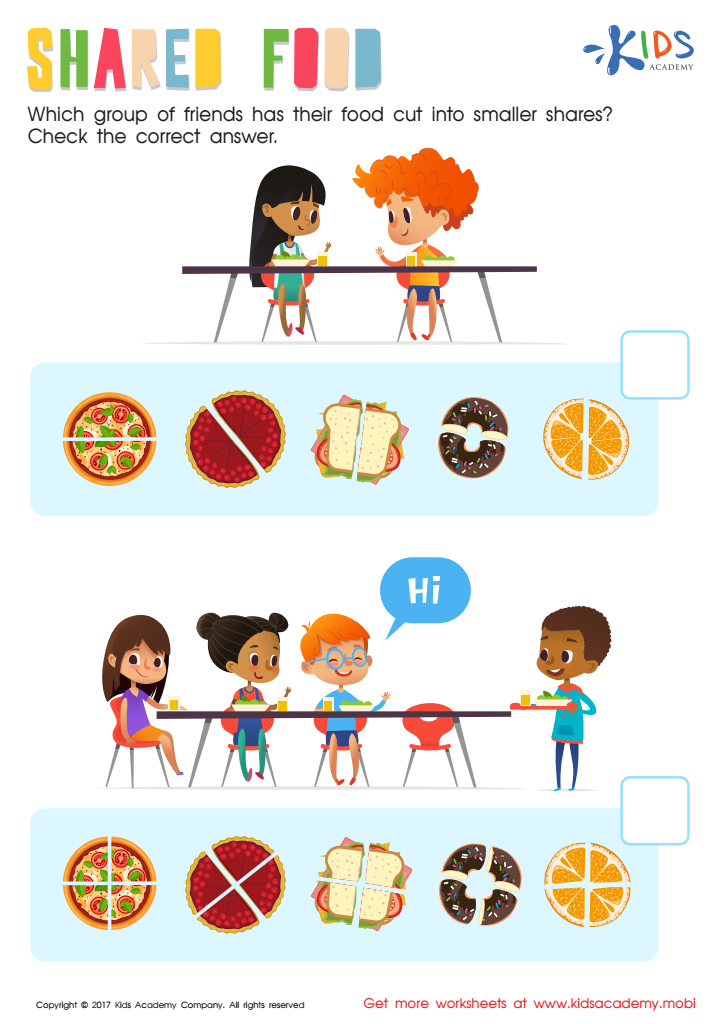
Shared Food Worksheet
In this worksheet, kids learn about sharing and cutting shapes into equal parts. There are two groups of friends: one with two, the other with four. Ask your child which group has their food cut into smaller shares, and help them find the right answer.
 Assign to My Students
Shared Food Worksheet
Worksheet
Join Kids Academy for Free
Who is primarily going to use this learning content?








Parents and teachers should prioritize fraction addition for children aged 6-7 because it lays a crucial foundation for later mathematical understanding. At this age, children are beginning to develop number sense and the ability to comprehend parts of a whole. Introducing fraction addition early helps them understand concepts of sharing, division, and proportionality.
For instance, when children learn to add simple fractions, they experience firsthand how numbers can be combined in practical scenarios, such as sharing food or toys. This hands-on application makes learning more engaging and applicable to real life. Engaging with fractions encourages critical thinking and problem-solving, skills that are essential not only in math but also in everyday decision-making.
Additionally, mastering fractions at a young age can demystify more complex concepts they will encounter as they progress in school, such as variables, ratios, and percentages. By fostering a solid grasp of fraction addition, parents and teachers can build confidence in students, nurturing a love for math that often leads to academic success. Ultimately, a strong early foundation in fractions cultivates logical thinking, which is invaluable in today’s increasingly analytical world.








