Fraction comparison Worksheets for Ages 6-7 - Page 2
41 filtered results
-
From - To
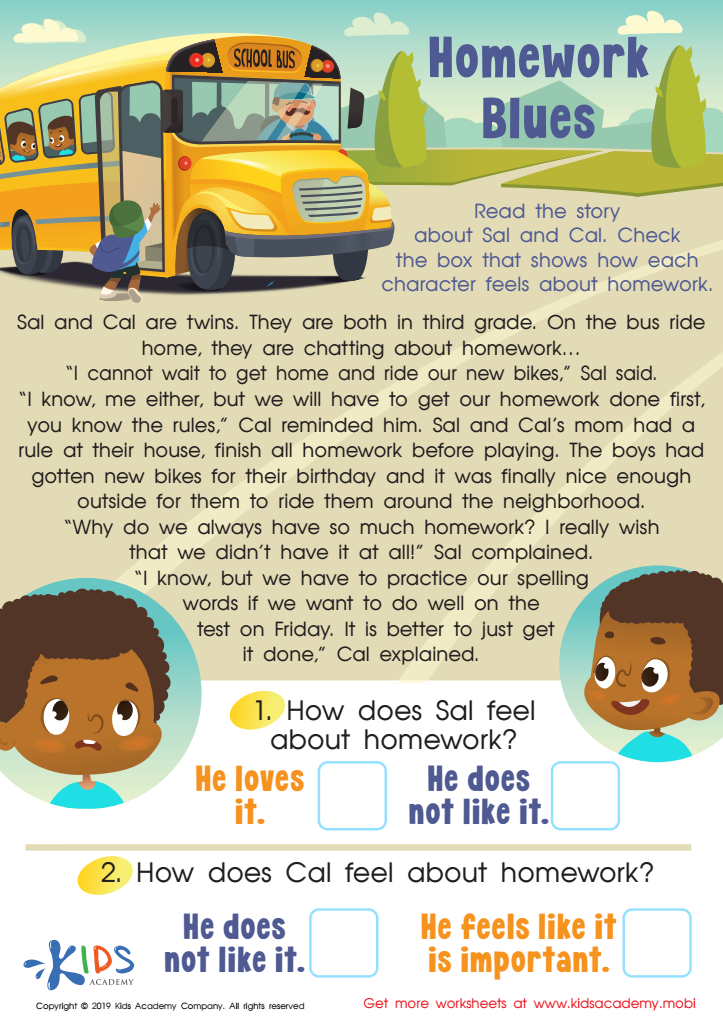
Homework Blues Worksheet
 Assign to My Students




.jpg)


Understanding fraction comparison is essential for children ages 6-7 as it lays the groundwork for their future mathematical skills and critical thinking abilities. At this early stage, students develop their conceptual understanding of numbers. By comparing fractions, they learn to recognize part-to-whole relationships, which is crucial for their understanding of basic math and everyday scenarios, such as sharing equally or measuring ingredients.
Teachers and parents play a pivotal role in nurturing these skills. It not only enhances mathematical comprehension but also boosts logical reasoning and problem-solving abilities. When children compare fractions, they learn to analyze and make decisions based on quantifiable information, fostering confidence and independence in their mathematical capabilities.
Furthermore, understanding fraction comparison introduces them to key concepts like equivalence, largest/smallest values, and the idea of benchmarks (e.g., 1/2). These concepts are foundational for more advanced topics in mathematics, such as addition and subtraction of fractions. If parents and teachers actively engage with and emphasize these competences, they help cultivate a positive and resilient attitude toward learning math—an essential skill that benefits children across all aspects of their education. Engaging activities and discussions around fractions can make learning enjoyable and impactful.








