
Problem solving enhancement Worksheets for Ages 6-7
3 filtered results
Difficulty Level
Grade
Age
-
From - To
Subject
Activity
Standards
Enhance your child’s critical thinking and problem-solving skills with our engaging worksheets designed for ages 6-7! Our Problem Solving Enhancement Worksheets feature a variety of fun activities that encourage creativity and analytical thinking. Featuring age-appropriate puzzles, scenarios, and challenges, these worksheets aim to stimulate your child’s cognitive abilities and boost their confidence. Perfect for use at home or in the classroom, the worksheets promote interactive learning while aligning with educational standards. Watch as your child develops essential skills that will benefit them throughout their educational journey! Start exploring our collection today and transform learning into a fun adventure!
Favorites
With answer key
Interactive
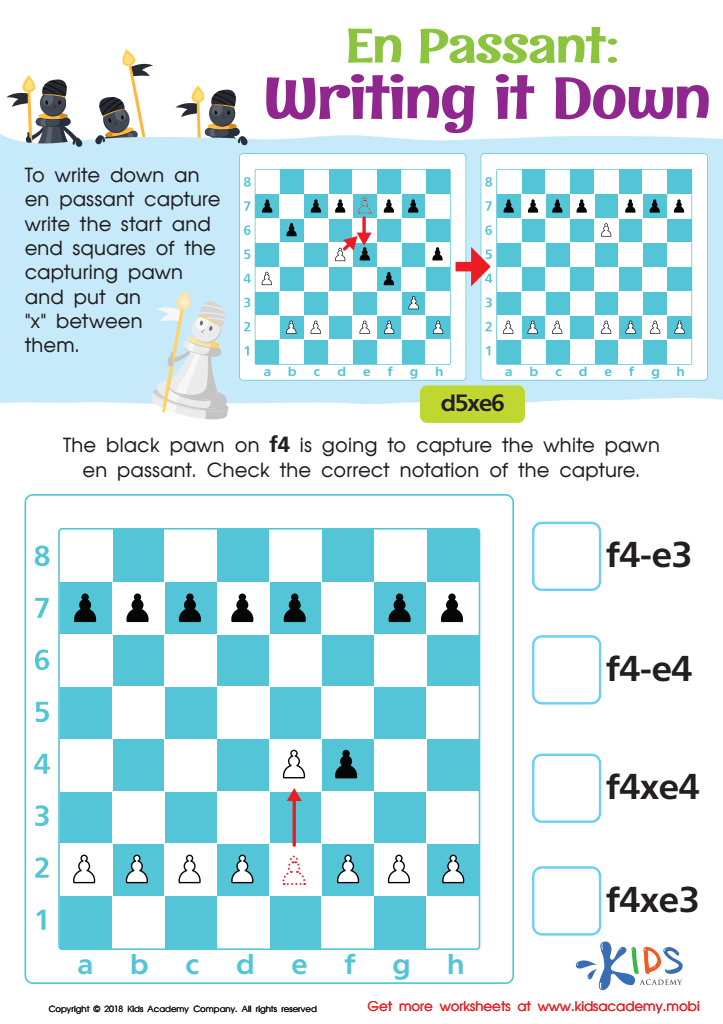
En Passant: Writing it Down Worksheet
Properly documenting moves in chess is often overlooked. En passant captures require your child to note the starting and ending squares (e.g. d5xe6) with an "X" in between them. Ask your children to review the worksheet and ensure they've notated the captures correctly. (80 words)
 Assign to My Students
En Passant: Writing it Down Worksheet
Worksheet
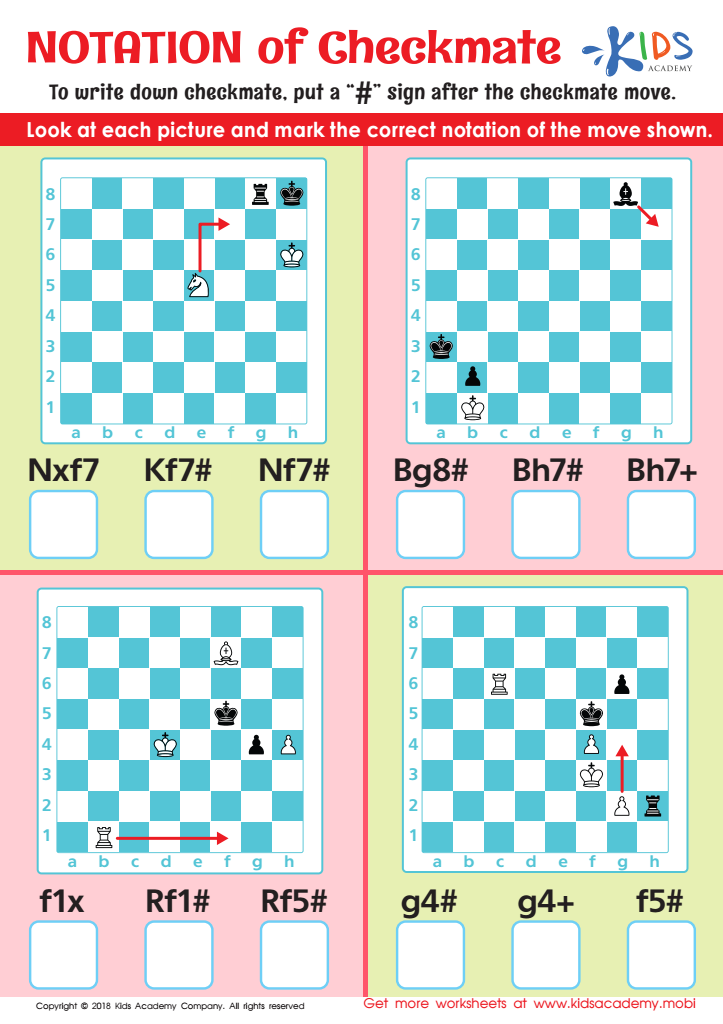
Notation of Checkmate Worksheet
Checkmate is the thrilling, ultimate move in chess! Teach your child to make it and notate it properly with this free worksheet. They'll love being able to capture the king and it's great for brain-building too! Have them look at the sample boards and place a # sign after the checkmate move for notation.
Notation of Checkmate Worksheet
Worksheet
Join Kids Academy for Free
Who is primarily going to use this learning content?






.jpg)

Problem-solving enhancement for children aged 6-7 is crucial for their cognitive and emotional development. At this age, children are beginning to think more independently and critically. By fostering problem-solving skills, parents and teachers can help children build resilience and adaptability, equipping them to tackle challenges throughout their lives.
In the early grades, children encounter various problems in school, from basic math challenges to social interactions. Developing problem-solving abilities allows them to approach these issues systematically. Engaging in activities that promote problem-solving encourages children to ask questions, hypothesize, experiment, and draw conclusions. This enhances their analytical thinking and creativity.
Furthermore, problem-solving skills contribute to emotional intelligence. When children learn to navigate obstacles, they cultivate persistence and realize that failure is a stepping stone to success. By creating a supportive environment, adults can encourage meaningful discussions around problem-solving and provide strategies for conflict resolution and decision-making.
Lastly, these skills lay a strong foundation for future learning. Encouraging problem-solving in early education promotes lifelong learning habits, preparing children to face increasingly complex challenges in later years. By prioritizing problem-solving enhancement, parents and teachers help shape a generation of thoughtful, capable individuals ready to thrive in an ever-changing world.








