Addition Practice Adding up to 1000 with Regrouping Worksheets for Ages 6-7
3 filtered results
-
From - To
Unlock your child's math potential with our "Addition Practice Adding up to 1000 with Regrouping Worksheets," designed specifically for ages 6-7! These engaging worksheets help young learners master regrouping techniques while building their addition skills. Through a variety of fun exercises, children will gain confidence in their abilities and learn to solve problems involving two- and three-digit numbers. With clear instructions and vibrant visuals, our resources make learning both effective and enjoyable. Supporting foundational math skills at an early age helps pave the way for future academic success. Get started today and let the numbers add up to fun and learning!
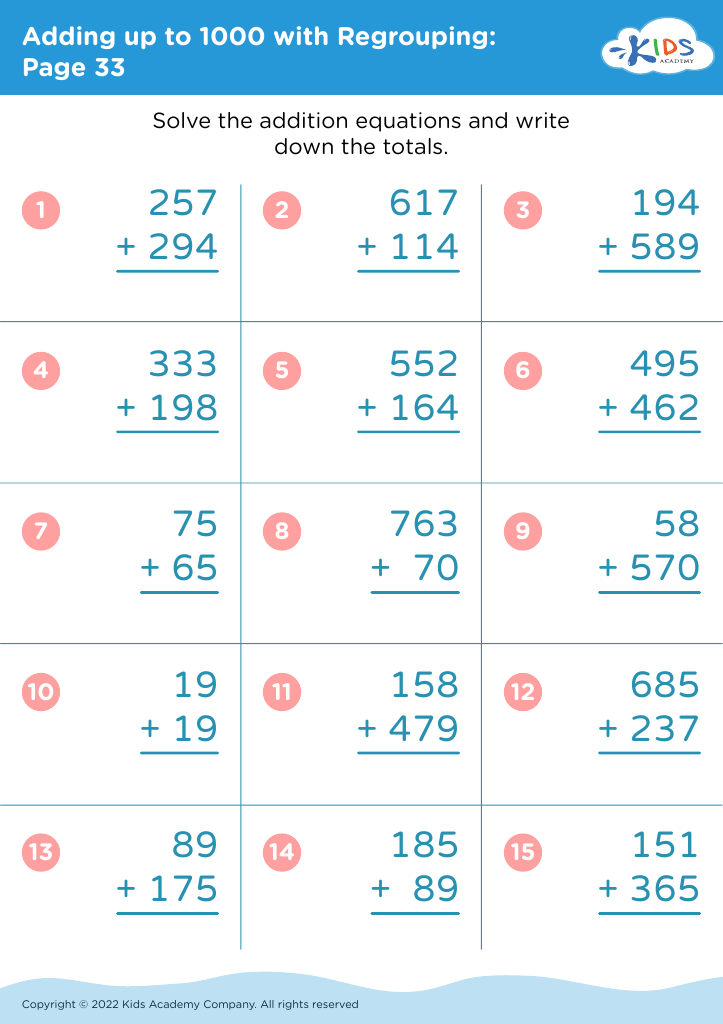
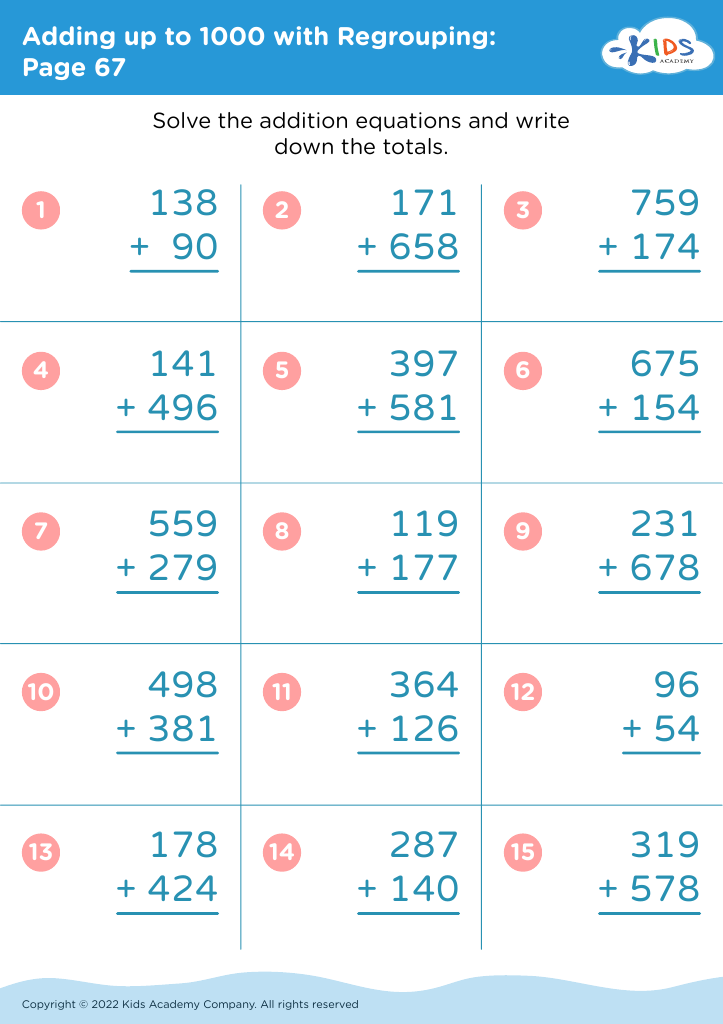
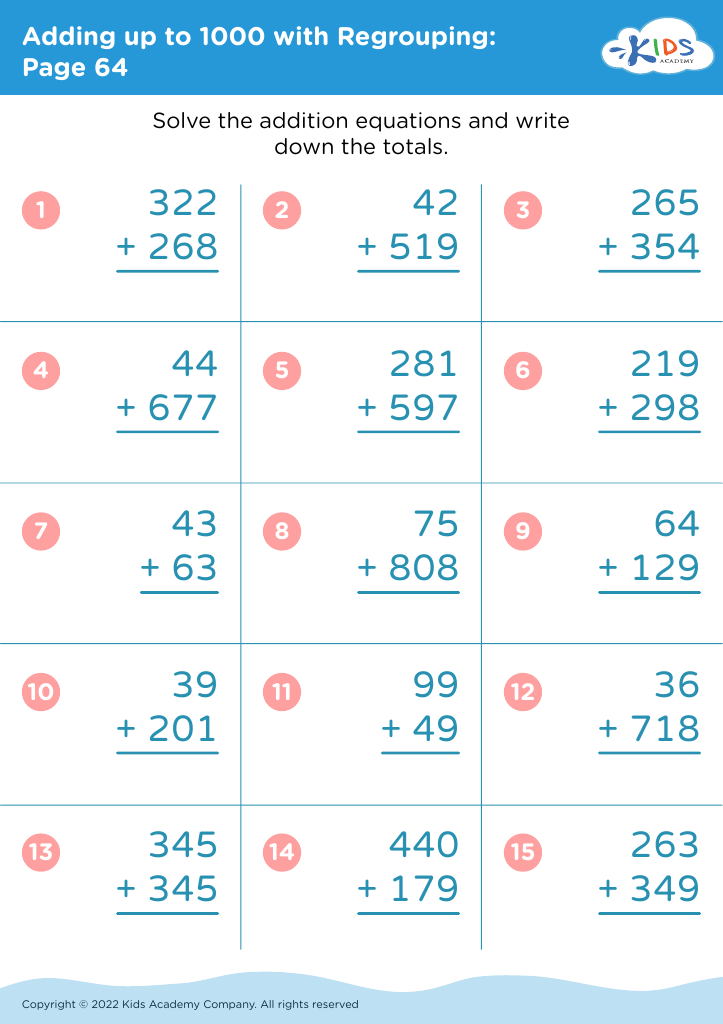


Addition practice, particularly for sums up to 1000 with regrouping, is vital for children aged 6-7 as it lays the foundation for their mathematical understanding. At this age, children are developing their cognitive skills and enhancing their ability to think critically and solve problems. Mastery of addition involving regrouping helps students gain confidence in handling larger numbers, which is crucial as they progress to more complex math concepts.
Moreover, this skill reinforces number sense, enabling children to understand place value and the role of each digit in a number. This knowledge is essential for future math topics such as subtraction, multiplication, and even division. As they practice regrouping, children learn strategies to break down numbers, making seemingly challenging problems more manageable.
Additionally, engaging in guided addition practice fosters a supportive learning environment where parents and teachers can provide encouragement and constructive feedback, helping children develop a positive attitude towards math. In today's data-driven world, being proficient in arithmetic is a valuable life skill that impacts academic performance, financial literacy, and problem-solving abilities later in life. Thus, investing time in these foundational skills not only enhances a child's educational journey but also prepares them for lifelong success in mathematics and beyond.