Develop counting skills Adding up to 1000 Without Regrouping Worksheets for Ages 6-7
3 filtered results
-
From - To
Explore our engaging "Develop Counting Skills: Adding Up to 1000 Without Regrouping Worksheets" designed specifically for 6- to 7-year-olds! These worksheets provide a fun and interactive way for young learners to master addition skills, focusing on summing up to 1000 without regrouping. Through neatly structured exercises and visually appealing graphics, children will enhance their counting abilities, improve number recognition, and build a solid foundation in math. Perfect for classroom activities or at-home practice, these worksheets encourage independent learning and boost confidence in mathematical concepts. Unlock your child's potential and make learning math an enjoyable experience!
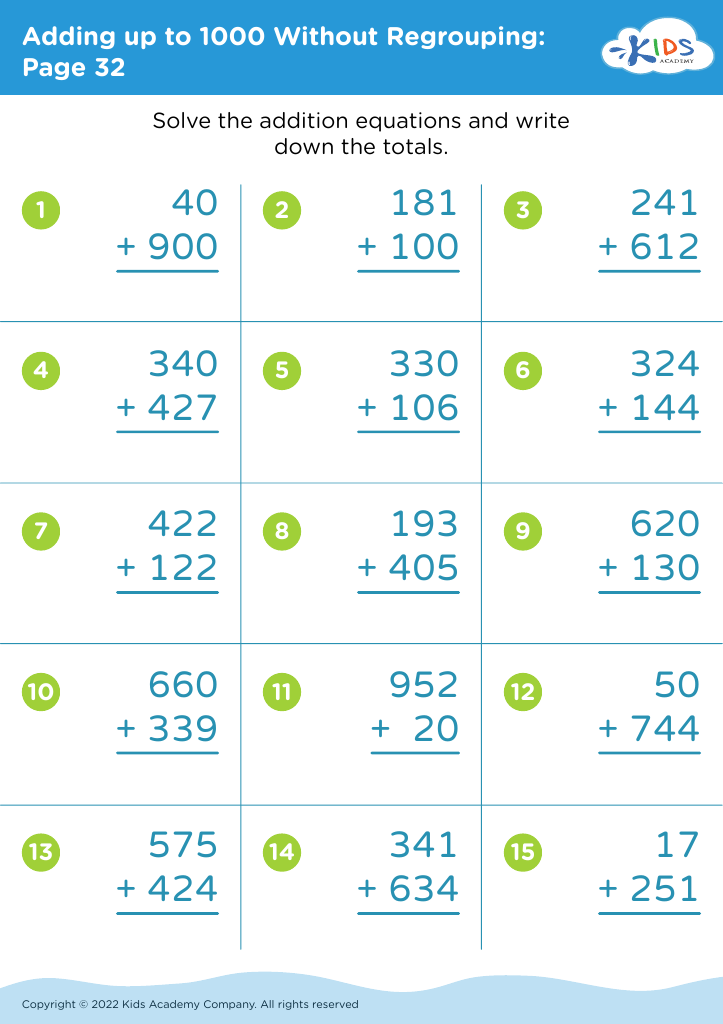
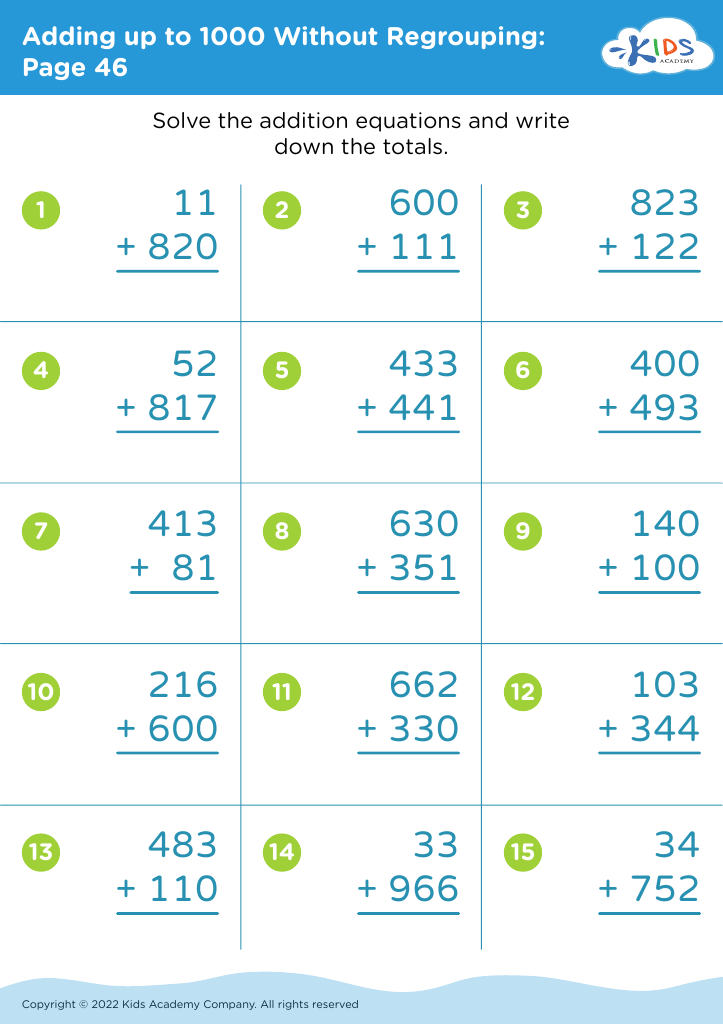
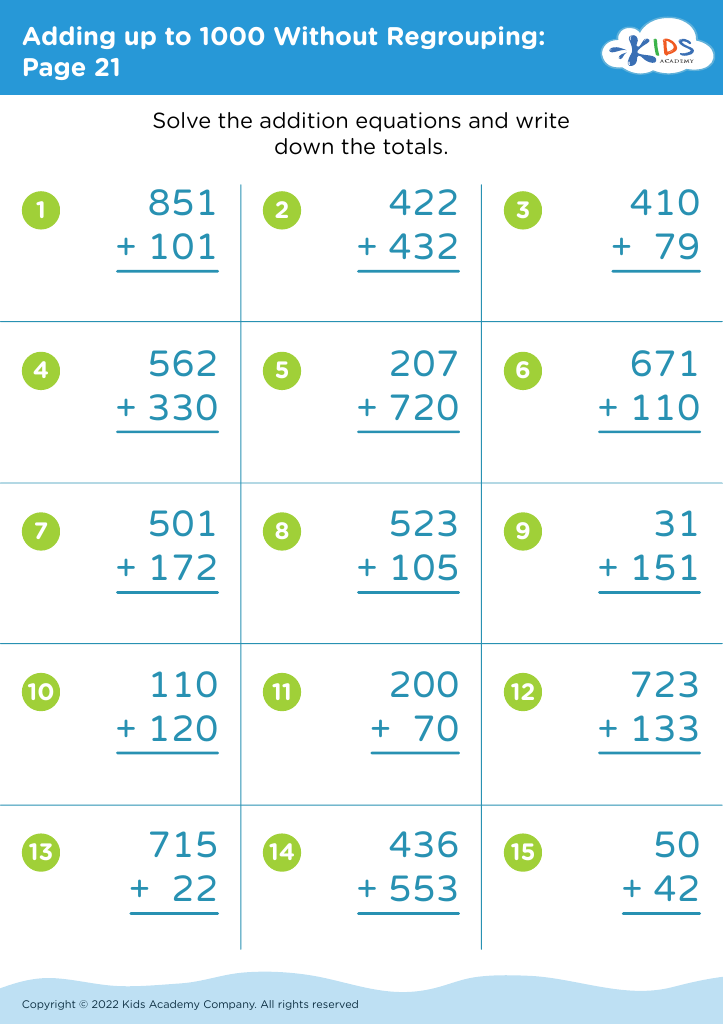


Developing counting skills, particularly adding up to 1000 without regrouping, is crucial for children aged 6-7. Firstly, these skills serve as foundational elements of mathematics, influencing their future mathematical understanding. Discerning how to count and add efficiently boosts children's confidence, fostering a positive attitude towards math.
Additionally, mastering counting without regrouping enhances mental math abilities, enabling children to perform quicker calculations. This is essential in increasingly complex math problems they will encounter as they progress in school.
Moreover, strong counting and addition skills are directly connected to real-life applications. Children encounter situations where they need to add quantities—whether during shopping, cooking, or managing allowances—strengthening their practical understanding and problem-solving abilities.
Parents and teachers play a key role in reinforcing these skills. Engaging children in fun, hands-on activities, such as counting objects or playing math games, makes learning enjoyable and effective. Paying attention to their counting mastery ensures they are well-prepared for future challenges, ultimately setting them up for academic success in mathematics and beyond. Thus, fostering these essential skills should be a high priority for both parents and educators.