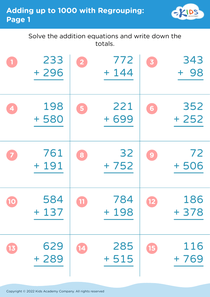
Improving counting skills Adding up to 1000 Without Regrouping Worksheets for Ages 6-7
4 filtered results
-
From - To
Enhance your child’s counting skills with our “Improving Counting Skills: Adding Up to 1000 Without Regrouping” worksheets, specifically designed for ages 6-7. These engaging and intuitive resources help young learners practice addition confidently and accurately, reinforcing essential mathematical concepts. With a focus on numbers up to 1000, our worksheets provide a variety of problems that eliminate the complications of regrouping, allowing children to build a solid foundation in arithmetic. Perfect for homeschooling, classroom use, or extra practice at home, these worksheets are a fun and effective way to foster a love for math in early learners. Get started today!
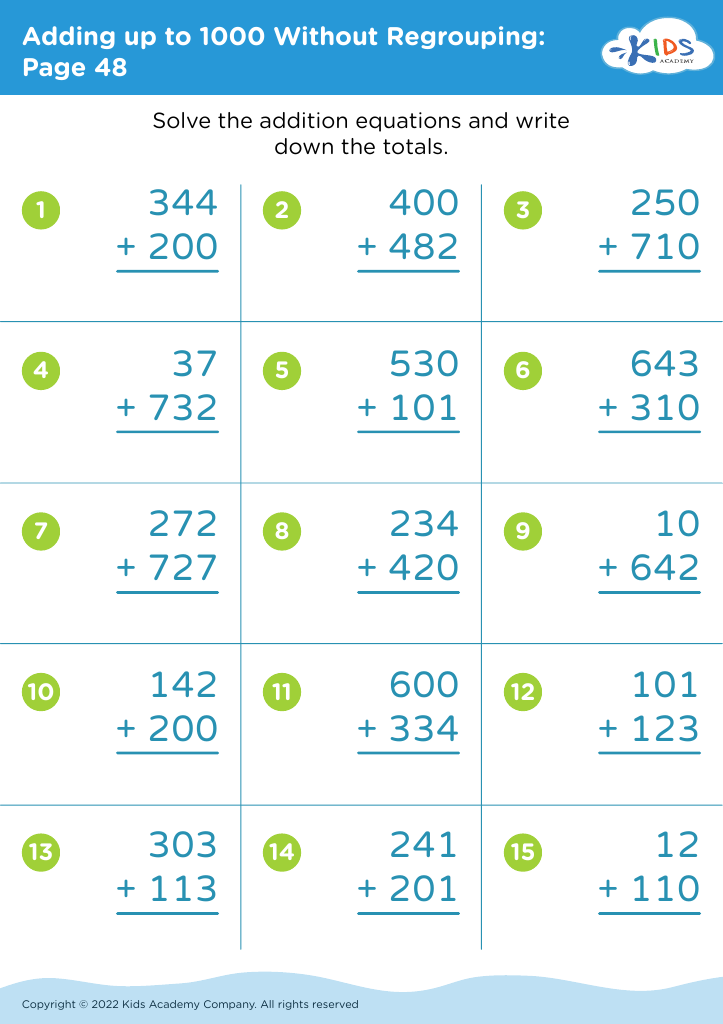
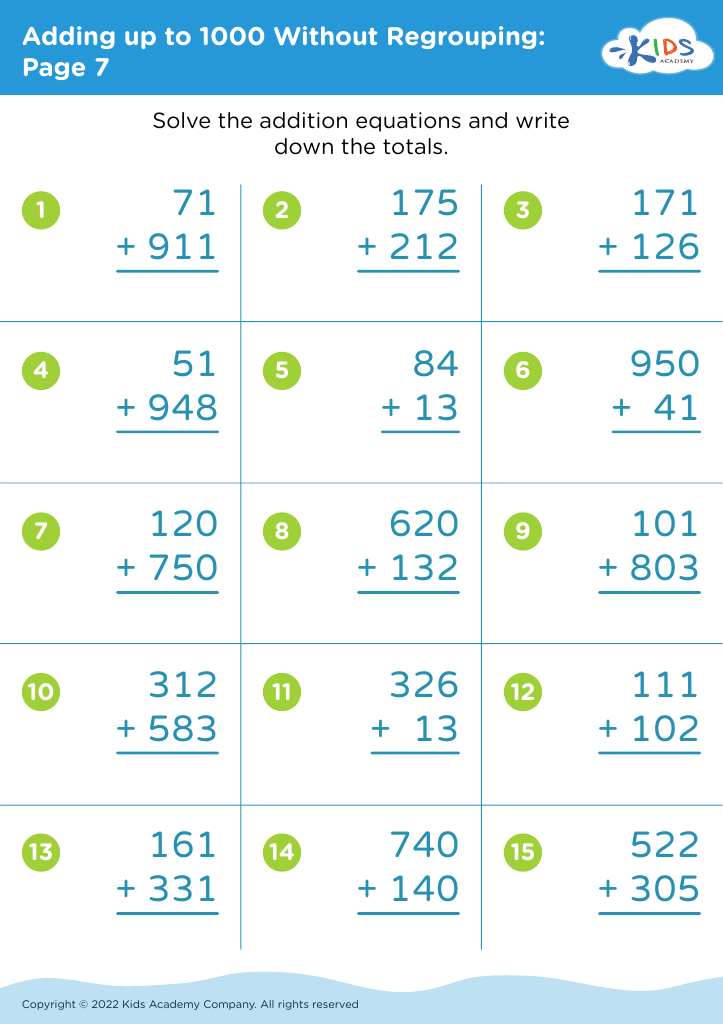
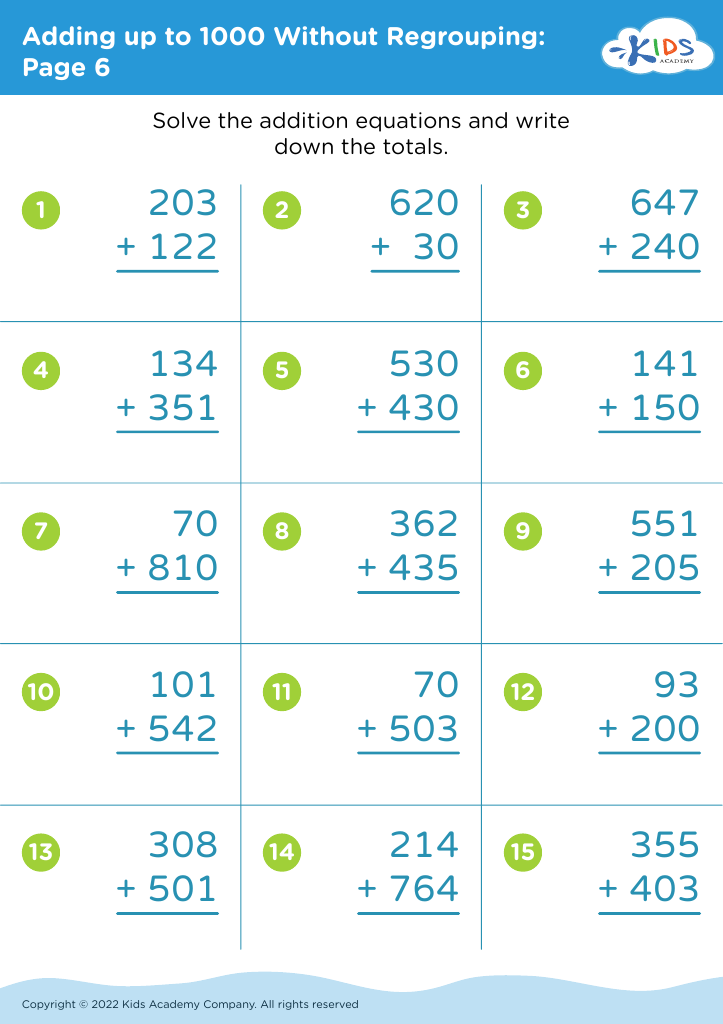
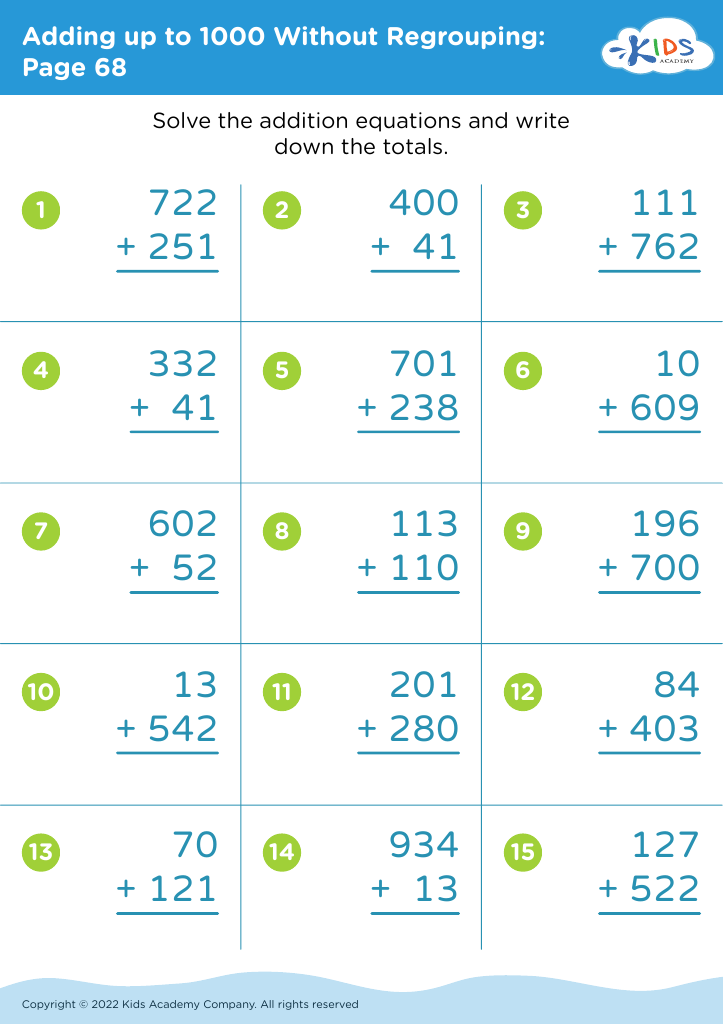


Improving counting skills and the ability to add up to 1000 without regrouping is crucial for young learners aged 6-7. At this developmental stage, children are building the foundation for their mathematical understanding, and strong counting skills are essential. Mastering addition without regrouping enables students to confidently work within a manageable number range, reinforcing their numeracy skills and fostering a positive attitude towards math.
Developing these skills encourages logical thinking and problem-solving abilities, as children learn to break down larger problems into simpler parts. This practice not only aids in arithmetic but enhances cognitive development as they start to understand number relationships and sequences. Moreover, strong counting and addition skills are essential in various real-life applications, from shopping to scheduling activities.
Parents and teachers play a pivotal role in nurturing these skills, using engaging methods such as games, visual aids, and hands-on activities that captivate children’s attention. Creating a supportive learning environment where children feel comfortable making mistakes encourages exploration and persistence, crucial traits for lifelong learning. Overall, prioritizing counting and addition skills prepares students for more advanced mathematical concepts in the future, helping them become confident and competent learners.