Recognizing shapes Adding up to 1000 Without Regrouping Worksheets for Ages 6-7
3 filtered results
-
From - To
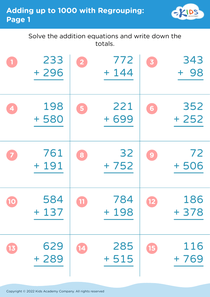
Unlock exciting learning opportunities with our "Recognizing Shapes Adding up to 1000 Without Regrouping Worksheets for ages 6-7." Our expertly crafted worksheets blend essential mathematical skills with engaging shape recognition exercises. Designed to boost your child's arithmetic confidence, these resources support learning without the complexity of regrouping. By recognizing shapes and solving addition problems up to 1000, young learners strengthen their geometry and math skills simultaneously. Perfect for classroom or at-home practice, these enjoyable, printable worksheets provide a dynamic and comprehensive learning experience for children aged 6-7, setting a strong foundation for future mathematical success. Download now from KidsAcademy.mobi!
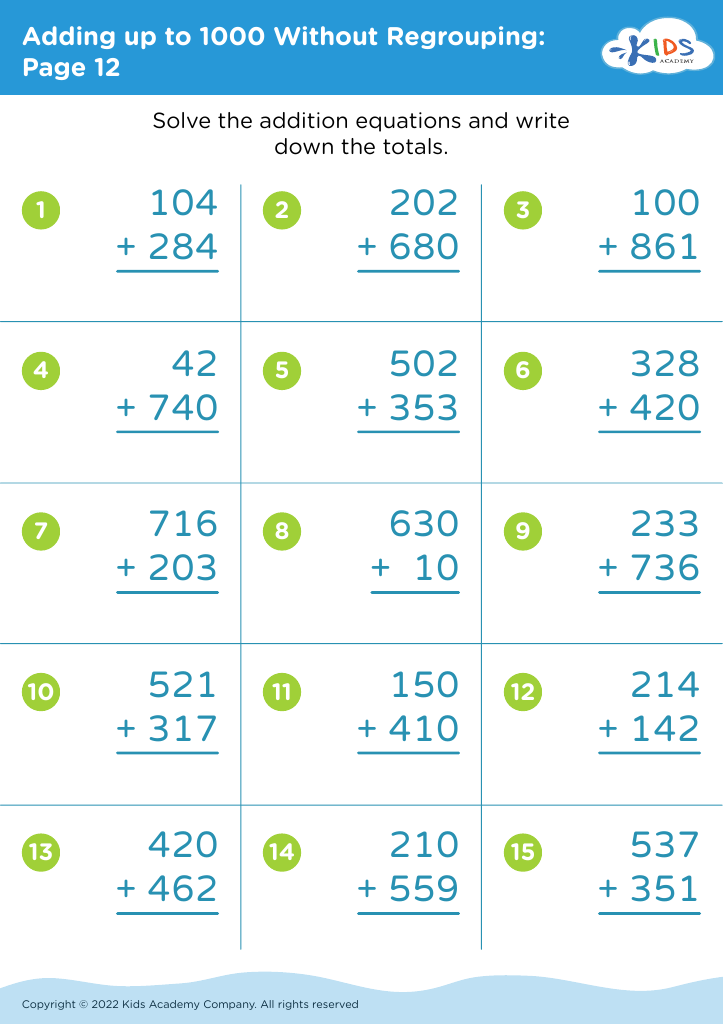
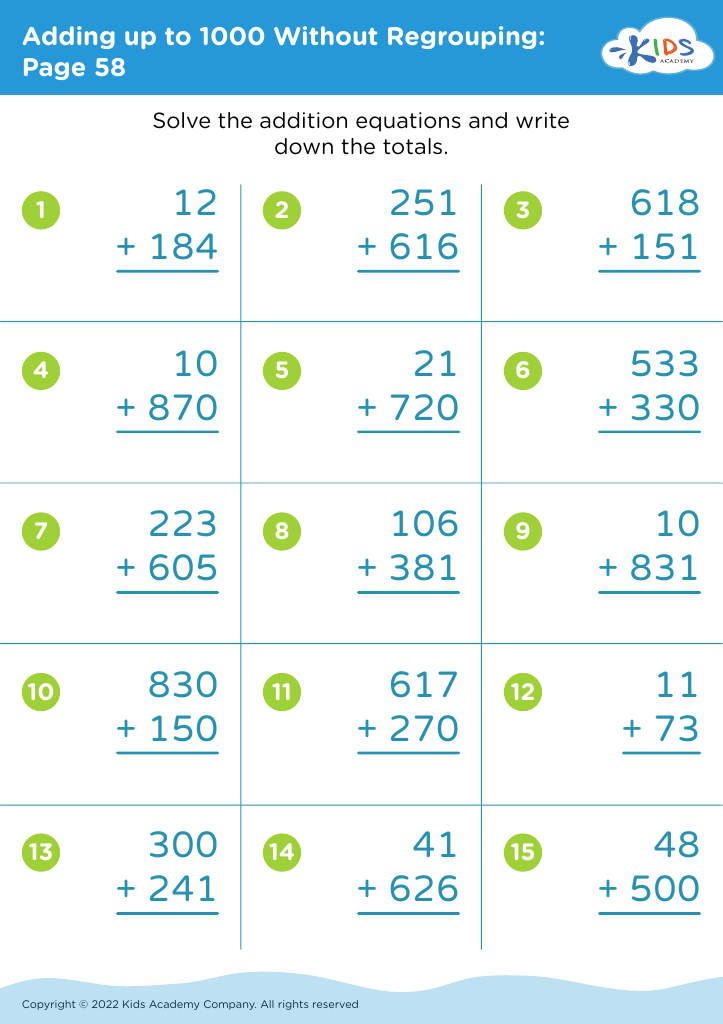
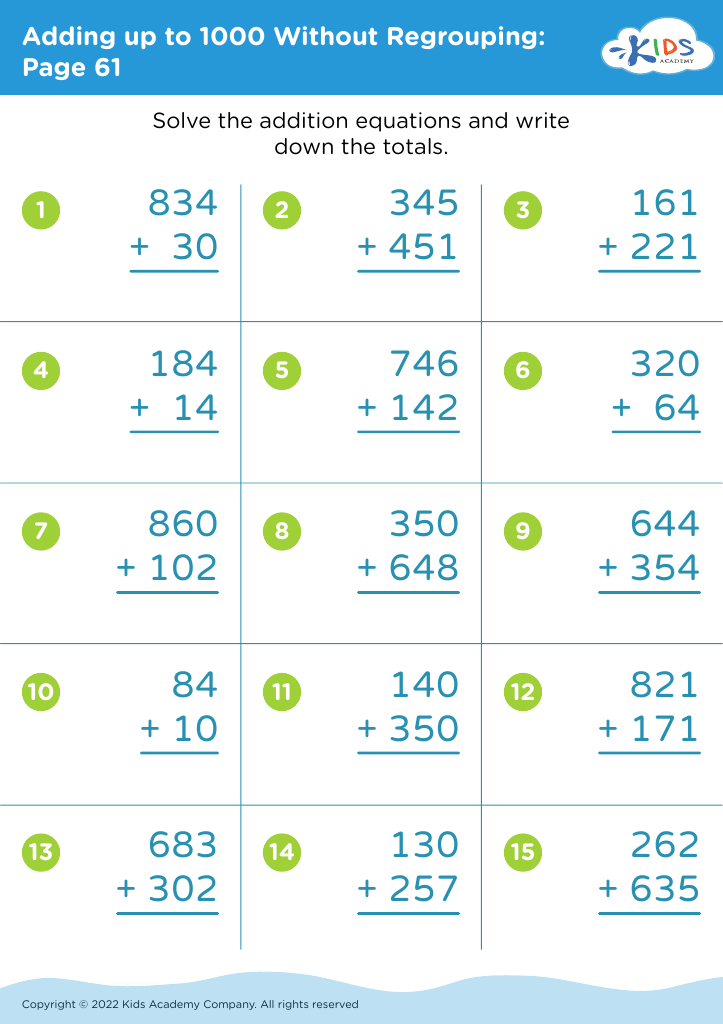


Understanding shapes and adding numbers up to 1000 without regrouping are foundational skills for children aged 6-7, and parents or teachers should pay close attention to ensure these concepts are mastered. Recognizing shapes is essential as it helps children develop spatial awareness and geometric thinking, which are critical for fields like science, engineering, and everyday problem-solving. Shapes are also integral to identifying patterns, categorizing objects, and better understanding the physical world.
Adding up to 1000 without regrouping, on the other hand, strengthens basic arithmetic skills. This involves simple addition problems that don’t require carrying over numbers to the next column, allowing children to focus on grasping the base-ten number system. Proficiency in this area builds a strong foundation for more complex mathematical concepts like subtraction, multiplication, and eventually, division. Moreover, understanding place value becomes more intuitive, aiding in diverse areas of learning, including money management and data interpretation.
Both these skills are deeply interconnected. For example, recognizing patterns in shapes paves the way for understanding patterns in numbers, while addition is often visualized using shapes like number blocks. Encouraging mastery in these areas boosts confidence and fosters a positive attitude towards learning, ultimately facilitating long-term academic and practical success.