Pattern recognition Adding up to 1000 Worksheets for Ages 6-7
3 filtered results
-
From - To
Boost your child's math skills with our engaging Pattern Recognition Adding up to 1000 Worksheets, designed specifically for ages 6-7. These worksheets provide a fun and educational way to enhance their ability to recognize and complete number patterns while mastering addition up to 1000. By working through these colorful exercises, children will strengthen their problem-solving skills, improve their understanding of mathematical relationships, and build a strong foundation for future math success. Perfect for young learners, these worksheets support cognitive development while making learning enjoyable. Dive into a world of numbers and patterns, and watch your child's confidence in math soar!
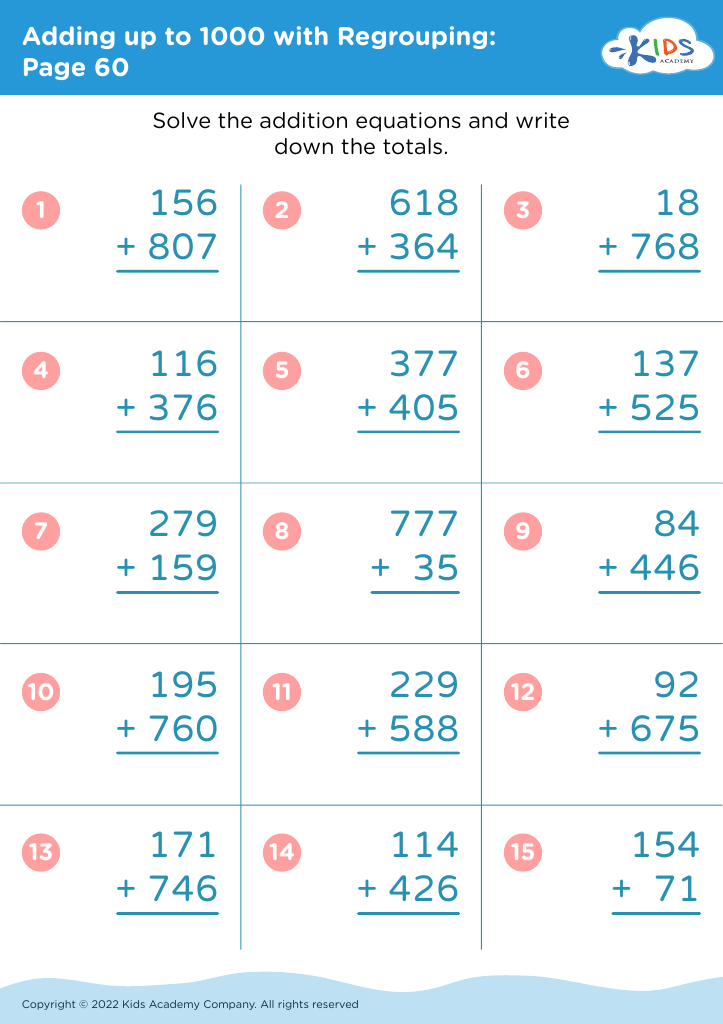
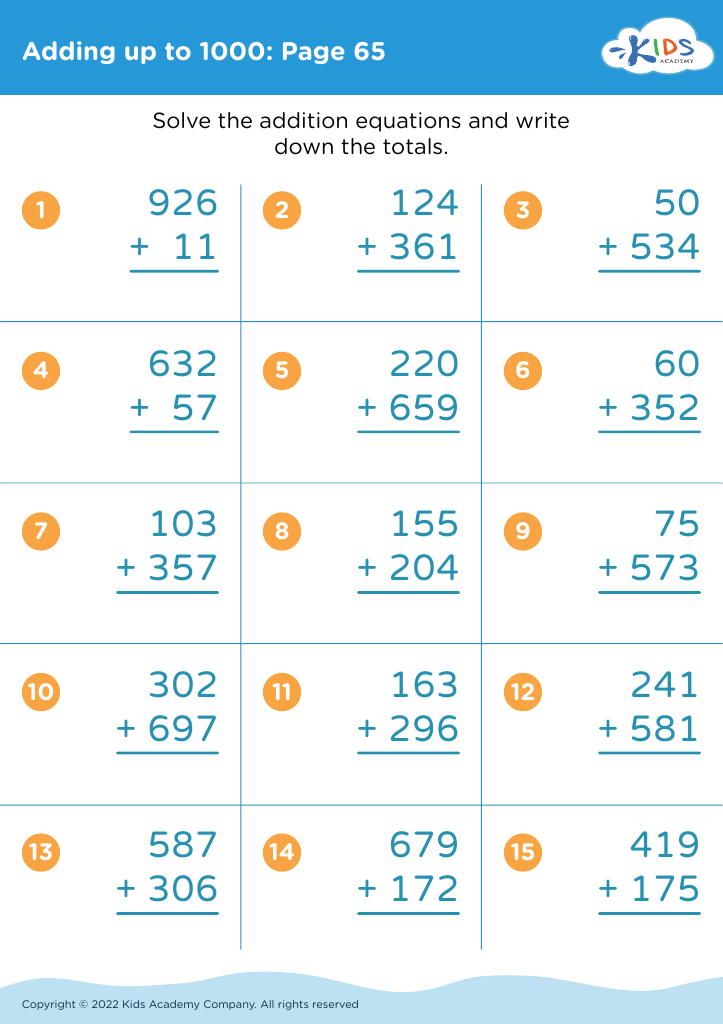
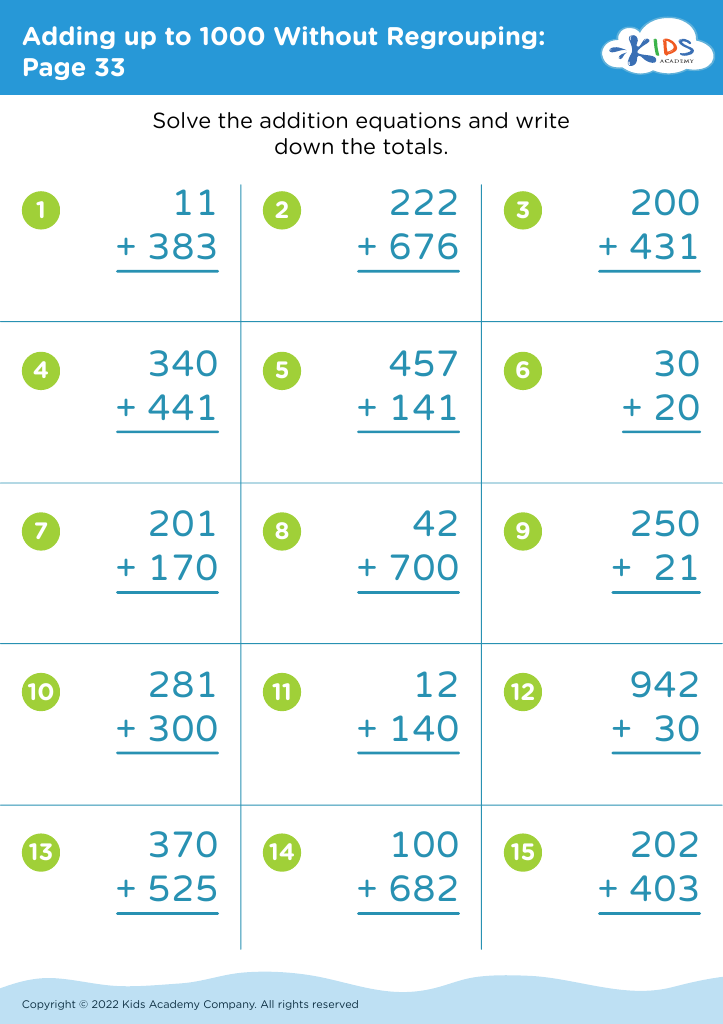



Pattern recognition in addition is an essential skill for children aged 6-7 because it lays the foundation for their future mathematics learning and cognitive development. At this age, children are in key developmental stages where recognizing patterns can enhance their number sense, an important precursor to more complex arithmetic and mathematical concepts. Understanding patterns in numbers helps children grasp the properties of addition and familiarizes them with number relationships, which is crucial for their ability to perform arithmetic operations efficiently and accurately.
When children practice adding numbers up to 1000, they not only improve their basic addition skills but also gain a deeper understanding of place value and the base-ten number system. This helps them make more meaningful connections between numbers, leading to improved problem-solving abilities and logical reasoning.
Pattern recognition is also related to language and reading skills. By identifying and predicting patterns in numbers, children improve their ability to recognize word patterns and sequences, enhancing their reading comprehension. Teachers and parents should prioritize these activities because strong foundational math and cognitive skills build confidence, facilitate a smoother transition to higher level mathematics, and help children achieve better academic outcomes overall. Engaging children in pattern recognition and addition practices can thus promote a well-rounded and meaningful learning experience.








