Reading analog clocks Adding up to 1000 Worksheets for Ages 6-7
3 filtered results
-
From - To
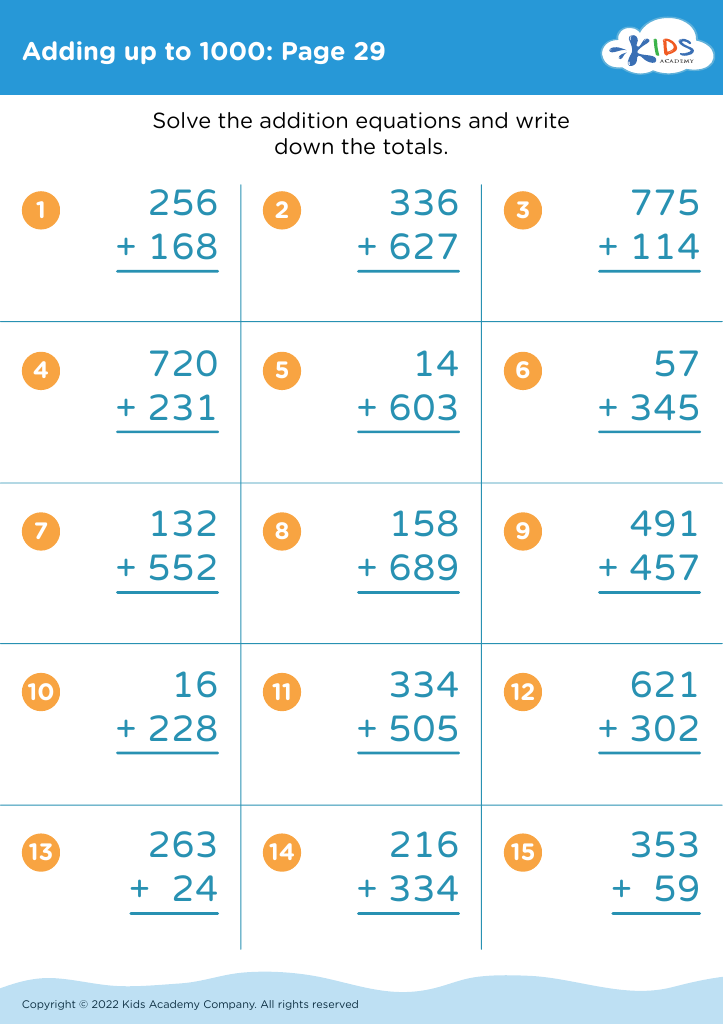
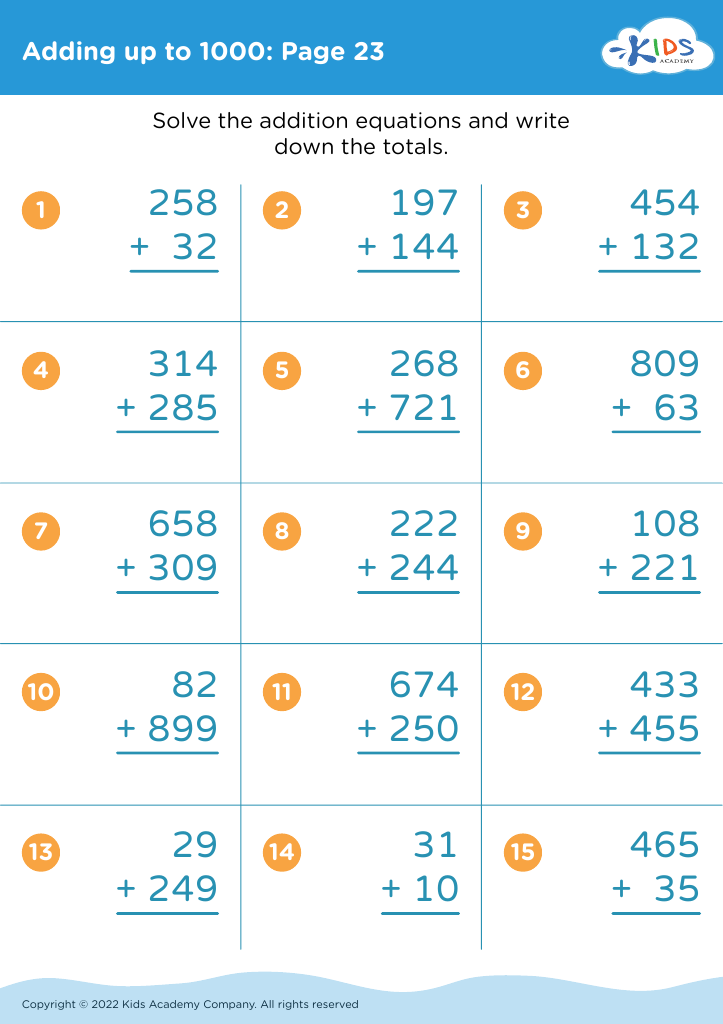
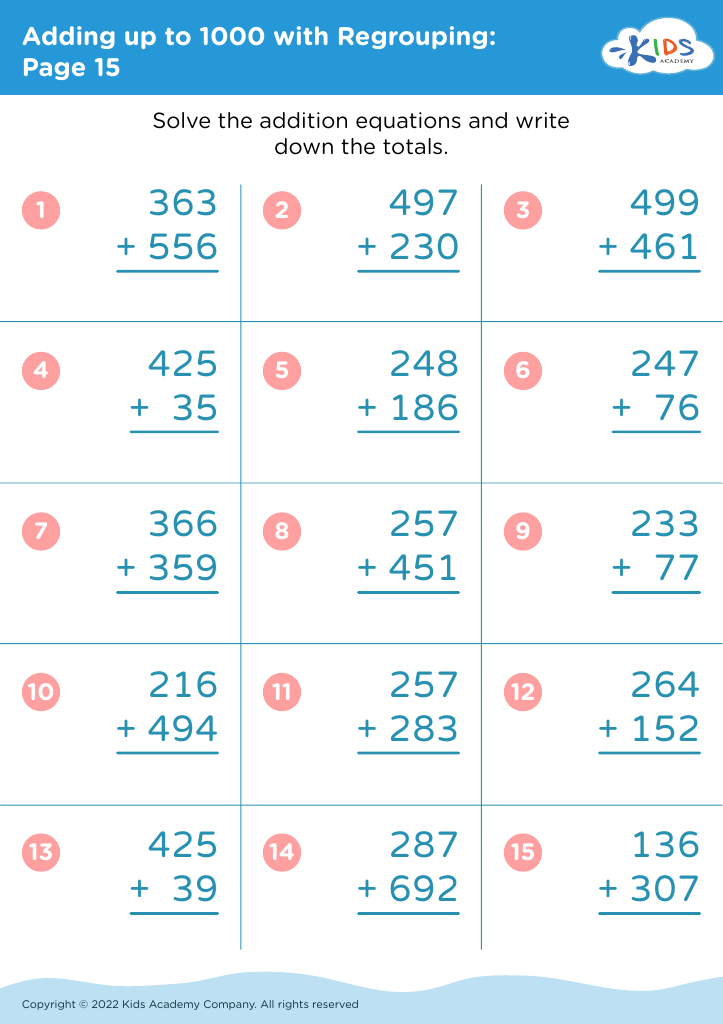
Enhance your child’s math skills with our engaging worksheets designed for ages 6-7! These activities combine the fundamental concepts of reading analog clocks and adding up to 1000. Perfect for young learners, our colorful and interactive exercises make learning fun and effective. Each worksheet is carefully crafted to develop time-telling abilities and advanced addition practice, laying a solid foundation for future math success. Ideal for classroom or home use, these resources help kids build confidence and improve their problem-solving skills while keeping them entertained. Start your child's journey to mastering math concepts today!



Parents and teachers should prioritize teaching children aged 6-7 how to read analog clocks and add numbers up to 1,000 as these foundational skills are critical for comprehensive cognitive development. Firstly, reading analog clocks enhances a child's ability to understand the concept of time, which fosters time management and organizational skills. It assists them in recognizing elapsed time, which is essential for daily routines and scheduling.
Secondly, the ability to perform addition up to 1,000 offers crucial numerical fluency, paving the way for proficient mathematical thinking. Strong arithmetic skills are the backbone of more complex mathematical concepts, ensuring a smoother educational journey. These skills also bolster problem-solving abilities and logical reasoning, which are necessary across various subjects and real-life situations.
Furthermore, engaging in such activities nurtures fine motor skills and visual-spatial awareness. Reading analog clocks requires interpreting and aligning hour and minute hand positions, enhancing attention to detail. Similarly, arithmetic exercises foster pattern recognition and memory retention.
Parents and teachers play an integral role in making these learning experiences interactive and enjoyable, providing a solid foundation for lifelong skills. Mastery of these abilities builds confidence, academic preparedness, and fosters a growth mindset crucial for future educational success and personal development.








