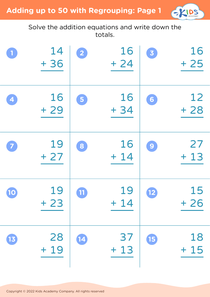
Enhance number recognition Adding up to 50 Without Regrouping Worksheets for Ages 6-7
3 filtered results
-
From - To
Boost your child’s number recognition skills with our specialized "Adding up to 50 Without Regrouping Worksheets" designed for ages 6-7. These engaging worksheets, available on Kids Academy, provide fun, interactive exercises to help children confidently add numbers up to 50. By focusing on numbers straight addition, without the complexity of regrouping, young learners can build a solid mathematical foundation while enhancing their ability to recognize and work with numbers effectively. Perfect for parents and teachers looking for practical, educational resources to refine students’ arithmetic skills while building confidence in their math abilities. Visit Kids Academy for our educational worksheets today!
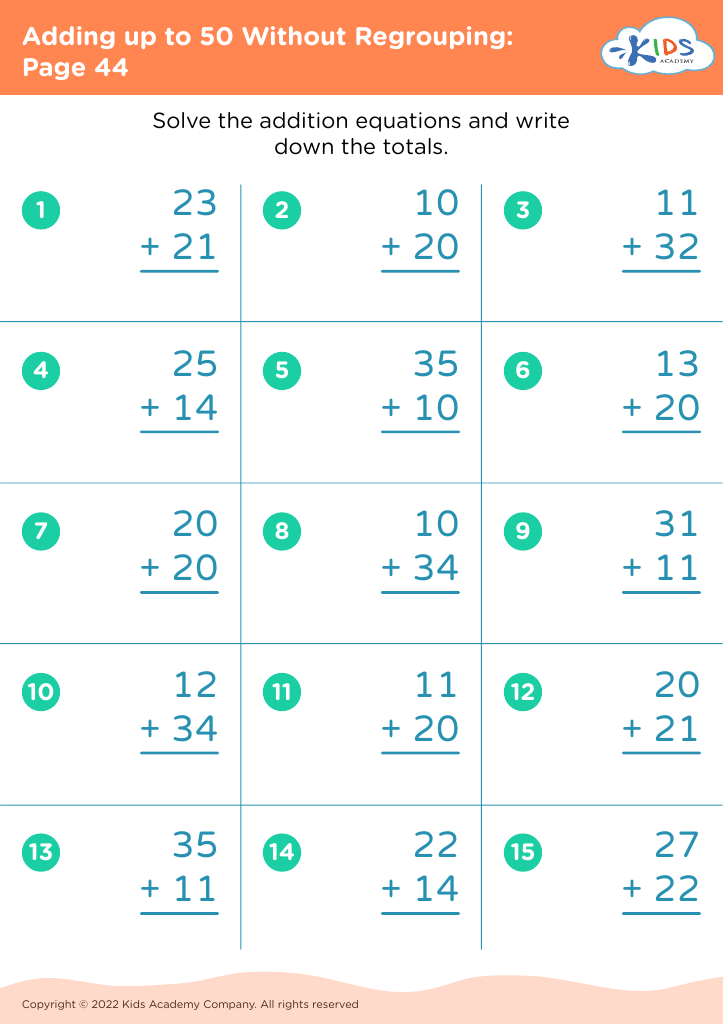
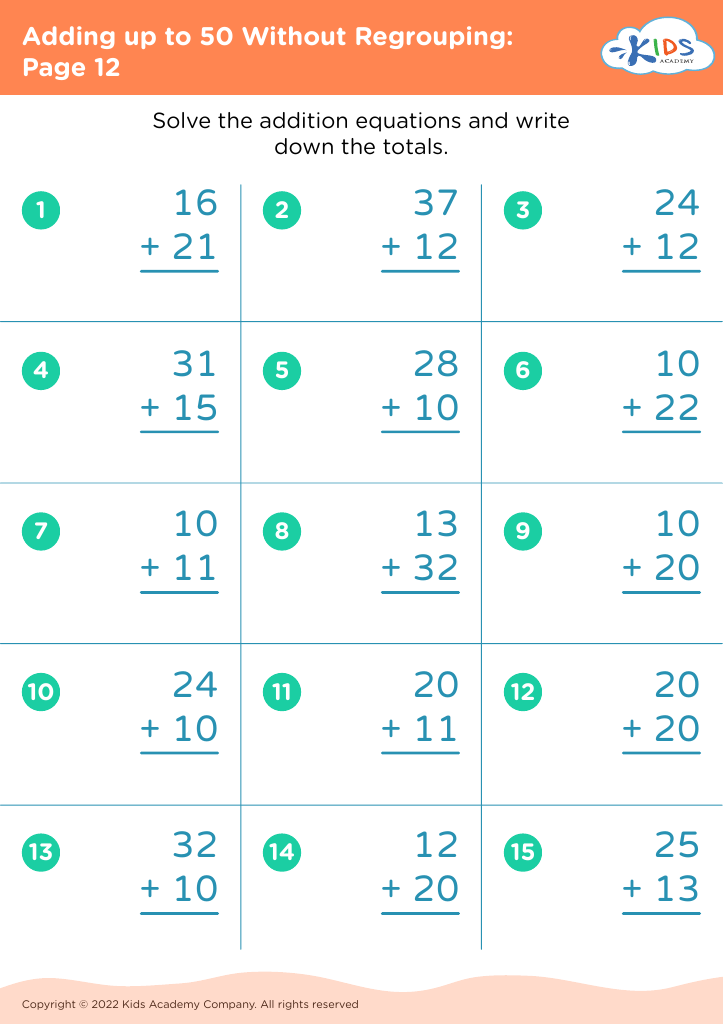
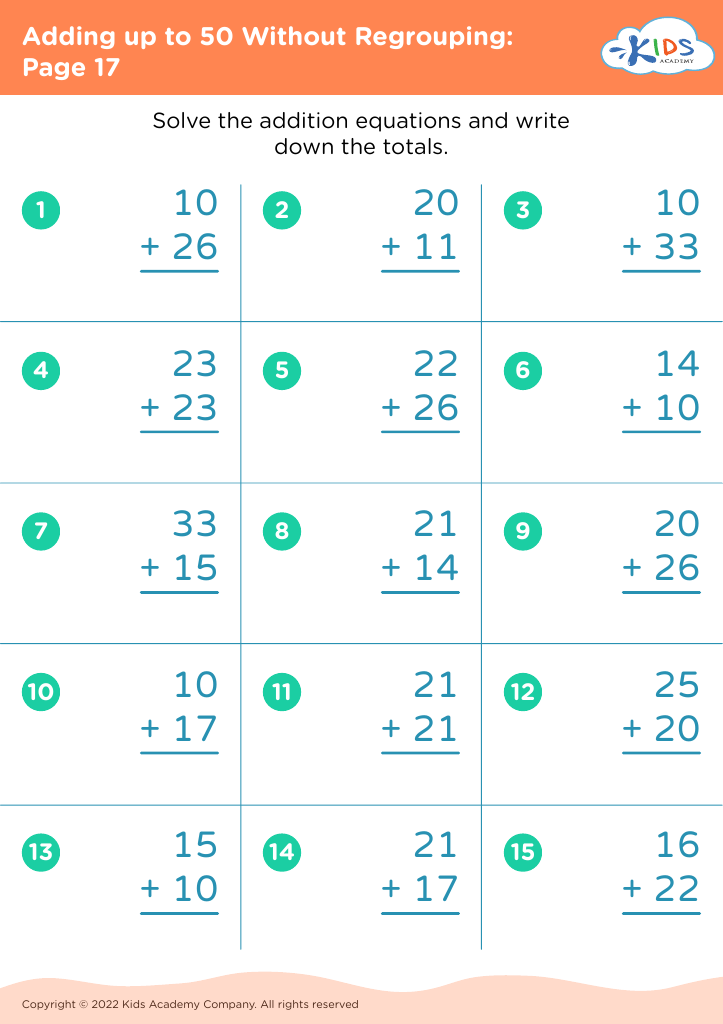


Enhancing number recognition and practicing addition up to 50 without regrouping for children ages 6-7 is crucial for laying a strong foundational basis in mathematics. At this developmental stage, children are learning to understand numbers, their value, and how they interact through addition. Improved number recognition enables children to quickly and accurately identify, compare, and work with numbers, promoting confidence in their math skills.
Focusing on addition up to 50 ensures that children build basic computation skills necessary for more complex problem-solving in later grades. Mastery of addition without regrouping streamlines future learning of more intricate operations involving regrouping, subtraction, multiplication, and division.
By practicing these skills early on, children develop logical thinking and problem-solving capabilities paramount not only in academics but in real-life situations as well. Progress in numeracy increases a child's readiness for higher academic challenges and diminishes the anxiety often associated with math.
Teachers and parents should care about this development as it impacts overall academic success and fosters an attitude of resilience and curiosity. Early positive experiences with math also encourage lifelong positive learning attitudes, supporting the holistic development of children into confident, capable individuals.igur]])