
Enhancing math skills Addition Worksheets for Ages 6-7
4 filtered results
Difficulty Level
Grade
Age
-
From - To
Subject
Activity
Standards
Boost your child's math confidence with our engaging addition worksheets designed for ages 6-7. At Kids Academy, we focus on enhancing math skills through fun and interactive activities tailored to young learners. Our worksheets support skill development in basic addition, ensuring your child builds a solid mathematical foundation. Each worksheet features vibrant illustrations and varied problems to keep kids excited about learning. Perfect for practicing at home or in the classroom, our addition worksheets help children develop both accuracy and speed. Join us at Kids Academy to make math practice enjoyable and effective for your young scholar!
Favorites
With answer key
Interactive
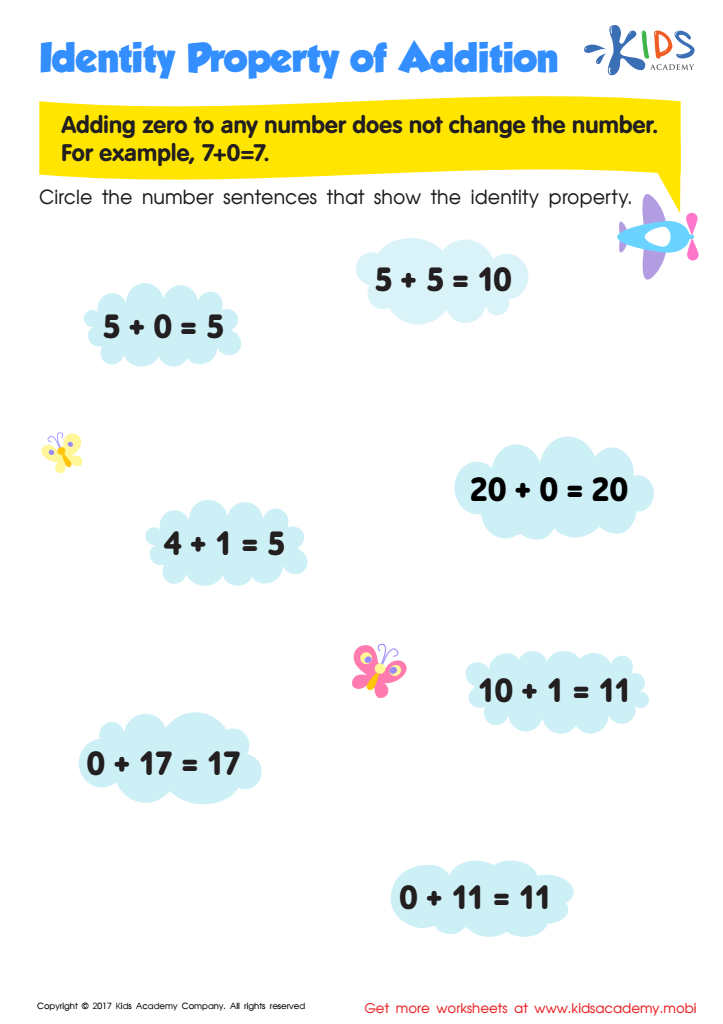
Identity Property of Addition Worksheet
Kids must learn the identity property of addition in math. It states that adding zero to an equation does not change the number. A great way to help kids understand this concept is with a Kids Academy worksheet. It encourages kids to identify which number sentences demonstrate the identity property of addition. Doing so builds vital mental math skills for fast addition.
 Assign to My Students
Identity Property of Addition Worksheet
Worksheet
Join Kids Academy for Free
Who is primarily going to use this learning content?








Enhancing math skills, particularly addition, for ages 6-7 is crucial as it lays the foundation for higher mathematical understanding and everyday problem-solving abilities. At this age, children's brains are highly receptive to new information, making it an ideal time to reinforce fundamental concepts such as addition. Mastery of this skill not only boosts confidence but also fosters a positive attitude towards math, which can lead to long-term academic success.
Addition is a basic building block for more complex mathematical operations, such as subtraction, multiplication, and division. By strengthening these skills early, children are better prepared for future math challenges. Additionally, proficient math skills at an early age have been linked to improved cognitive functions, such as critical thinking and logical reasoning.
Parents and teachers both play an essential role in this learning process. Teachers provide structured guidance and introduce methodologies that make learning addition enjoyable and effective, while parents can support this education at home through practical applications, such as counting money, measuring ingredients during cooking, or playing math-related games.
Overall, fostering strong addition skills at ages 6-7 helps ensure that children develop a solid mathematical foundation, which is essential for academic achievement and practical, everyday tasks. This dual support system from parents and teachers is vital for continuous, seamless learning.








