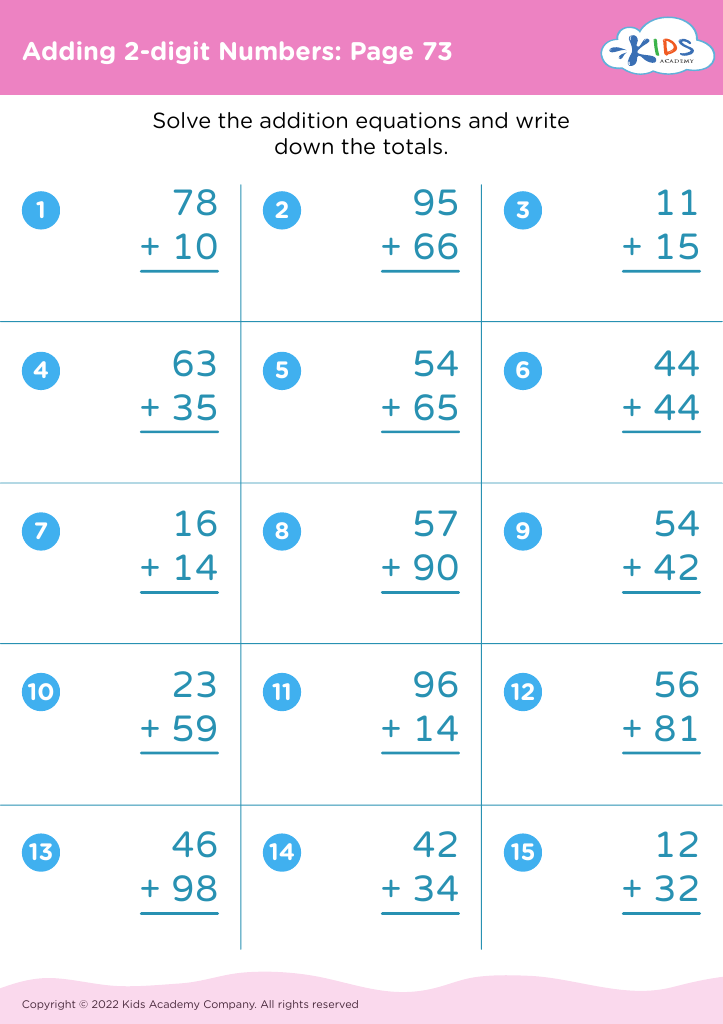








Parents and teachers should care about teaching fraction comparison and addition to children aged 6-7 because it builds foundational math skills crucial for their future learning. At this age, children are transitioning from basic whole number understanding to more complex concepts. Introducing fractions helps enhance their number sense, an essential aspect of mathematical literacy.
Understanding fractions early on aids in developing critical thinking and problem-solving skills. Children learn to discern quantities and make comparisons, an ability that translates into everyday situations like dividing a pizza or comparing portions. Additionally, it fosters a deeper comprehension of addition and subtraction, promoting arithmetic fluency.
Fractions are also omnipresent in various real-world contexts, including cooking, time management, and financial literacy. Familiarity with fractions ensures that children are better prepared for these practical applications. Moreover, early exposure to fractions aligns with most educational standards, ensuring that children meet necessary learning benchmarks and avoiding potential gaps that could hinder more advanced mathematical understandings, such as algebra and geometry.
By prioritizing fraction comparison and addition at an early age, parents and teachers set children on a path toward academic success, equipping them with the confidence and skills to tackle more complex math concepts with ease as they progress through their education.








