Identifying Animals Math Worksheets for Ages 6-7
4 filtered results
-
From - To
Explore our "Identifying Animals Math Worksheets" designed specifically for children aged 6-7! These engaging worksheets combine essential math skills with the fun of learning about animals. Your child will practice recognizing various animal species while developing counting, sorting, and comparing abilities. Each worksheet promotes critical thinking and enhances their understanding of the animal kingdom in an interactive way. Perfect for homeschoolers, educators, or parents looking to supplement learning, our resources are easy to print and packed with colorful illustrations that will capture your child’s imagination. Help your little ones build a strong foundation in math while exploring the fascinating world of animals!
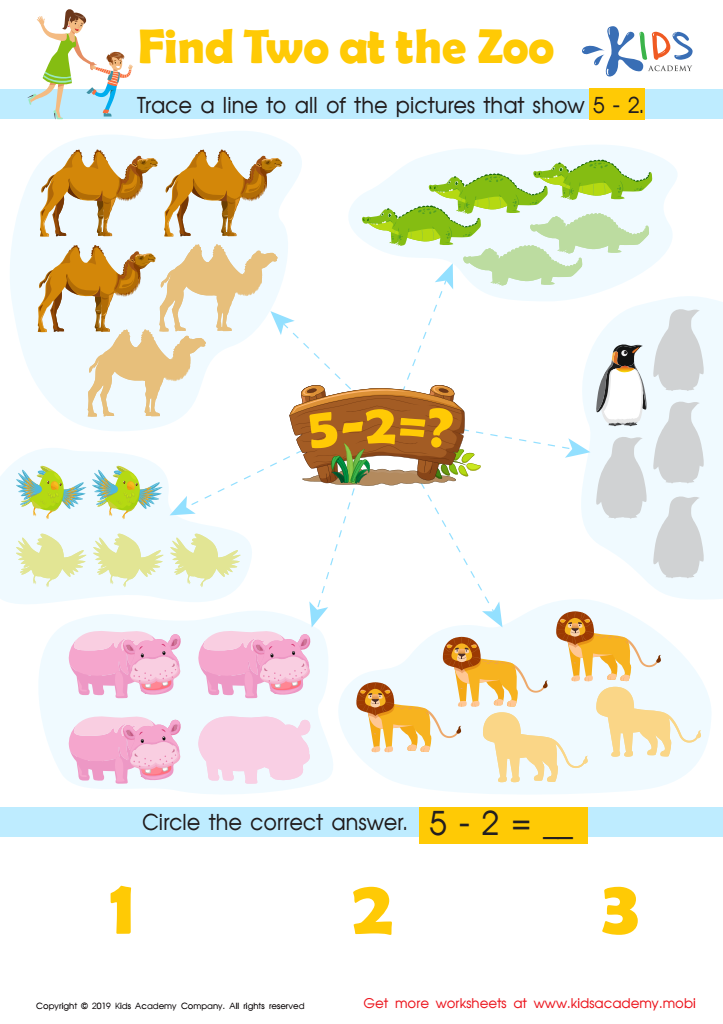
Find Two at the Zoo Worksheet
 Assign to My Students








Identifying Animals Math for children aged 6-7 offers a unique opportunity for parents and teachers to foster both mathematical skills and a passion for the natural world. At this crucial developmental stage, children are naturally curious and eager to learn. Integrating animal identification into math encourages active engagement, making abstract concepts more relatable and meaningful.
Learning about animals through math can enhance various skills. For example, activities involving counting animals, grouping them by types, or measuring their sizes help strengthen basic arithmetic, critical thinking, and problem-solving abilities. Additionally, exploring patterns or using graphs to represent different animal species can develop data literacy skills, which are essential for future learning.
Beyond math, this approach cultivates a sense of empathy and mindfulness about biodiversity. Children begin to understand the importance of wildlife and conservation, fostering responsible attitudes toward the environment.
Incorporating animal identification into math instruction can be a dynamic way to bridge curriculum subjects, making learning more cohesive and enjoyable. By engaging with animals through math, parents and teachers can inspire young learners to see connections between numbers and the world around them, nurturing both their intellect and empathetic understanding of nature.








