
Understanding measurement units Measurement Worksheets for Ages 6-7
3 filtered results
Difficulty Level
Grade
Age
-
From - To
Subject
Activity
Standards
Explore our engaging "Understanding Measurement Units Worksheets" designed for young learners ages 6-7! These worksheets offer a fun and interactive way for children to grasp essential measurement concepts, including length, weight, and volume. With a variety of activities featuring colorful illustrations and relatable scenarios, kids can practice using both standard and metric units. Our resources aim to build confidence in measurement skills through hands-on experience, enabling children to apply what they’ve learned in real-world situations. Perfect for teachers and parents alike, these worksheets support early math skills development while keeping learning enjoyable and engaging! Start measuring success today!
Favorites
With answer key
Interactive
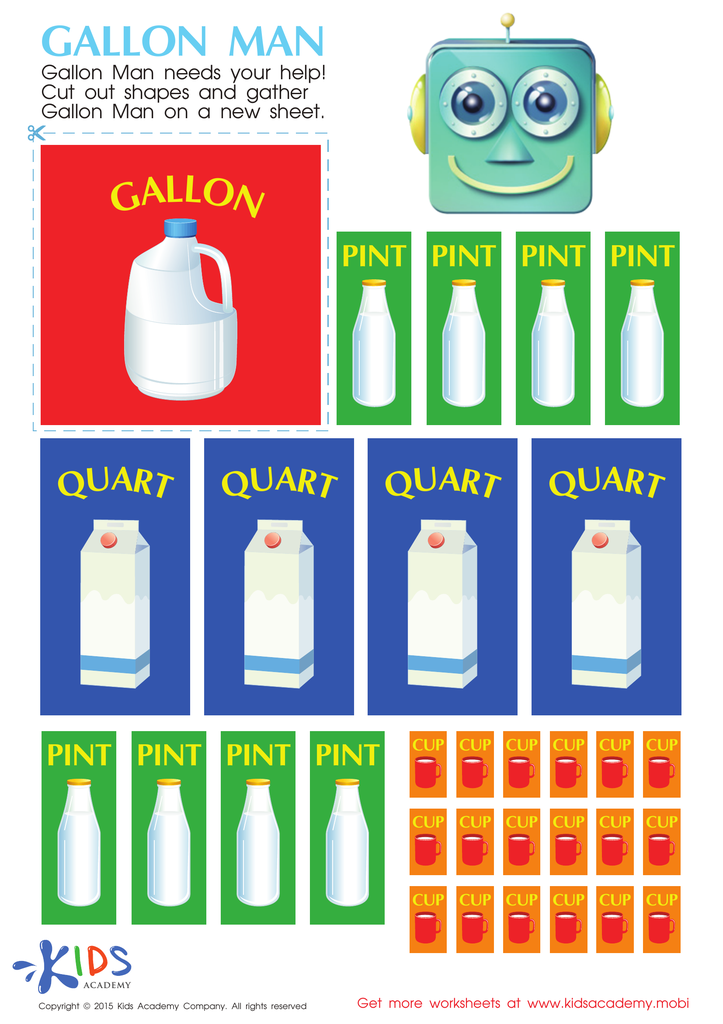
Cups, Pints and Quarts With Gallon Man Worksheet
Measurement in cups, pints, quarts and gallons has never been this fun!
Cups, Pints and Quarts With Gallon Man Worksheet
Worksheet
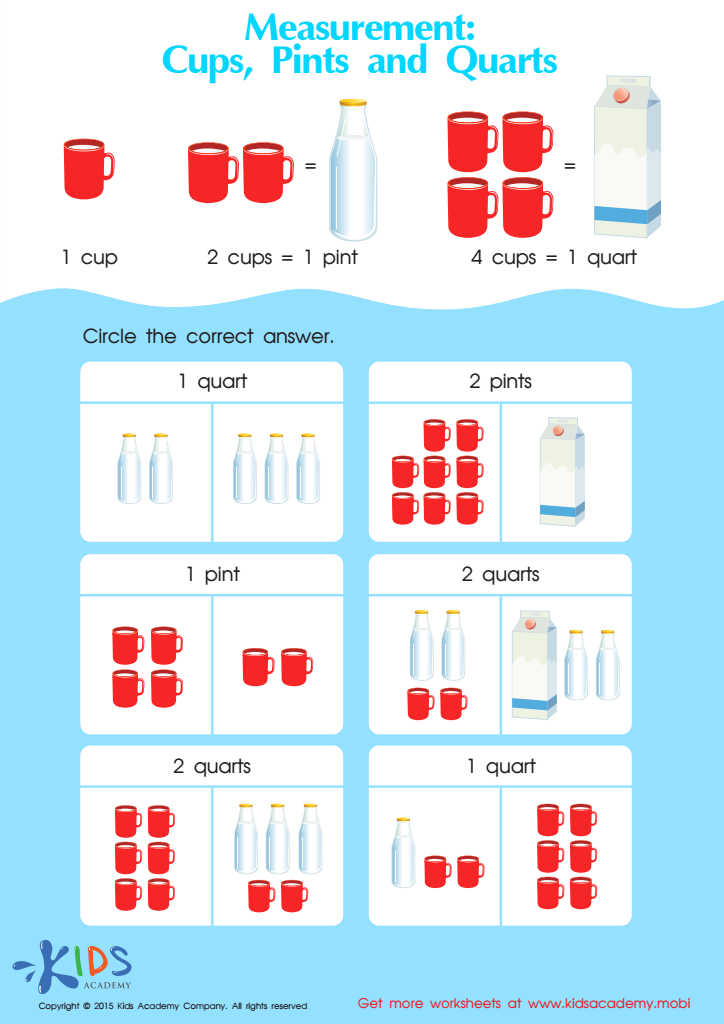
Cups, Pints and Quarts Worksheet
Let your kids explore the world of math with our worksheet! Have them count cups, pints and quarts in pictures and circle the right answer. Get even more free printable math worksheets for kindergarten on our website. Come on, join the adventure!
 Assign to My Students
Cups, Pints and Quarts Worksheet
Worksheet
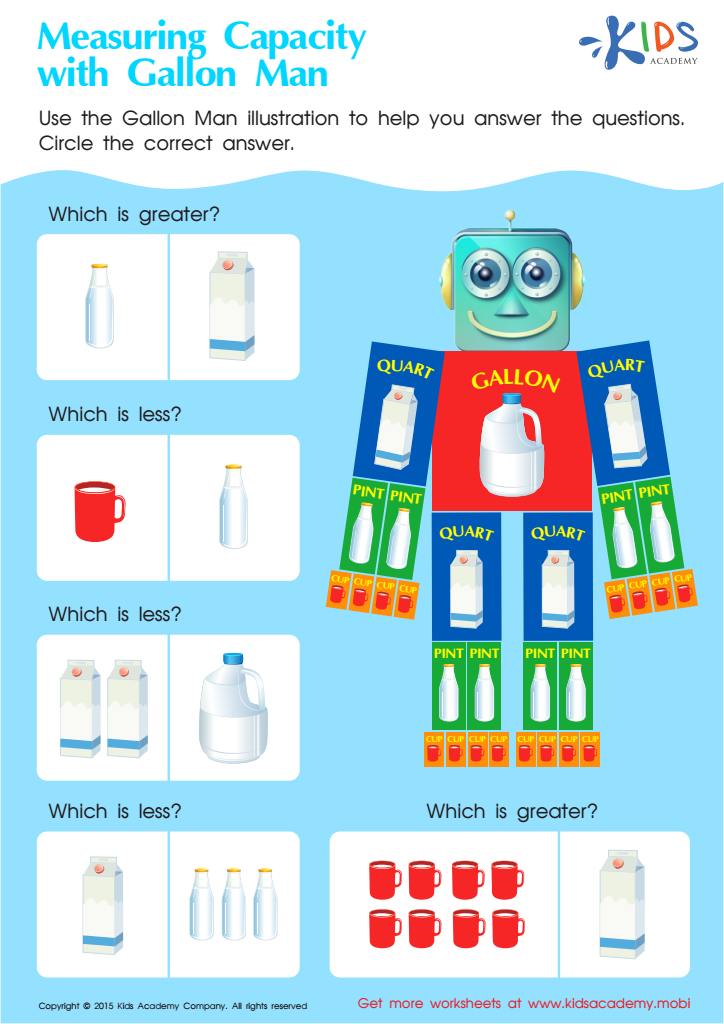
Measurement: Measuring Capacity with Gallon Man Worksheet
Check out Gallon Man to practice measuring capacity with cups, pints, quarts, and gallons. Our worksheet has questions with answers checked against Gallon Man. For more practice, visit our site for free printable math worksheets for kindergarten and learn math with fun!
Measurement: Measuring Capacity with Gallon Man Worksheet
Worksheet
Join Kids Academy for Free
Who is primarily going to use this learning content?








Understanding measurement units is fundamental for children aged 6-7 as it lays the groundwork for essential life skills. At this age, children are naturally curious and eager to explore the world around them, making it the perfect time to introduce concepts of measurement. These foundational skills assist children in making sense of their environment—helping them compare lengths, weights, and capacities in everyday situations like cooking, shopping, or timing activities.
Measurement units encourage critical thinking and problem-solving. When children grasp concepts like inches, centimeters, grams, or liters, they develop analytical skills by comparing and estimating. Additionally, measuring activities can enhance mathematical proficiency, paving the way for future success in STEM subjects.
For parents and teachers, emphasizing measurement education can be a gateway to enriching curriculum content and integrating cross-disciplinary learning. It fosters a collaborative and engaging classroom atmosphere, as hands-on activities related to measurement provide both fun and meaningful learning experiences.
Ultimately, encouraging young students to understand measurement units contributes to their overall cognitive development, prepares them for more advanced mathematical concepts, and helps nurture a lifelong appreciation for learning. Investing in these foundational skills now builds confidence and competence for future academic achievements and daily tasks in later life.








