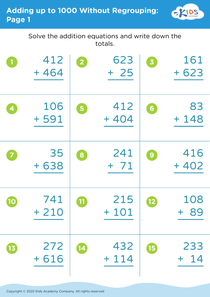
Mathematical reasoning Adding up to 1000 with Regrouping Worksheets for Ages 6-8
3 filtered results
-
From - To
Discover our engaging "Mathematical Reasoning: Adding Up to 1000 with Regrouping" worksheets designed for children ages 6-8. These interactive resources encourage young learners to refine their addition skills through fun and challenging problems that necessitate regrouping. Each worksheet supports the development of critical thinking and problem-solving abilities while making math enjoyable. Ideal for home or classroom use, our worksheets foster independent practice and conceptual understanding, laying a strong foundation for future mathematical success. Explore this essential collection today to enrich your child’s learning experience and boost their confidence in tackling larger numbers!
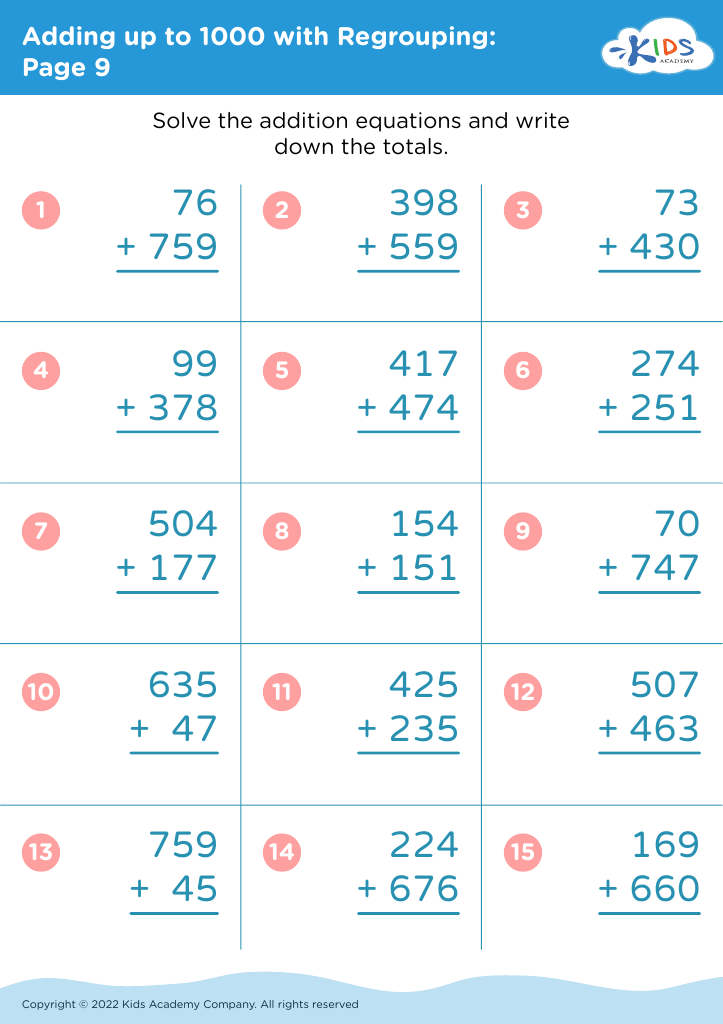
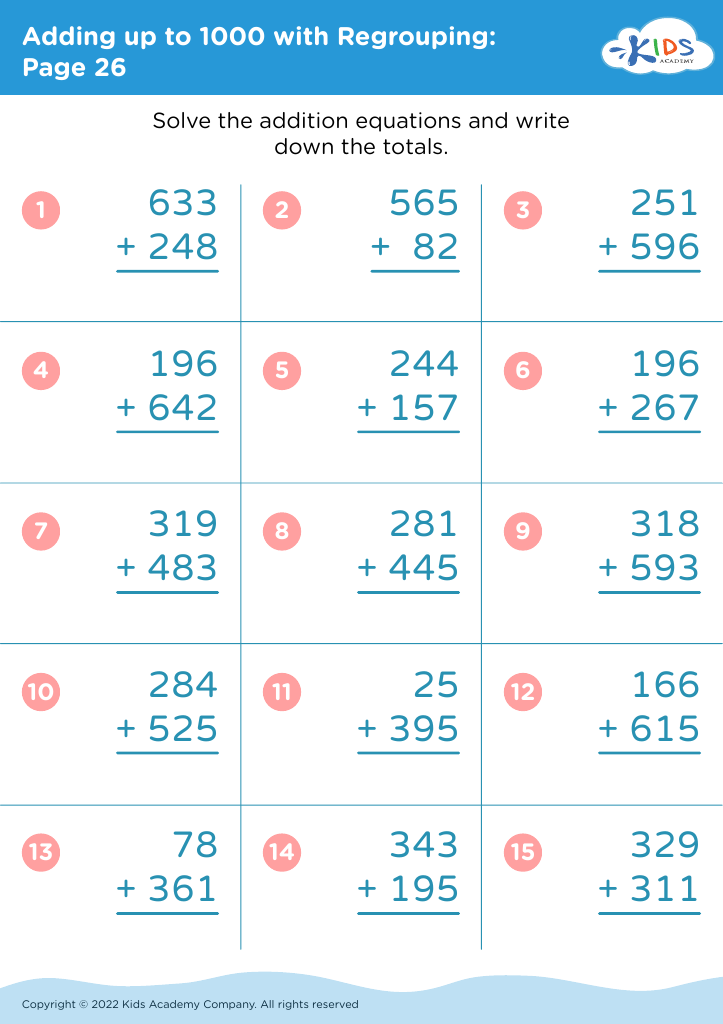
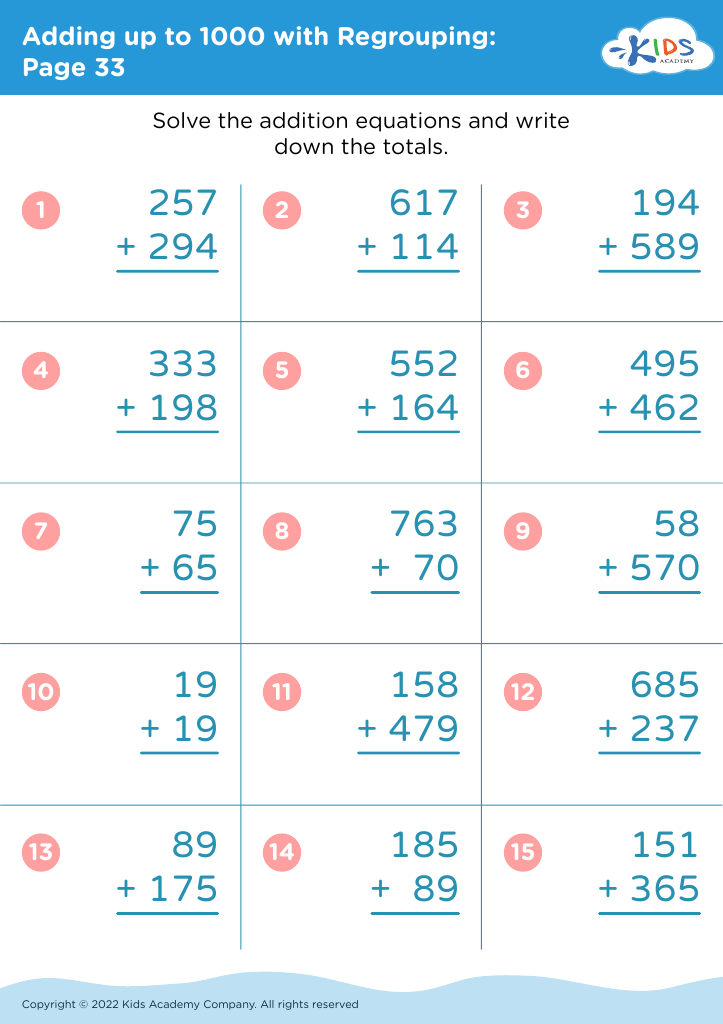


Mathematical reasoning, particularly in the context of adding up to 1000 with regrouping, is essential for children aged 6-8. This foundational skill not only strengthens their understanding of numbers but also fosters critical thinking abilities that are crucial for future learning. When teachers and parents emphasize these concepts, they help children grasp the base-10 number system, enhancing their ability to visualize and manipulate numbers, which are fundamental qualities for success in mathematics.
Understanding regrouping allows children to break down larger numbers, encouraging them to see relationships between numbers and develop strategies for solving complex problems. This competence builds not just accuracy in calculations, but also perseverance and resilience in facing mathematical challenges. Moreover, incorporating math in everyday situations, such as budgeting, measuring, or planning, makes learning relevant and engaging.
Furthermore, this skill prepares students for advanced concepts in mathematics, establishing a solid groundwork for future educational pursuits in STEM fields. Parents and teachers play a key role in fostering a positive relationship with math, helping to instill confidence and a love for learning in children. By understanding the significance of mathematical reasoning, they can effectively contribute to their children's academic success and overall cognitive development.