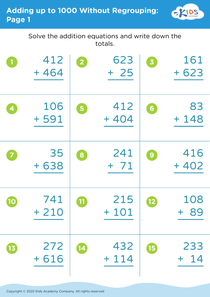
Simplifying Fractions Adding up to 1000 with Regrouping Worksheets for Ages 6-8
3 filtered results
-
From - To
Our "Simplifying Fractions Adding up to 1000 with Regrouping Worksheets for Ages 6-8" help young learners develop crucial math skills. Designed for kids aged 6-8, these engaging worksheets blend activities on simplifying fractions and adding numbers up to 1000 with regrouping. Each exercise fosters a deep understanding of essential arithmetic concepts, embraces visual learning aids, and offers fun challenges to spark interest. Perfect for at-home practice or classroom use, these worksheets make complex math tasks accessible and enjoyable for early learners. Guide your child's mathematical journey with structured, educational, and entertaining printable worksheets.
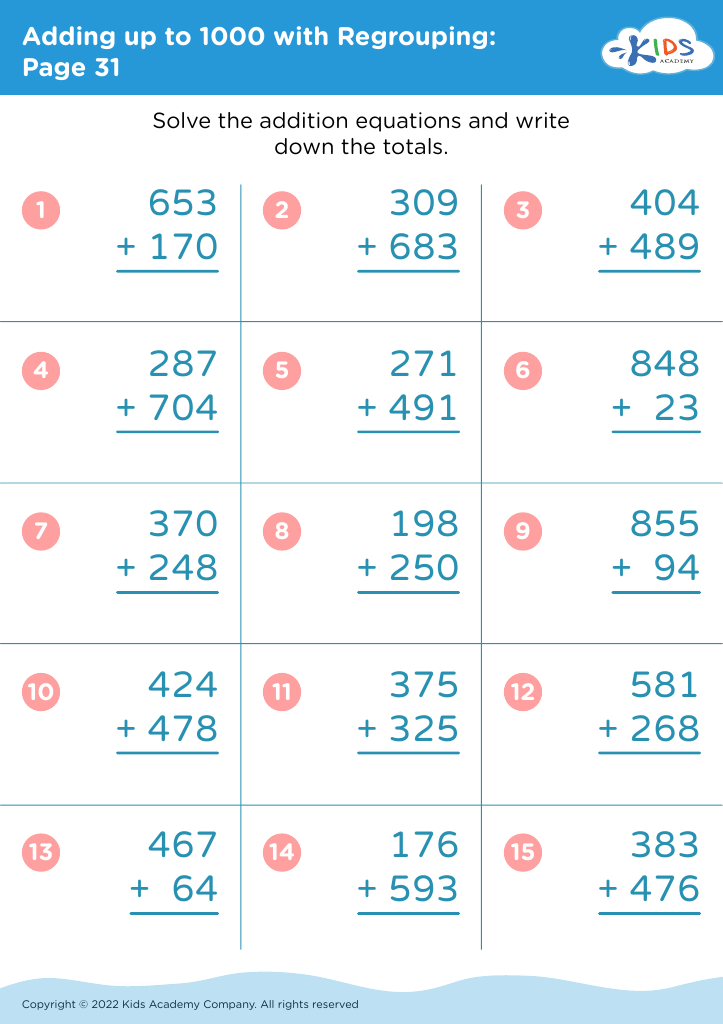
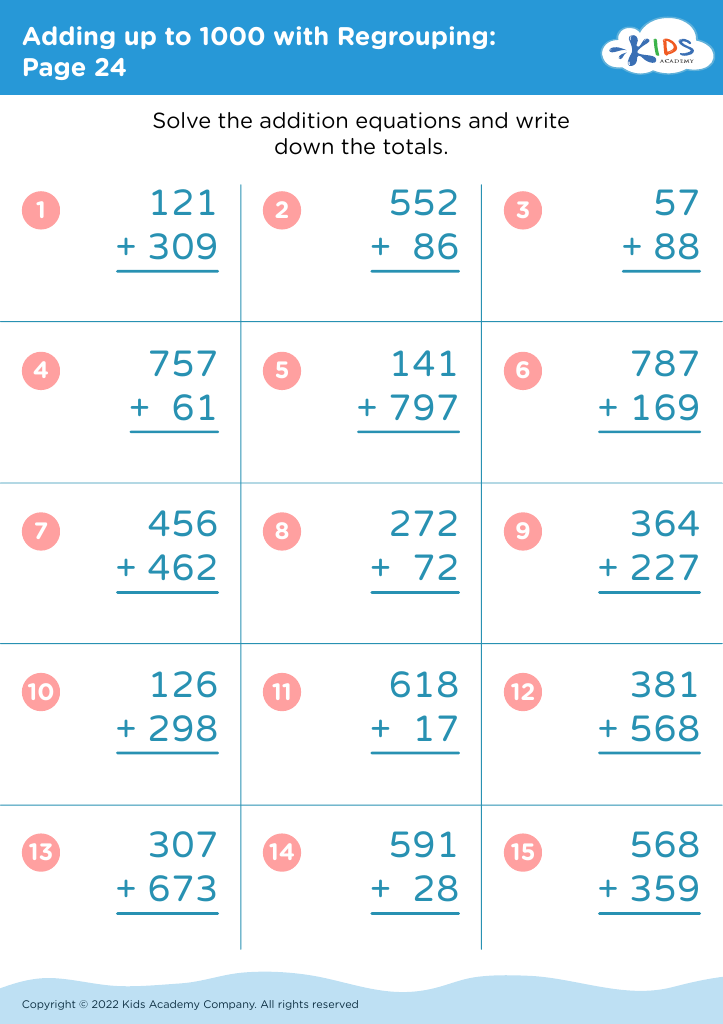
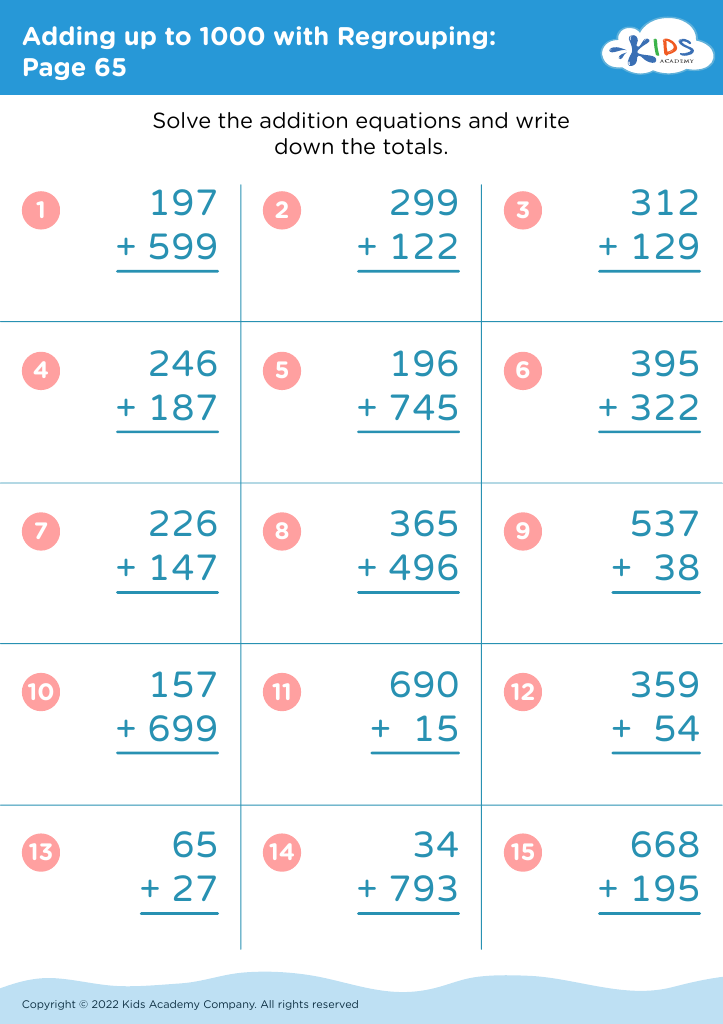


Simplifying fractions and understanding addition are foundational math skills crucial for young students, typically aged 6-8. At this developmental stage, children are honing their ability to recognize numerical relationships and operations, skills that will underlie all future math learning. Introducing them to simplifying fractions and regrouping during addition practices key cognitive processes like pattern recognition, critical thinking, and problem-solving.
Understanding fractions emphasizes comprehension over rote learning. When students grasp why and how fractions can be simplified or how regrouping works in finding sums, they gain a deeper insight into number theory and arithmetic. Regrouping, for instance, helps them understand carrying over numbers in multi-digit addition, a skill that ensures accuracy and efficiency in calculations as problems become more complex.
Additionally, math exercises involving higher numbers up to 1000 scale reinforcing these principles on a grander scale, cementing understanding and boosting confidence. This practice emerges as pivotal in preparing young learners for more advanced math topics like algebra and geometry. Plus, fostering a comfort with numbers helps challenge and reduce any developing math anxiety, encouraging a positive, resilient attitude towards the subject—something which benefits both academic growth and everyday problem solving in later life.