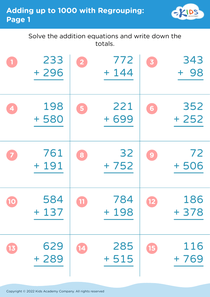
Recognize patterns Adding up to 1000 Without Regrouping Worksheets for Ages 6-8
3 filtered results
-
From - To
Help your child master addition effortlessly with our "Recognize Patterns Adding up to 1000 Without Regrouping Worksheets for Ages 6-8." These engaging and educational worksheets empower young learners to identify patterns and enhance their addition skills without the challenge of regrouping. With colorful designs and fun exercises, students will practice adding up to 1000, building a solid mathematical foundation. Perfect for classroom use or homeschooling, our expertly designed worksheets provide a hands-on learning experience, fostering confidence and a love for math. Boost your child's number sense and pattern recognition today, making math practice a stress-free and enjoyable activity!
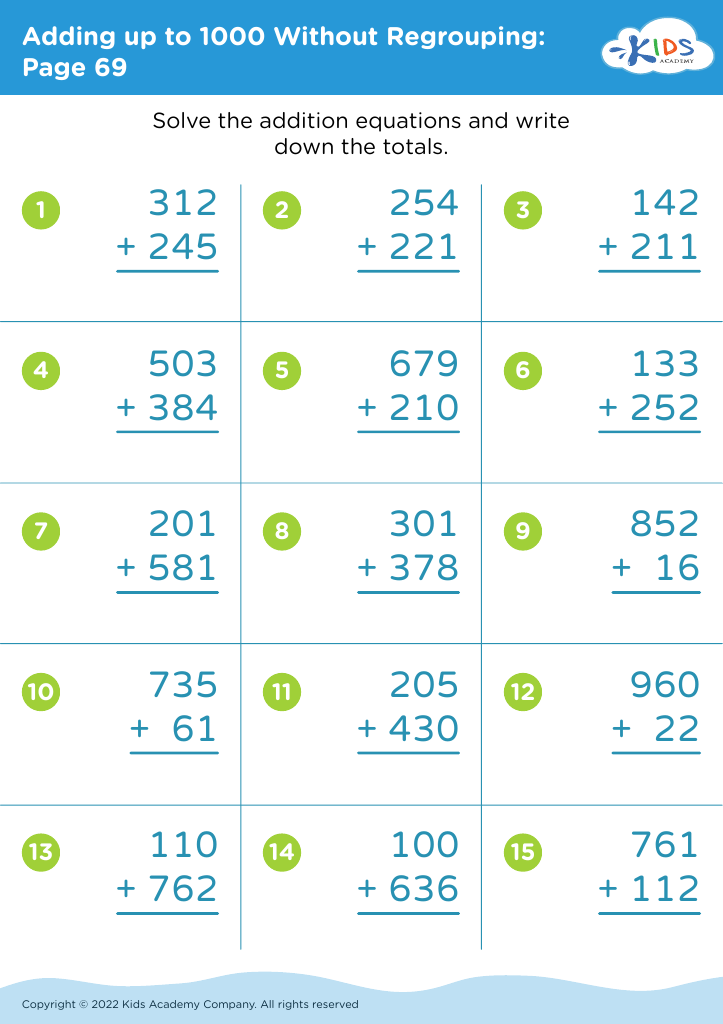
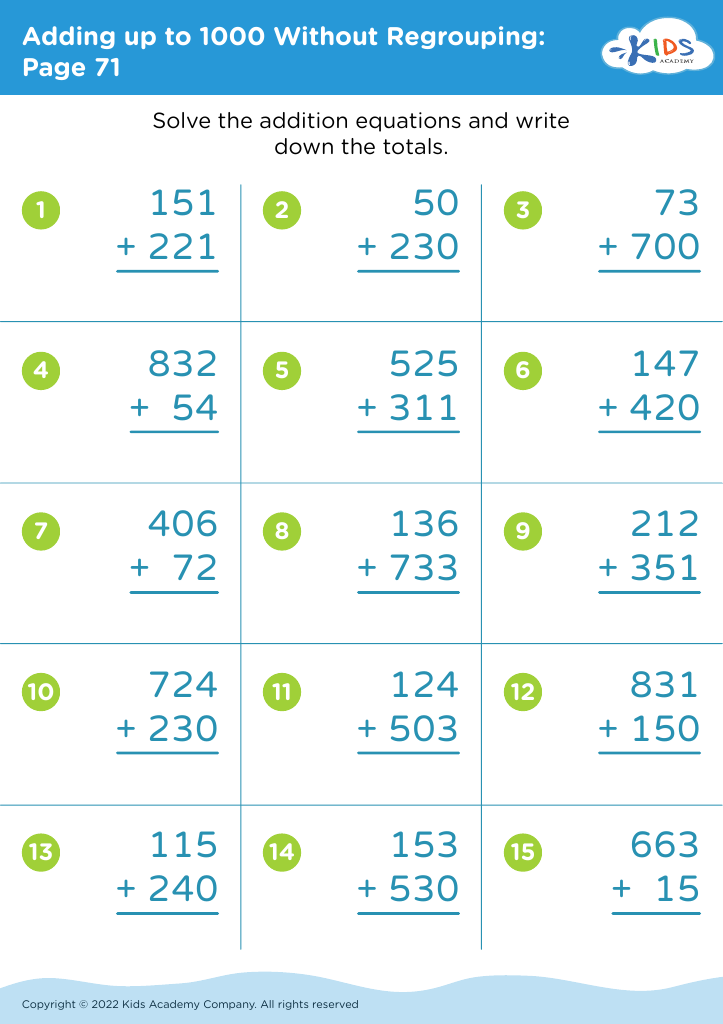
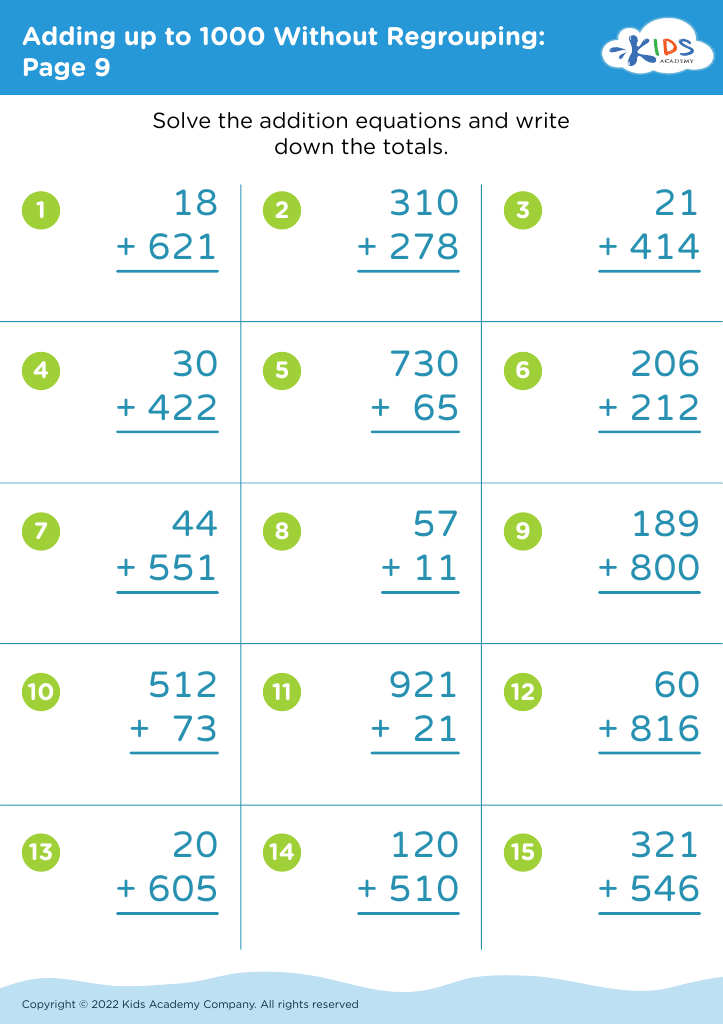


Recognizing patterns and performing arithmetic operations without regrouping up to 1,000 are crucial skills for 6-8-year-olds, forming a foundational element in their mathematical development. When children identify patterns, they gain a deeper understanding of the number system's structure, strengthening their cognitive ability to predict and generalize regular sequences. This skill is directly correlated with advanced mathematical problem-solving and critical thinking.
When children learn to add numbers within 1,000 without the need for regrouping, they become familiar with place value concepts and bolster their mental arithmetic skills. This approach aids in accuracy and efficiency in calculation, fostering strong confidence in their mathematical abilities. By mastering these calculations, children can tackle more complex problems with ease in the future, enabling them to proceed to regrouping smoothly and effectively.
Furthermore, solid comprehension and practice of these skills pave the way for achievement in broader STEM areas. As students accurately recognize patterns and numbers, prepare to transition seamlessly into more advanced topics such as multiplication, division, and algebra, creating a strong competency from a very young age.
Investing time in these skills sets children up for prolonged academic success and instills a love for learning and numerical challenges, creating a positive educational trajectory.