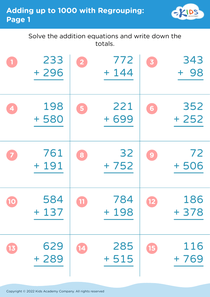
Understanding division Adding up to 1000 Without Regrouping Worksheets for Ages 6-8
3 filtered results
-
From - To
Discover essential "Understanding Division" and "Adding up to 1000 Without Regrouping" worksheets for ages 6-8 at Kids Academy. Our expertly designed printables cater to young learners, making division concepts easy and fun. Enhance your child's arithmetic skills with engaging activities that focus on adding large numbers without the need for regrouping. These worksheets help build a strong mathematical foundation, boost confidence, and foster a love for learning. Perfect for teachers and parents aiming to support their students' educational journey, our resources ensure effective learning and mastery of essential math concepts. Explore and download today!
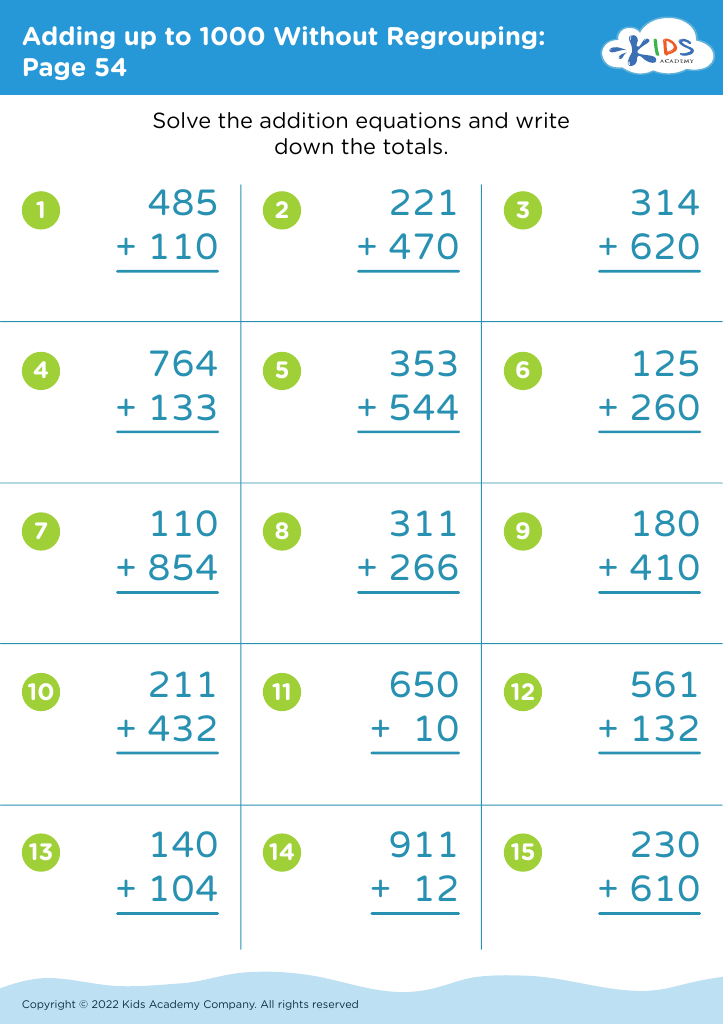
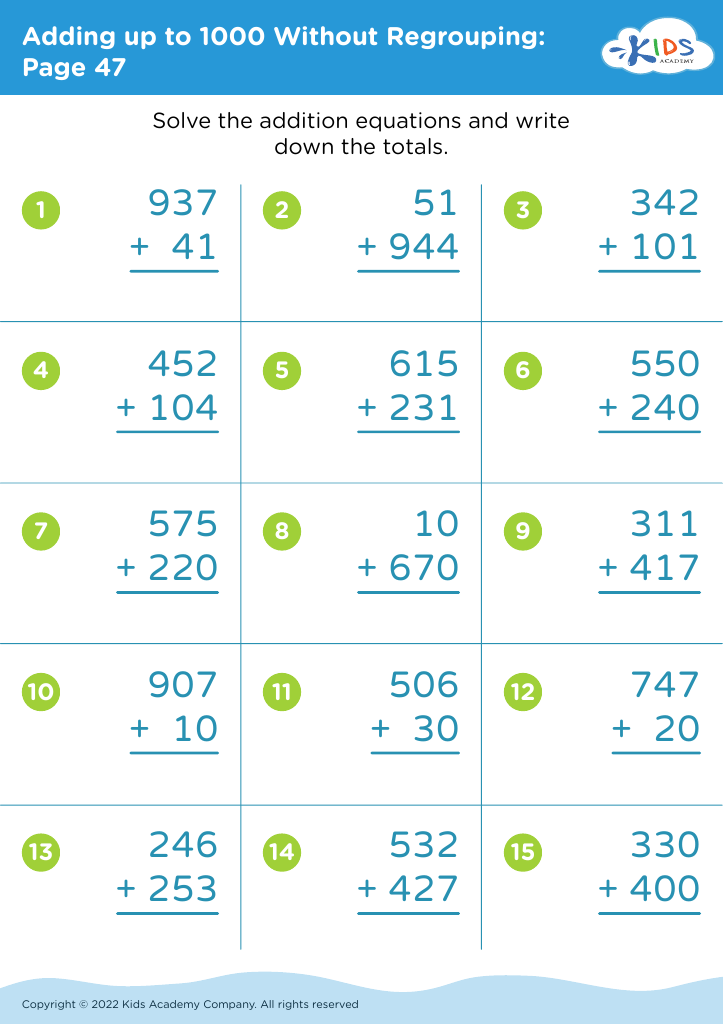
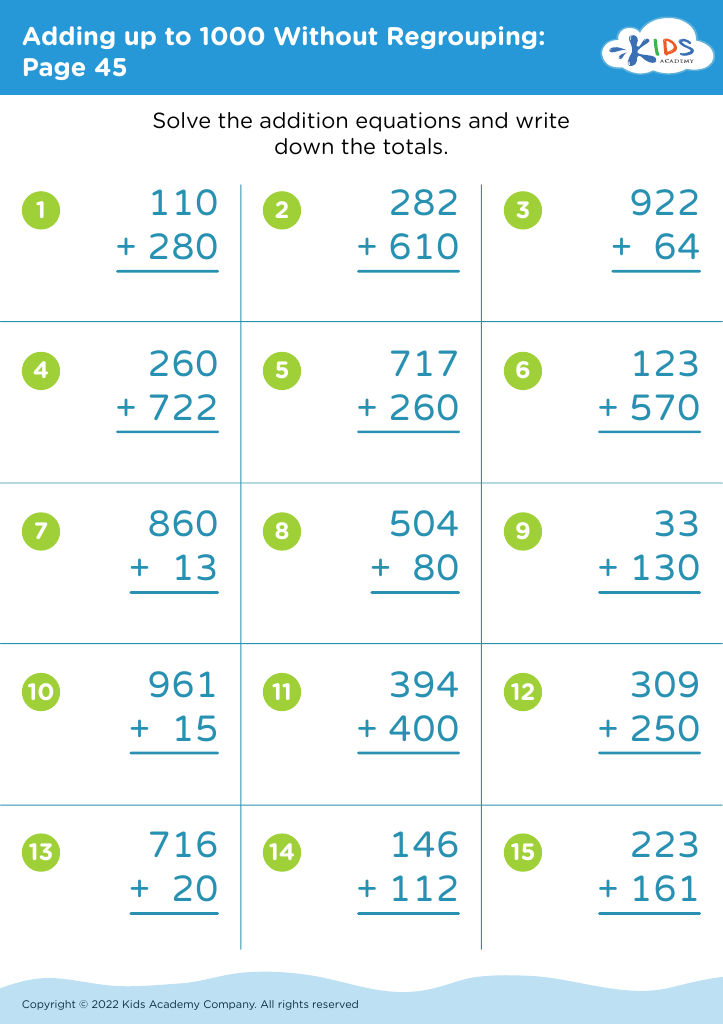


Understanding division and addition up to 1000 without regrouping is pivotal for children aged 6-8 as it forms a fundamental part of their early math education, fostering cognitive development and setting a strong foundation for more complex mathematics. Mastering these skills enhances numerical fluency, which involves recognizing number patterns, boosting problem-solving capabilities, and enabling logical thinking.
For parents and teachers, ensuring that children grasp these concepts is essential because it underpins their academic success in all STEM-related areas. Division teaches kids how to think critically about how larger quantities can be broken down into smaller, equal parts, fostering an ability to manage and understand quantities in everyday life. Similarly, being able to add numbers within the range of 1000 without regrouping simplifies arithmetic operations and bolsters confidence in tackling more complicated sums in the future.
Moreover, engaging with these fundamental operations can be a fun, tactile experience; students build confidence through games, manipulatives, and interactive exercises. It reinforces patience, attention to detail, and perseverance, positively influencing their overall learning habits. When parents and teachers emphasize these skills, they equip children with critical tools that benefit their educational journey and practical, daily tasks, thereby boosting their self-esteem and long-term academic enjoyment.