Learning number patterns Addition Worksheets for Ages 6-8
3 filtered results
-
From - To
Introduce your child to the fascinating world of number patterns with our engaging Addition Worksheets for Ages 6-8. These printables are designed to make learning math fun and interactive, helping young learners grasp the concept of addition while identifying and completing number patterns. Through colorful and thoughtfully crafted exercises, children enhance their problem-solving skills, critical thinking, and mathematical curiosity. Perfect for both classroom and home use, our worksheets provide a foundational boost that will support kids on their educational journey. Unlock the magic of numbers and watch your child's confidence soar with our expertly designed addition practice materials.
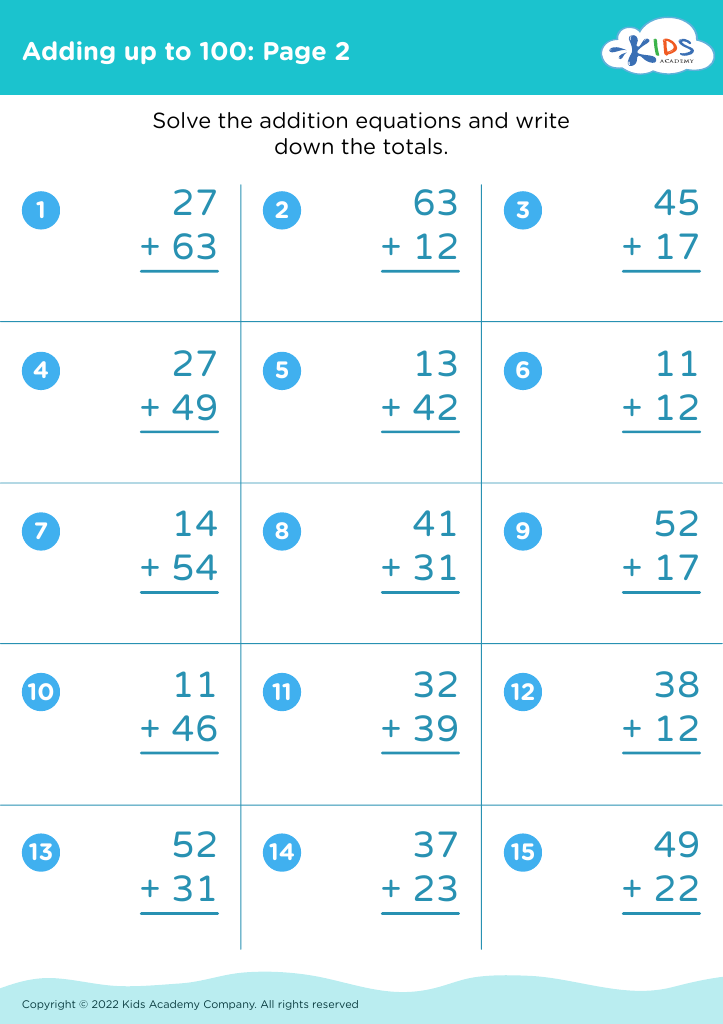
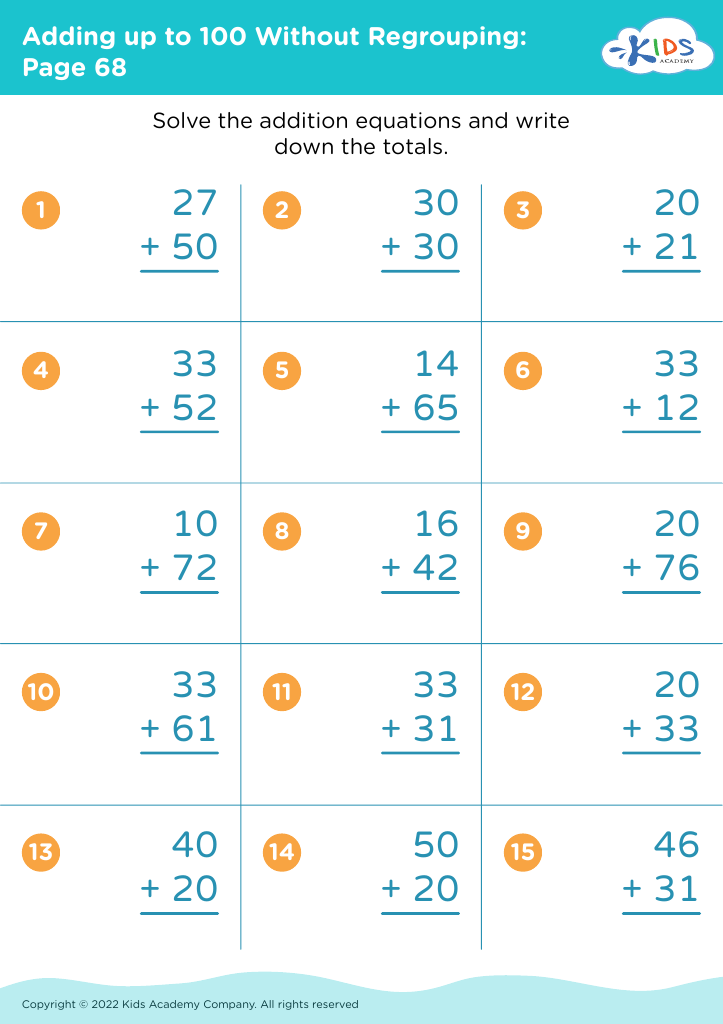
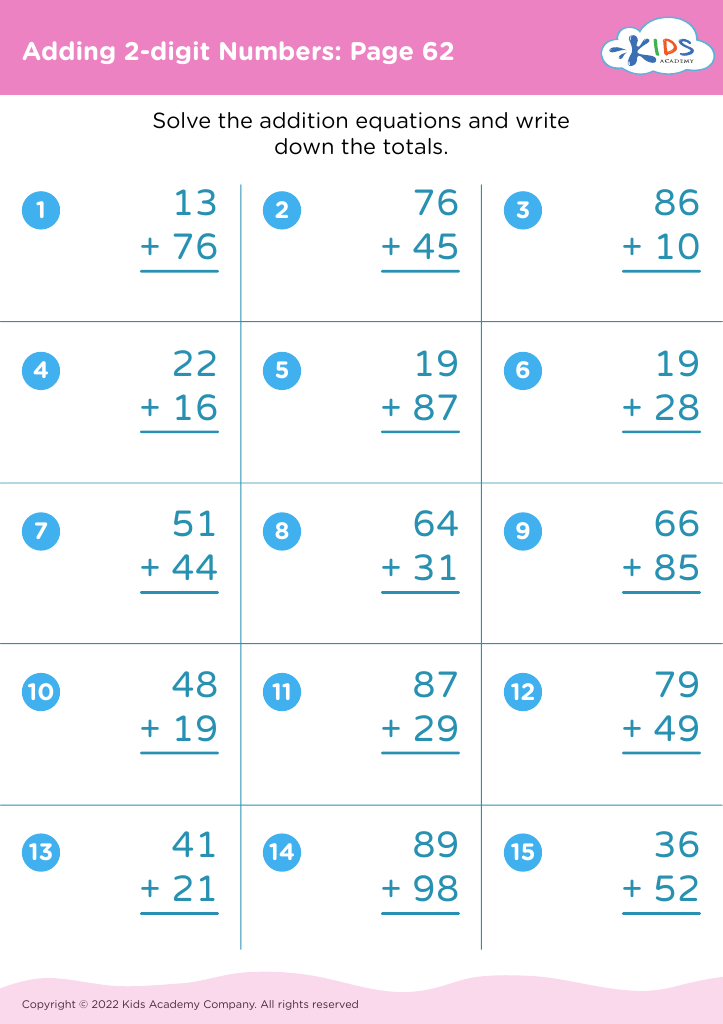








Understanding number patterns, particularly in addition, is foundational for children aged 6-8 as it establishes a critical base for future mathematical learning. Parents and teachers should care about this aspect of education because it nurtures essential cognitive skills such as pattern recognition, logical reasoning, and problem-solving. When children grasp the concept of adding in patterns — like adding two to each number in a sequence (2, 4, 6, 8) — they start to see mathematical relationships and regularities. This foundational understanding helps students transition smoothly to more complex arithmetic and algebraic concepts in later grades.
Furthermore, familiarity with number patterns boosts mental arithmetic capabilities, enhancing both speed and accuracy in calculations. It encourages children to use different strategies for solving mathematical problems, thereby increasing their confidence and independence in handling various mathematical operations.
Incorporating these patterns at an early age also engages children in a fun, interactive way, making math enjoyable and less intimidating. Providing them with frequent opportunities to explore these patterns supports their academic achievement and fosters a lifelong appreciation for math. In essence, learning number patterns in addition is not just about acquiring a specific skill; it's about building a strong, versatile foundation for all future math learning.








