Practice inference skills Addition Worksheets for Ages 6-8
3 filtered results
-
From - To
Enhance your child's math abilities with our "Practice Inference Skills Addition Worksheets" tailored for ages 6-8! These engaging worksheets focus on helping young learners develop critical thinking through inference while mastering addition concepts. Each activity is designed to challenge students to analyze information, deduce answers, and understand mathematical relationships. With a variety of fun exercises, children will enjoy building their addition skills while improving their inference capabilities. Our resources are perfect for classroom use or at-home practice, ensuring your child gains confidence and proficiency in math. Download now and watch their math skills flourish!

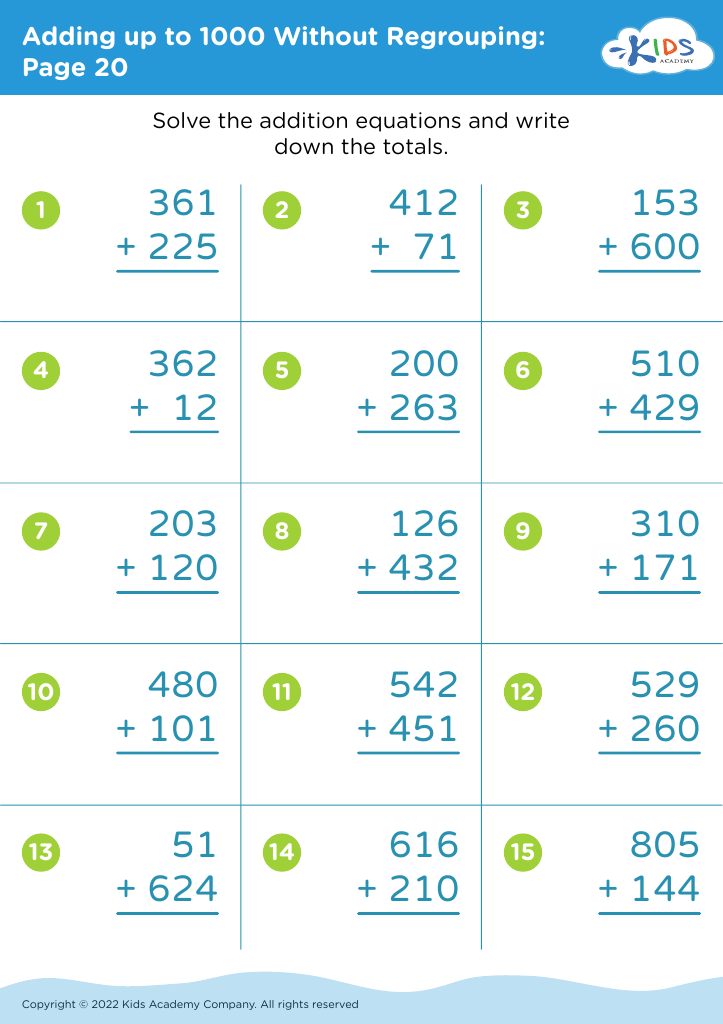








Practice inference skills in addition for children ages 6-8 are crucial because they lay the foundation for both mathematical understanding and critical thinking. At this developmental stage, children are developing their ability to think abstractly and solve problems. Effective inference skills help them connect the concepts of addition to real-life situations, enhancing their overall comprehension of mathematics.
Encouraging children to practice addition inference enables them to make educated guesses and predictions based on the information at hand. This means they can approach addition tasks with more confidence and creativity. Moreover, these skills foster logical reasoning and analytical thinking, essential competencies in today's increasingly data-driven world.
When parents and teachers prioritize the development of these skills, they help students move from rote memorization of number facts to a deeper understanding of mathematical relationships. This knowledge not only builds a strong math foundation but also contributes to students' success in later grades, where these skills are vital in tackling more complex math problems.
Ultimately, enhancing inference skills ensures that children develop a lifelong love for learning and a resilient mindset towards challenges. Effective implementation can lead to improved academic outcomes and better preparation for future academic endeavors.








