Improve writing skills Math Worksheets for Ages 6-8
3 filtered results
-
From - To
Unlock your child's potential with our "Improve Writing Skills Math Worksheets for Ages 6-8." Designed to develop essential writing abilities through engaging math exercises, these worksheets integrate creativity with critical thinking. Children will enhance their vocabulary, sentence structure, and overall writing confidence while solving fun math problems. Each worksheet features colorful visuals and age-appropriate challenges that make learning enjoyable and effective. Perfect for classroom activities or home practice, our resources provide a comprehensive approach to improve both math and writing skills simultaneously. Give your child the tools they need to succeed academically while having fun learning!
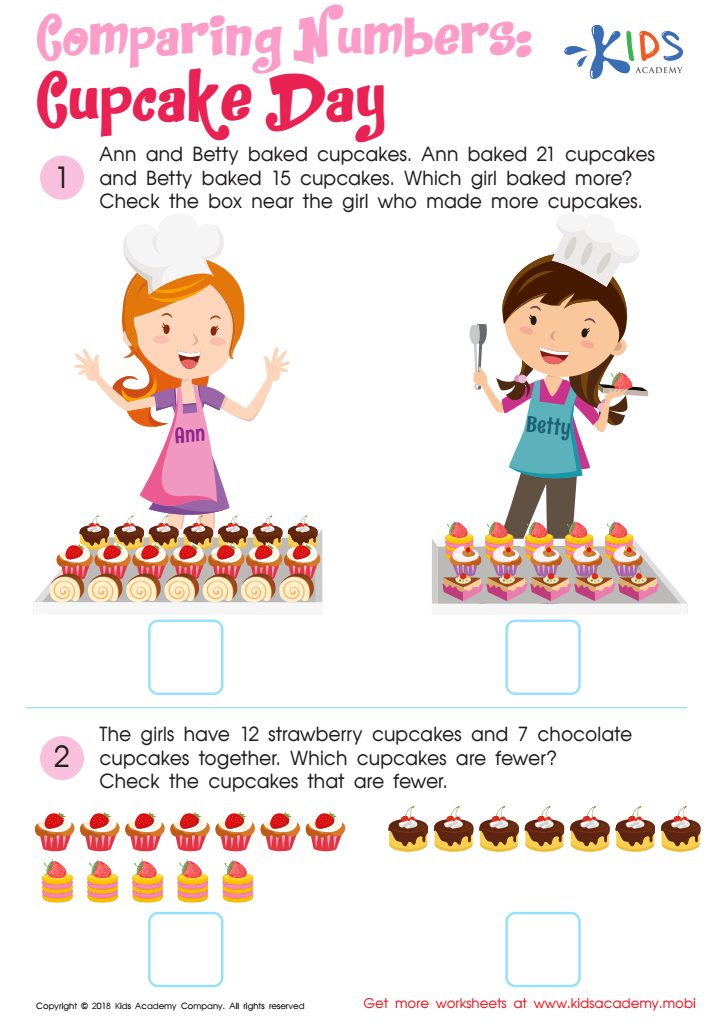
Cupcake Day Worksheet
 Assign to My Students








Improving writing skills and math proficiency in children aged 6-8 is crucial for several reasons.
Firstly, early writing skills are essential for effective communication. By learning to express their thoughts clearly and coherently, children not only develop their creativity but also improve in other subjects, including math. Writing helps kids articulate their problem-solving processes, allowing them to clearly document their reasoning and understand how they arrived at an answer.
Secondly, math skills establish a foundation for logical thinking and critical reasoning. As children practice basic concepts like addition, subtraction, and patterns, they develop cognitive abilities that are transferable to writing, aiding them in organizing their thoughts and presenting ideas logically.
Moreover, proficiency in both areas can enhance academic confidence; children who are competent writers and mathematicians are more likely to engage enthusiastically in learning, fostering a positive learning environment.
Lastly, strong writing and math skills are integral to lifelong learning. They prepare students for more advanced topics in school, ensuring that they have the tools to succeed in an increasingly complex world.
In summary, parents and teachers should prioritize improving these skills to foster well-rounded, capable learners equipped for future challenges.








