
Improving observational skills Math Worksheets for Ages 6-8
3 filtered results
Difficulty Level
Grade
Age
-
From - To
Subject
Activity
Standards
Enhance your child’s observational skills with our engaging math worksheets designed specifically for ages 6-8! These printable resources help young learners develop critical thinking and attention to detail through fun activities that promote close observation. Each worksheet is crafted to encourage children to explore patterns, shapes, and quantities, making math an exciting subject. Parents and teachers will appreciate the well-structured exercises that promote hands-on learning and the development of essential cognitive skills. Download our worksheets today and empower your children to improve their observational skills while building a strong foundation for future math success!
Favorites
With answer key
Interactive
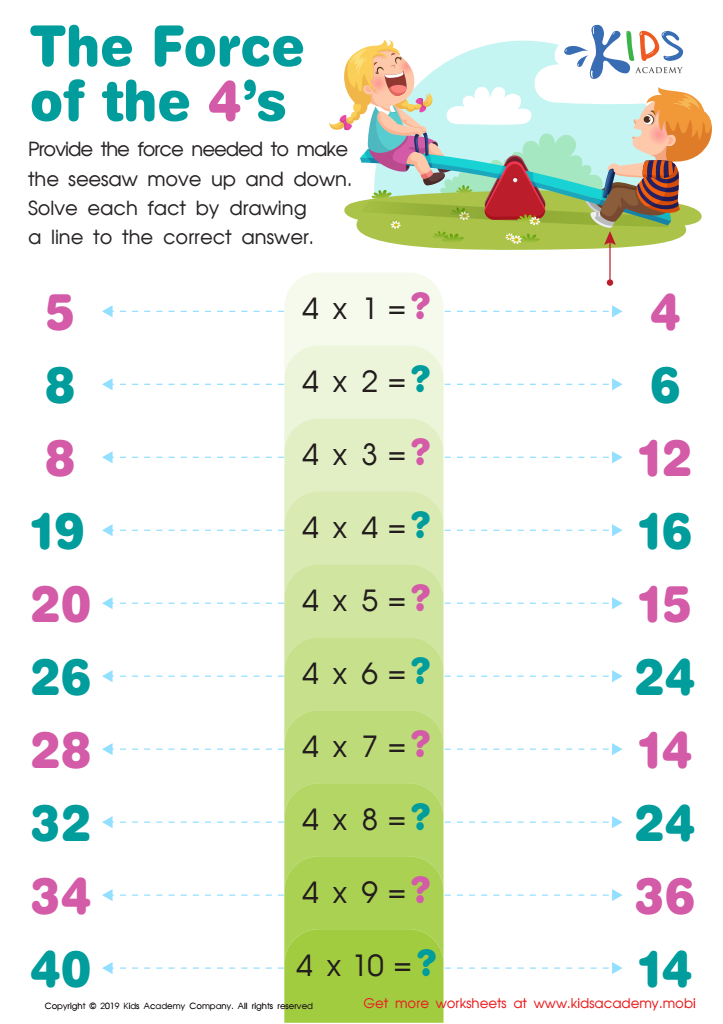
The Force of the 4's Worksheet
Ride a seesaw with your child and explore the physics behind it! Explain how it needs two people and how force makes it go up and down. Use the memories of the pleasurable experience to teach your kid a lesson in force. Show them how to solve the worksheet by drawing a line to the correct answer. This way, they'll learn the force needed for the seesaw to move.
 Assign to My Students
The Force of the 4's Worksheet
Worksheet
Join Kids Academy for Free
Who is primarily going to use this learning content?








Improving observational skills in mathematics for children aged 6-8 is crucial for their cognitive development and problem-solving abilities. At this age, children are developing foundational concepts that will serve as the basis for more complex mathematical ideas. Observational skills enable kids to notice patterns, relationships, and spatial reasoning—essential components of mathematical thinking.
When children sharpen their observation skills, they enhance their ability to analyze information and draw conclusions. For example, recognizing shapes and understanding their properties can lead to better comprehension of geometry. Furthermore, strong observational skills allow children to engage in hands-on activities, such as measuring, classifying, and comparing objects, making math more tangible and relatable.
As they learn to observe carefully, children also become more confident in tackling math problems, as they can draw connections to real-world scenarios. This skill fosters curiosity and encourages a growth mindset, which is vital for academic success.
Parents and teachers should prioritize teaching observational skills in math to create a solid foundation. By incorporating games, manipulatives, and exploratory tasks, they can help children build these skills while making learning enjoyable, ultimately leading to long-term academic success and a positive attitude toward mathematics.








