
Recognizing equivalent fractions Math Worksheets for Ages 6-8
5 filtered results
Difficulty Level
Grade
Age
-
From - To
Subject
Activity
Standards
Our Recognizing Equivalent Fractions Math Worksheets for Ages 6-8 are engaging and educational tools designed to help young learners grasp the concept of equivalent fractions with ease. These colorful and interactive printable worksheets provide various exercises and activities that make learning fractions fun. By using visual aids and step-by-step examples, children will develop a strong foundation in this essential math skill. Perfect for classroom or at-home practice, our worksheets ensure your child builds the confidence to recognize and work with equivalent fractions. Boost your child’s math success today with our expertly designed fraction worksheets!
Favorites
With answer key
Interactive
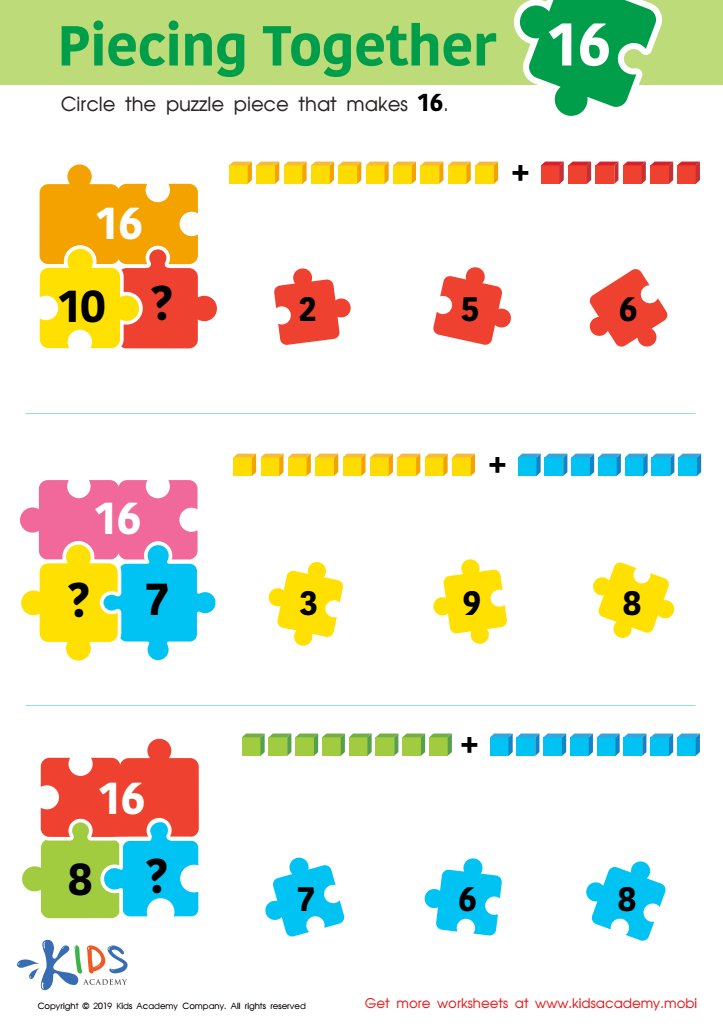
Piecing Together 16 Worksheet
Combine learning with fun using this colorful worksheet! Ask your preschoolers what they see in the picture, then help them solve the mathematical equations on the puzzle pieces. One equation is missing on each; have them circle the piece that will make the bottom puzzle piece numbers equal 16. Use puzzles and bright colors to teach - it's one of the best ways your kids can learn!
 Assign to My Students
Piecing Together 16 Worksheet
Worksheet
Join Kids Academy for Free
Who is primarily going to use this learning content?







Recognizing equivalent fractions is a foundational skill in early math education that benefits young learners significantly. For ages 6-8, understanding equivalent fractions helps build a strong number sense, crucial for future arithmetic operations like addition, subtraction, multiplication, and division involving fractions.
Parents and teachers should prioritize this concept because it fosters a child's ability to see that different fractions can express the same value (e.g., 1/2 is equivalent to 2/4). This insight enhances their flexibility in mathematical thinking and promotes deeper comprehension of how numbers relate to one another.
Additionally, recognizing equivalent fractions aids in developing problem-solving skills and cognitive abilities such as logical reasoning and analytical thinking. By manipulations, like simplifying fractions or finding common denominators, children practice critical skills that cascade into more advanced areas of mathematics they will encounter later, such as algebra and geometry.
Furthermore, mastery of equivalent fractions often boosts a child's confidence, allowing them to participate more actively in math discussions and build a positive attitude towards learning. Being skilled in this area can prevent future struggles with more complex fraction operations.
Thus, investing time in teaching and reinforcing equivalent fractions at ages 6-8 lays a vital groundwork for math success, encouraging continued academic achievement and fostering life-long numerical literacy.








