Enhancing mathematical logic Worksheets for Ages 6-9
3 filtered results
-
From - To
Discover our "Enhancing Mathematical Logic Worksheets for Ages 6-9"! Designed to challenge and engage young minds, these worksheets help develop critical thinking and problem-solving skills through a variety of fun activities. Each worksheet focuses on essential math concepts including patterns, sequences, classification, and visualization. Suitable for classroom use or as supplementary practice at home, our carefully crafted exercises support curriculum standards while making learning enjoyable. With colorful illustrations and thought-provoking questions, these materials are ideal for nurturing a strong mathematical foundation. Visit our page to start enhancing your child’s mathematical logic and watch their confidence soar!
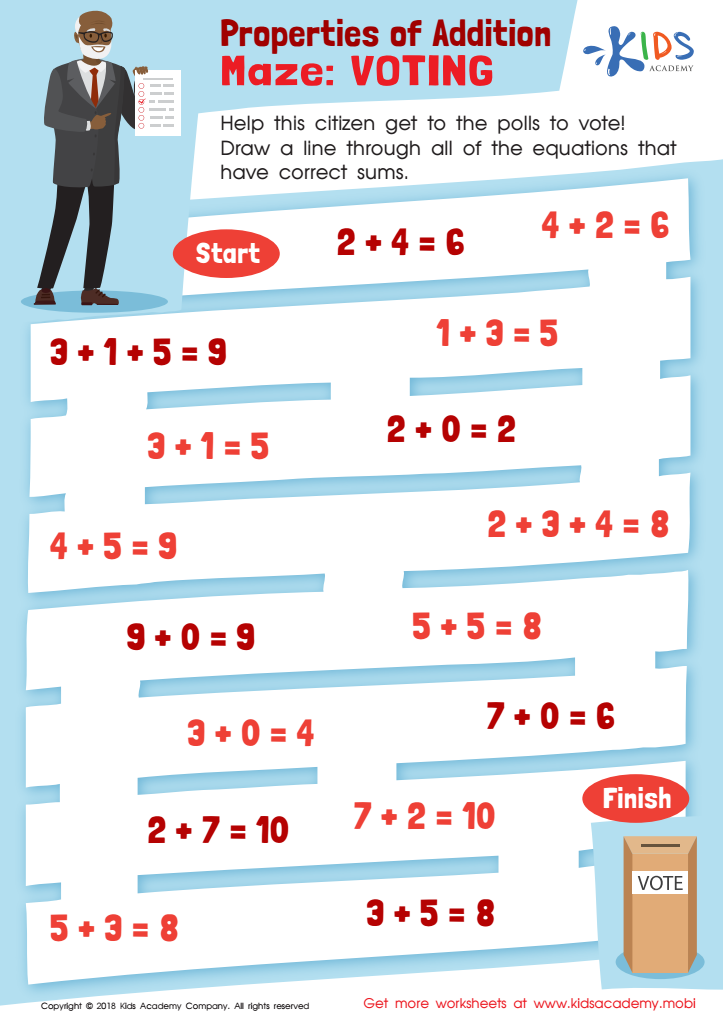
Properties of Addition Maze: Voting Worksheet
 Assign to My Students
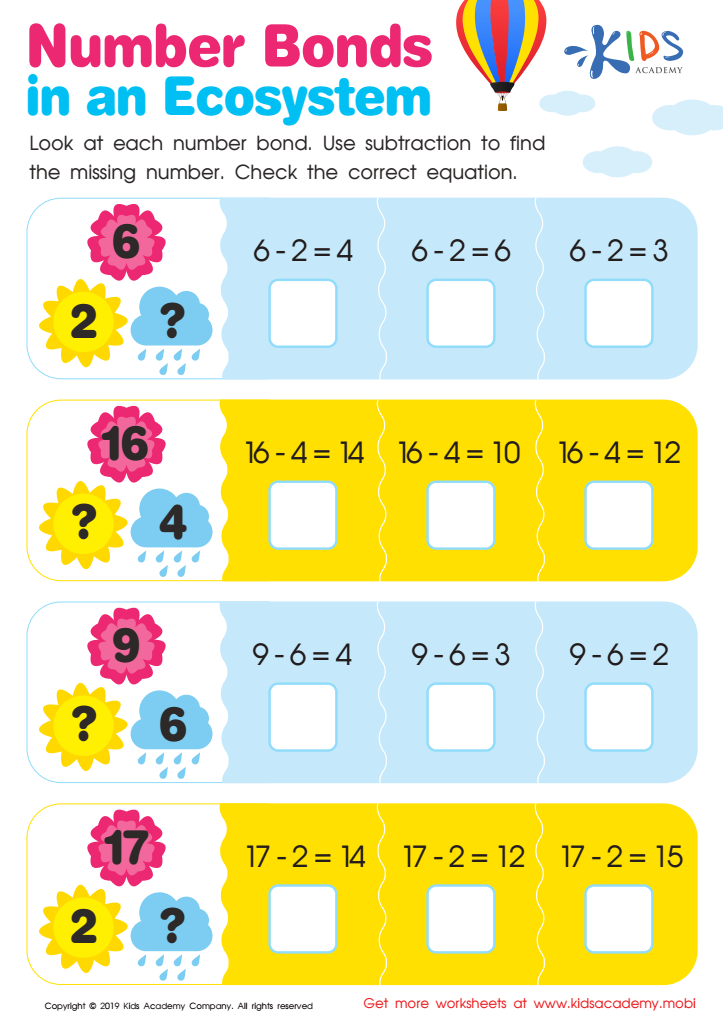
Number Bonds in an Ecosystem Worksheet








Enhancing mathematical logic in children aged 6-9 is crucial for their overall cognitive development and future academic success. During these early years, children's brains are highly adaptable and capable of forming foundational neural connections that will support complex thinking later in life. Engaging them in activities that stimulate mathematical reasoning helps build critical problem-solving skills, such as identifying patterns, recognizing relationships, and making logical decisions. These skills are not only fundamental to mathematics but also essential across various academic disciplines and real-life situations.
Furthermore, a strong foundation in mathematical logic fosters confidence and positive attitudes toward learning. When children succeed in mathematical reasoning, they develop a sense of achievement and perseverance, qualities that can carry over to other subjects and challenges. For teachers, emphasizing mathematical logic in the classroom can create a more engaging and dynamic learning environment. For parents, supporting this aspect of their child's education can be as simple as incorporating math-based games and everyday activities that encourage logical thinking.
Moreover, early exposure to mathematical logic can bridge gaps in understanding, making future lessons in more advanced mathematics easier to grasp. By investing in this key area during the formative years, parents and teachers can set children on a path of academic excellence and lifelong curiosity, preparing them for a world that increasingly values analytical and logical skills.








