Identify shapes Worksheets for Ages 6-9
12 filtered results
-
From - To
Welcome to our "Identify Shapes Worksheets" page, designed specifically for children ages 6-9! Our engaging and interactive worksheets help young learners develop their shape recognition skills through a variety of fun activities. Kids will explore different geometric shapes, like circles, squares, triangles, and more, while enhancing their cognitive abilities. Each worksheet is tailored to provide age-appropriate challenges that encourage creativity and critical thinking. Perfect for home or classroom use, these materials support the foundational maths skills essential for early education. Download and print our worksheets today to make learning shapes both enjoyable and effective for your young learners!
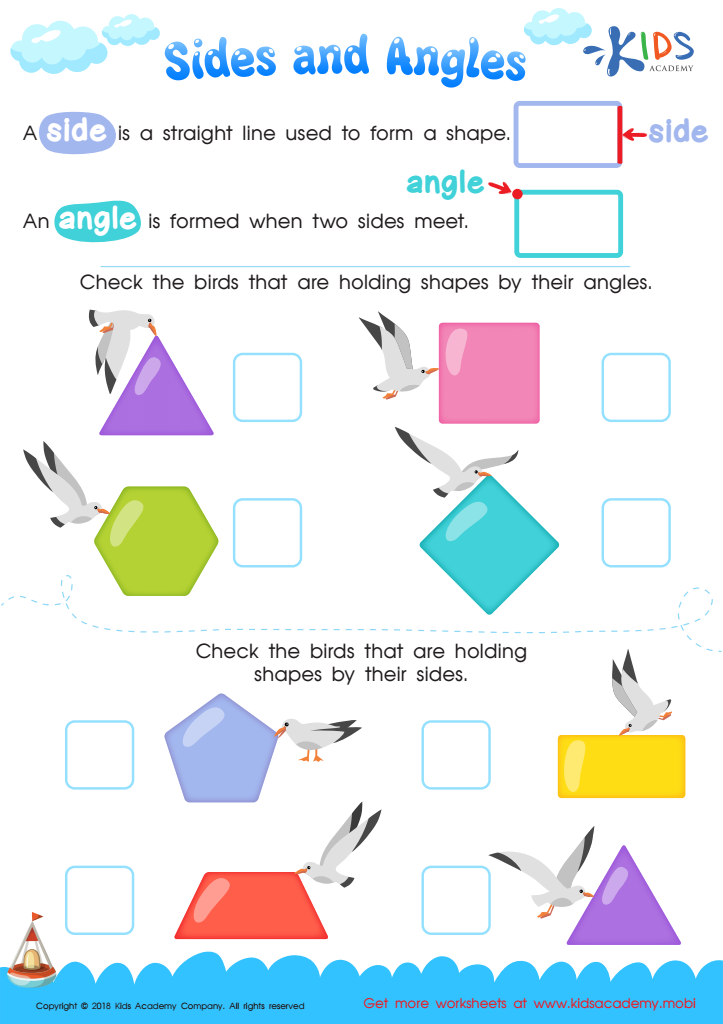
Sides and Angles Worksheet
 Assign to My Students







Teaching children to identify shapes is fundamental in their early development, especially for ages 6-9. At this stage, children are refining their cognitive and spatial awareness skills, crucial for their understanding of the world around them. Recognizing shapes helps them develop critical thinking and problem-solving abilities. For instance, being able to distinguish between a triangle and a square fosters analytical skills and lays the groundwork for future mathematical concepts like geometry.
Shapes also have practical applications in everyday life and help children make connections to real-world objects—like recognizing a rectangular door or a circular clock. Furthermore, understanding shapes supports their artistic expression, encouraging skills in drawing and building.
Parents and teachers should be invested in this learning process as it enhances children's confidence and competence in math, influencing their overall academic progress. Engaging children in shape-related activities and games makes learning enjoyable, often leading to a lifelong love of learning. Ultimately, focusing on shape identification provides essential tools for children, aiding their intellectual growth and equipping them for more complex mathematical concepts that will come later in their education.








