Understanding ordinal numbers Worksheets for Ages 6-9
3 filtered results
-
From - To
Explore our engaging "Understanding Ordinal Numbers Worksheets" designed for ages 6-9! These fun and educational resources help young learners grasp the concept of ordinal numbers through a variety of interactive activities. Our worksheets feature colorful illustrations, clear instructions, and exercises that encourage children to identify and use ordinal numbers in practical contexts. From first to tenth, your child will build a solid foundation in mathematics while enhancing their critical thinking skills. Perfect for both classroom and home use, these worksheets make learning about ordinal numbers enjoyable and effective. Dive into the world of numbers today and watch your child thrive!
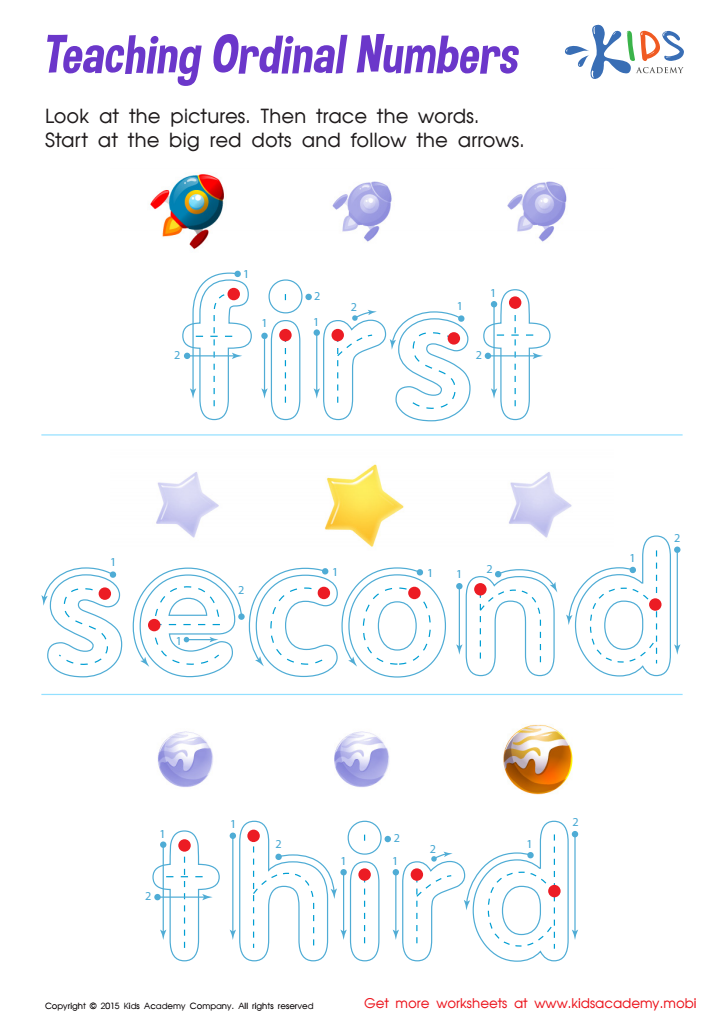
Ordinal Numbers: Teaching Ordinal Numbers Printable
 Assign to My Students
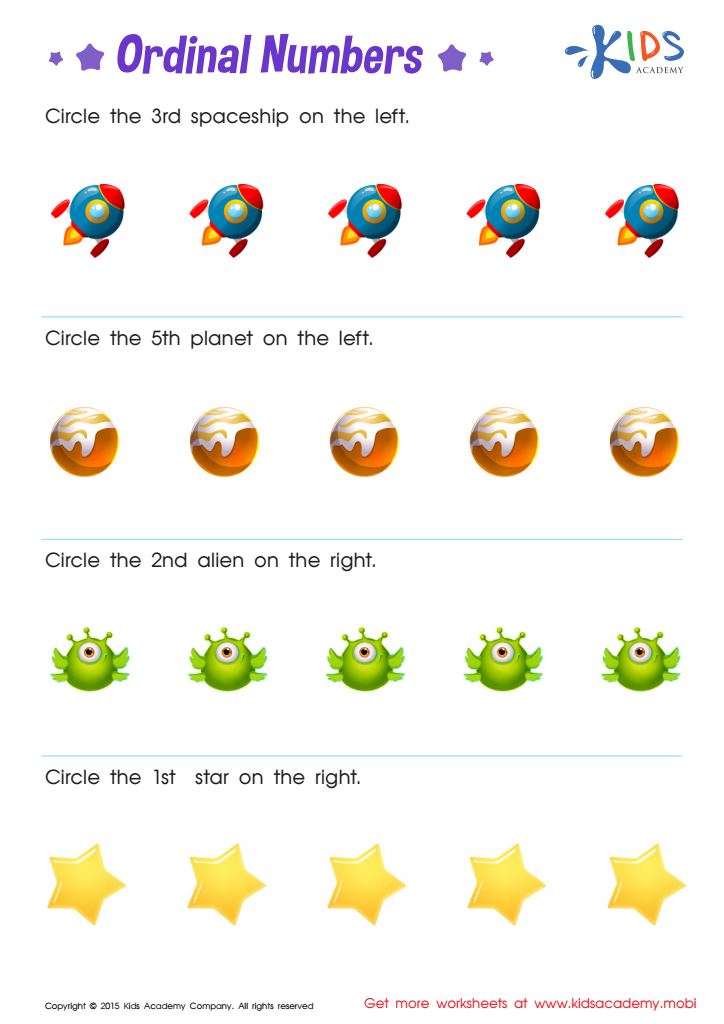
Ordinal Numbers: Space Ordinals Worksheet






Understanding ordinal numbers is essential for children aged 6-9 as it lays the foundation for crucial cognitive and mathematical skills. Ordinal numbers represent position or rank, such as first, second, or third, enabling children to navigate everyday situations. For instance, they help in understanding sequences in time, like days of the week or days in a month.
This knowledge enhances comprehension in various subjects such as math, language, and science. In math, children rely on ordinal numbers to solve problems related to ordering, grouping, and comparisons. In language arts, using ordinals aids in storytelling and sequencing events. Science lessons, particularly in experiments, often utilize ordinals when discussing step-by-step processes.
Parents and teachers play a crucial role in reinforcing these concepts through practical applications and engaging activities. By incorporating discussions about positions in games, classrooms, or even during daily routines, they enhance children’s understanding. Furthermore, early mastery of ordinal numbers fosters critical thinking skills and prepares children for more complex mathematical concepts in the future. In summary, fostering a knowledge of ordinal numbers enriches children’s learning experiences and equips them with vital skills for lifelong learning.








